The Only Difference Between Takashi Murakami and You Is Whether You Have the Burning Desire to Leave Your Name and Work in History—even If You Were to Collapse Tomorrow! [My History No. 8]

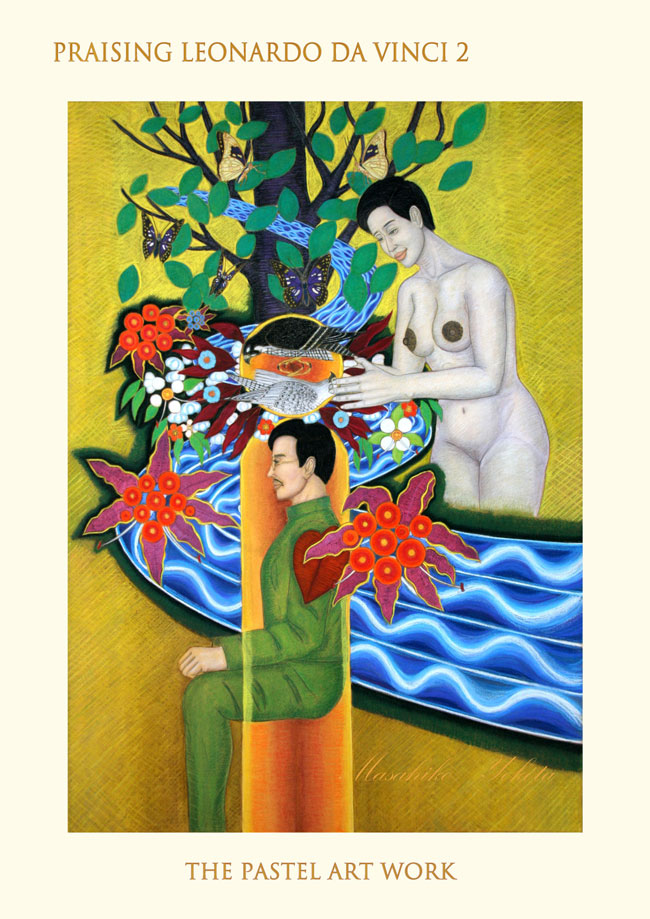 In 2007, I visited Tokyo Gallery (東京画廊) once again, carrying a photograph of one of my proudest works, *In Praise of Leonardo da Vinci II* (レオナルド・ダヴィンチ礼讃Ⅱ).
Mr. Yamamoto (山本豊津) told me:
“Your style has changed considerably. I'm not a painter myself, but I've seen an enormous number of paintings. First of all, you possess all the qualities required of a professional artist. You have lines reminiscent of Ogata Korin (尾形光琳), as well as lines like those of Tawaraya Sotatsu (俵屋宗達). As you approach the later years of your life, you've opened up a promising path for yourself.”
What exactly did Mr. Yamamoto mean by the qualities required of a professional artist?
My intuition told me that there were three: the ability to produce works of art, the artistic theories that support that creative ability, and the skills required for marketing and management.
He continued:
“You've opened up a promising path for yourself for the years ahead.
From now on, work hard so that you can hold a major retrospective at a museum, just like Picasso (パブロ・ピカソ). I want you to leave your mark as someone who lived in Japan in this particular era. Imagine an exhibition in which different rooms are devoted to different periods and styles of your work, such as Picasso's Blue Period, Rose Period, and Cubist Period.”
However, I firmly believe, almost to the point of conviction, that I am the reincarnation of Odilon Redon (オディロン・ルドン) and Leonardo da Vinci (レオナルド・ダ・ヴィンチ).
So I replied:
“No matter how much fame and wealth you enjoyed in a previous life, once you are reborn through reincarnation, you have to start again from ZERO.
I believe I've already enjoyed enough fame in my previous life.”
At that point, Mr. Yamamoto became absolutely furious.
“Now I understand why your paintings aren't good enough!
You know, I had a long, serious conversation with Takashi Murakami (村上隆) the other day. He lives with this conviction:
‘I'm going to leave proof that I lived in Japan in this particular era. I'm going to leave evidence of my existence as a man named Takashi Murakami in the world's most prestigious museums! If I were to collapse dead tomorrow after accomplishing that, I would have no regrets!’
That's the only difference between you and Murakami!”
He lectured me furiously for an hour and a half.
I felt profound gratitude and respect for Toyotsu Yamamoto, a man who was willing to speak so frankly and lecture someone who was not even his own child with such extraordinary sincerity.
When he said that my paintings weren't good enough, my intuition immediately told me what he really meant: I was not putting enough care into the finishing touches of my work.
Few artists are as extraordinarily meticulous in finishing their works as Takashi Murakami.
Indeed, Mr. Yamamoto was right. In the worlds of art and sports, you have to dream on a grand scale and work incredibly hard just to make a living.
If you think, “I don't need to become famous,” even earning enough to support yourself through your art becomes uncertain.
You must force yourself to stoke the fire within your own heart, develop a fierce competitive spirit toward the rivals ahead of you, aim to become the best in the world, and make every possible effort to get there.
Mr. Yamamoto's words of stern encouragement gave me the same sense of conviction that Daisuke Matsuzaka (松坂大輔) expressed after striking out Ichiro Suzuki (イチロー) in a head-to-head matchup:
“Today, my confidence has turned into conviction.”
Mr. Yamamoto and Takashi Murakami were already well acquainted, often engaging in lengthy conversations whenever they met at art fairs and other events. Mr. Yamamoto had even traveled to Germany to visit Yoshitomo Nara (奈良美智) before Nara began his series of paintings featuring young girls.
I believe Mr. Yamamoto's passionate words of encouragement were his way of telling me “How do I see you when I compare you with these artists?”
Through that experience, I gained the confidence that
“If I work hard enough, I can achieve great success in the world of art.”
Note: An extraordinary story about Toyotsu Yamamoto (山本豊津) ... (Note 8) As a boy, I used to eat meals at home with Taro Okamoto (岡本太郎).