◆What Is Art? (PartⅢ ) Japanese Art and Thought)— I Investigated the Theories of Earlier Thinkers and Artists

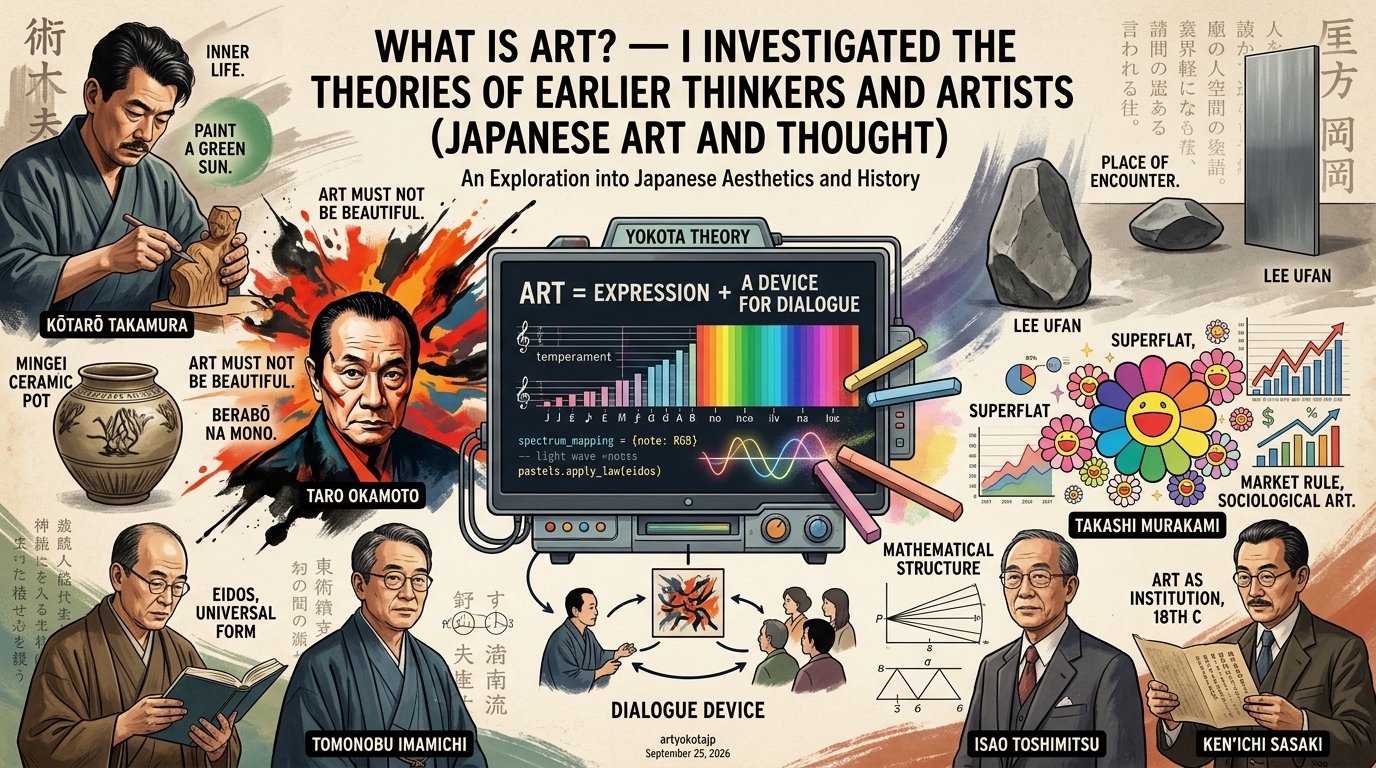 In the Japanese art world and in Japanese art-university education, one often hears statements such as, "I leave it to the viewer's sensibility," or "It is an expression of my inner energy" when artists discuss their works.
I have long had serious doubts about such ambiguous, unfalsifiable arguments based purely on emotion, and have therefore redefined geijutsu(芸術 / art)as "expression + a device for dialogue."
So, how have the concepts of geijutsu(芸術 / art)and bi(美 / beauty)been discussed by earlier thinkers in Japan?
Following my previous investigation into the definitions of "What is art?" proposed by thinkers in Europe and the United States, this article examines in detail the theories of Japanese artists, thinkers, and leading Japanese scholars of aesthetics since the Meiji period. I will clarify where my theory—geijutsu(芸術)= expression + a device for dialogue, together with the physical translation of musical temperament into color—stands within the history of Japanese bijutsu(美術 / fine art)and Japanese aesthetics.
1. From "Expression of Subjectivity" to "Relationships and Institutions"
The Japanese terms bijutsu(美術 / fine art)and geijutsu(芸術 / art)were institutional concepts created during the Meiji period in order to translate Western concepts into Japanese.
For that reason, Japanese theories of art have continually undergone their own conflicts and repeated revisions of definitions.
■ Modern Period: The Awakening of the Self and the Expression of "Subjectivity and Passion"
From the Meiji period through the Taishō period, the dominant tendency was to define geijutsu(芸術 / art)as the expression of an individual's subjectivity and emotions.
- Kōtarō Takamura(高村光太郎), sculptor and poet: He declared in 1910, "Even if I were to paint a green sun, you could not criticize me for it." Rather than accurately reproducing nature, he regarded the forceful expression of the absolute subjectivity hidden within the artist—the "inner life"—as the essence of geijutsu(芸術 / art).
- Sōetsu Yanagi(柳宗悦), thinker and aesthetician: He developed the aesthetics of Mingei(民藝 / folk craft). He rejected individual artistic intention and self-consciousness—the attitude of "I made this myself"—and argued that true beauty resides in everyday objects created selflessly by anonymous craftsmen: the beauty of utility or yō no bi(用の美).
■ From the Shōwa Period to the Present: "Hacking" Relationships and Institutions
After World War II, powerful theories emerged that sought to break through the limitations of merely expressing individual emotions.
- Tarō Okamoto(岡本太郎), artist: He fiercely criticized the Japanese art establishment of his time for celebrating "safe and pretty paintings that could be displayed in a tokonoma(床の間)," and declared: "Art must not be skillful. It must not be beautiful. It must not be comfortable."
He defined geijutsu(芸術 / art)as an explosive force of energy that violently collides with social conventions and predetermined harmony, something that must awaken the fundamental vitality of human beings—a "berabō na mono(べらぼうなもの / something outrageous and beyond ordinary common sense)."
- Lee Ufan(李禹煥), artist and leading figure of Mono-ha(もの派): He minimized the artist's intentional act of making as much as possible.
By simply arranging materials such as stones and steel plates, he defined the work as a "place in which an encounter (relationship) between things, space, and the viewer is disclosed."
- Takashi Murakami(村上隆), contemporary artist: He thoroughly analyzed the rules and contexts of the Western art world, connected them with Japanese otaku culture and flatness—his concept of Superflat—and established a "sociological and market-strategic theory of art" for creating value.
2. "The Truth of Art" Revealed by the Highest Level of Academic Scholarship
While Japanese theories of geijutsu(芸術 / art)have shifted from "the explosion of passion" represented by Tarō Okamoto(岡本太郎)to the "market game" represented by Takashi Murakami(村上隆), how have geijutsu(芸術 / art)and bi(美 / beauty)been defined at the highest level of academic and philosophical research into aesthetics?
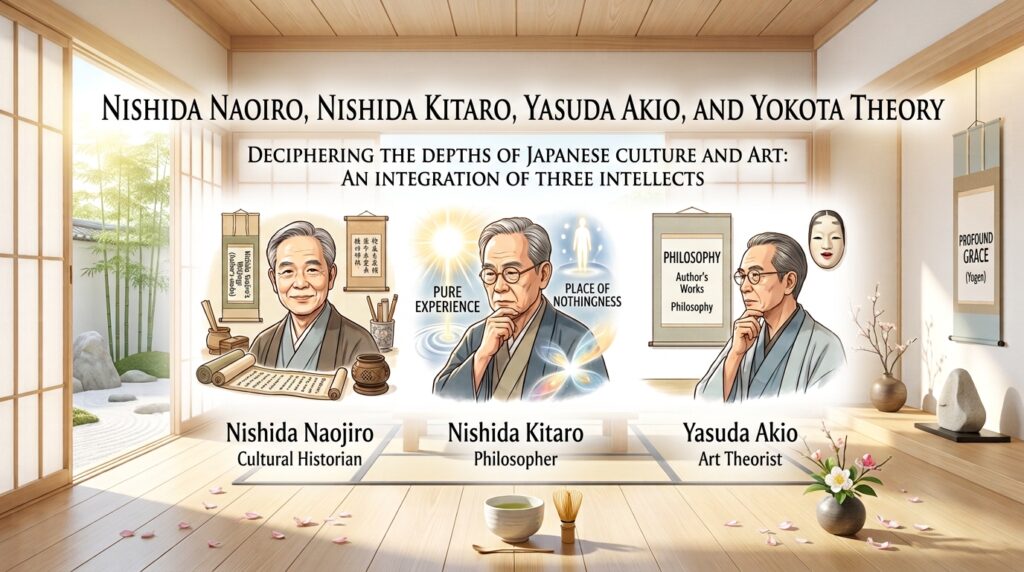
In Kōza Bigaku(講座 美学 / Lectures on Aesthetics), edited by Tomonobu Imamichi(今道友信) and published by the University of Tokyo Press from 1984 to 1985, we can examine extremely important theories left by three leading Japanese scholars.
① Ken'ichi Sasaki(佐々木健一), aesthetician: "Art" is nothing more than an "institution" invented in the eighteenth century
Sasaki challenges, through historical evidence, the kind of view expressed by Hiroshi Senju(千住博)that "art is communication, a natural human capacity that people have possessed from the beginning."
From antiquity through the Middle Ages, "art"—ars / technē—referred broadly to "skilled techniques based on rules," including shoemaking and medicine.
It was only when painting and music were separated from these other forms of skill and gathered together into the privileged category of "special activities whose purpose is beauty"—the fine arts—that this transformation occurred.
The society responsible for this was, at most, Western bourgeois society of the eighteenth century.
In other words, the "art" that we tend to regard unconditionally as something sacred and absolute is not an eternal and unchanging human activity. It is merely an "institutional framework" constructed by modern society.
② Isao Toshimitsu(利光功), aesthetician: Beauty is not a subjective emotion but an objective "mathematical and physical structure"
Since the modern period, beauty has often been reduced to an ambiguous question of what happens inside the human mind—"How does a person feel when looking at it? Do they like it or dislike it?" This is the position generally associated with subjectivism.
Toshimitsu, however, returned to the aesthetics of ancient Greece and argued that the essence of beauty lies in the "objective order and structure—proportion and harmonia—that the object itself possesses."
Just as Pythagoras discovered mathematical beauty in the relationship between the length of a string and musical scales or musical temperament, beauty, according to this view, should not be a matter of individual emotional whim. Rather, it should be rooted in the physical and mathematical truths of nature—the radiance of existence itself.
③ Tomonobu Imamichi(今道友信), philosopher: Creation (poiēsis) is not an outpouring of emotion but the act of giving "laws"
Imamichi warned against the casual use of the word "creation."
Unlike divine "creation from nothing," human artistic creation—poiēsis—is an extremely rigorous philosophical and existential act in which the artist gives existing materials, such as pigments and sound, a "universal form or law (eidos) through his or her own intellect and spirit."
In other words, simply throwing one's inner emotions onto a canvas—"expressing oneself"—cannot, in the true sense, be called creation.
3. The Significance and Historical Meaning of Yokota's Theory
So far, we have examined the theories of Japanese thinkers and the definitions of aesthetics developed by leading academic scholars.
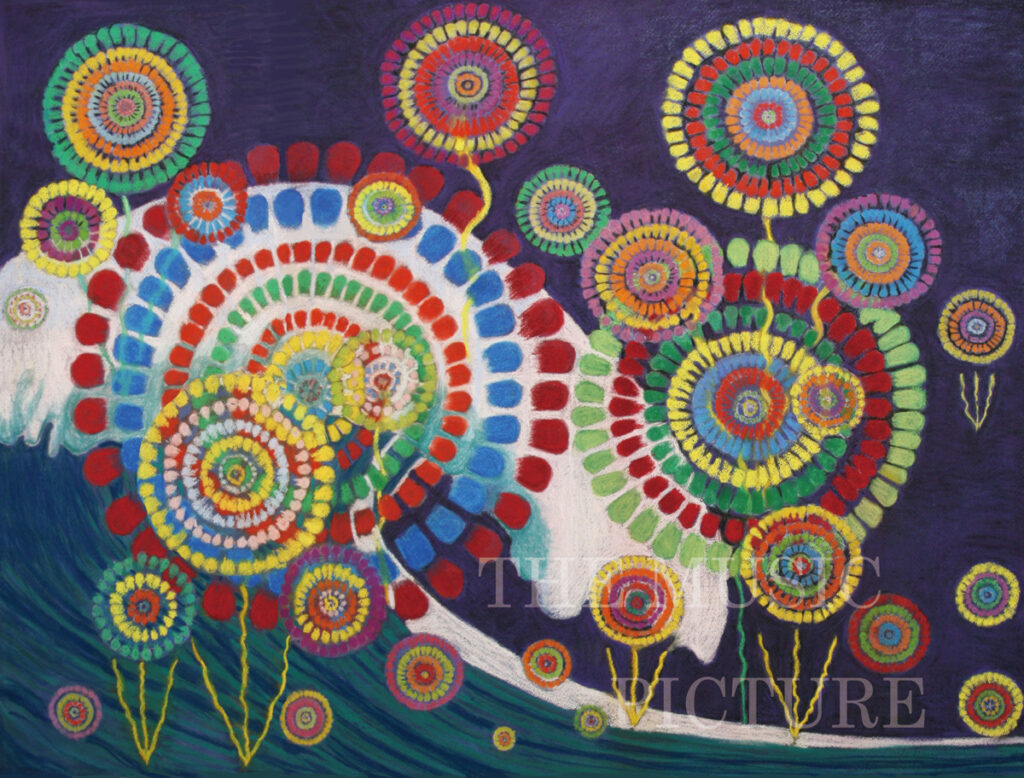
In light of these theories, the historical significance of my own proposition—"art = expression (a new way of seeing based on historical context) + a device for dialogue (a mechanism that encourages the viewer to reconstruct meaning)"—as well as my practical work of "demonstrating the structural correspondence between musical temperament and the color spectrum (translation through physical laws and computer programming)" becomes clear.
| Period / Figure | Definition and Approach to Art / Beauty | Function / Role of the Work |
|---|---|---|
| Kōtarō Takamura(高村光太郎) | Expression of absolute subjectivity and the self | A canvas onto which one's emotions are forcefully projected |
| Tarō Okamoto(岡本太郎) | Collision with society; explosion of vitality | Outrageous, almost magical energy that destroys conventional assumptions |
| Lee Ufan(李禹煥) | Revealing relationships with the world | A "place of encounter" between things, space, and human beings |
| Takashi Murakami(村上隆) | Mastering Western contexts and market rules | An intellectual context connected to art history |
| 【Yokota Theory】 | Translation of physical truths and activation of cognition | Art is an expression produced through some form of intention, and a device created with the intention of provoking discussion in the viewer. |
My theory builds upon these earlier theories while moving into an even more fundamental domain.
I have elucidated what Isao Toshimitsu(利光功)identified as "objective order and structure (the truth of beauty)" through the natural sciences of the modern era—the physical laws governing light waves and sound waves.
I then put into practice what Tomonobu Imamichi(今道友信)defined as "the act of giving a law (eidos) to a material" through a combination of mathematical transformation using Python programming and many years of hands-on work with pastel and painting techniques.
It is neither an outpouring of emotion nor a set of symbols designed for the market game.
First comes the creation of the work—the hands-on pursuit of beauty. At the same time, I continue theoretical research, and then feed the conclusions back into the creation of the artwork.
I take pride in believing that Yokota's definition represents one firm point of arrival in the history of Japanese bijutsu(美術 / fine art)—a way of bringing an end to vague emotionalism and purely intuitive theories of art.
Click here for other pages in this series!
◆What Is Art? (Part I) — Art Is an Expression of What the Artist Wants to Communicate, and a Device for Provoking Dialogue and Debate! (Part I)【Go to this page!】
◆What Is Art? (Part II)— I Investigated the Theories of Earlier Thinkers and Artists: Examining the Originality and Validity of My Definition【Go to this page!】
◆What Is Art? (Part IV)What Is Japanese Culture? Discovering the Characteristics of Japanese Art and Fine Art Through the Research of Earlier Scholars!【Go to this page!】