


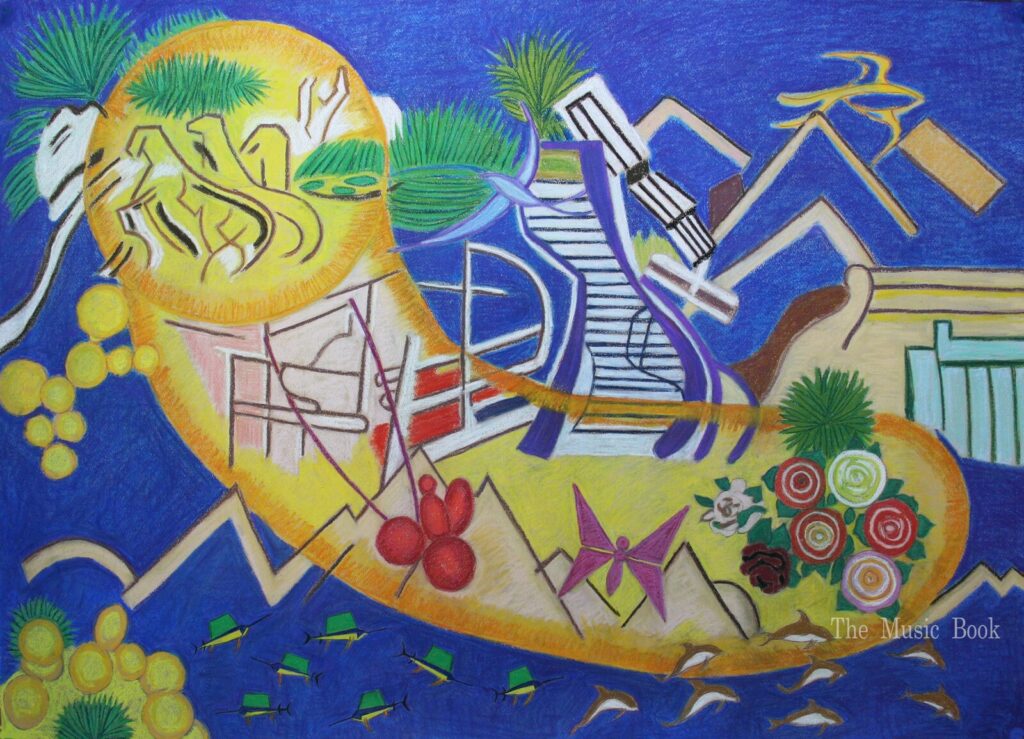
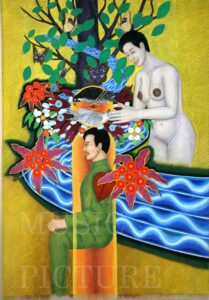
◆I am almost the best pastel painter in the world!
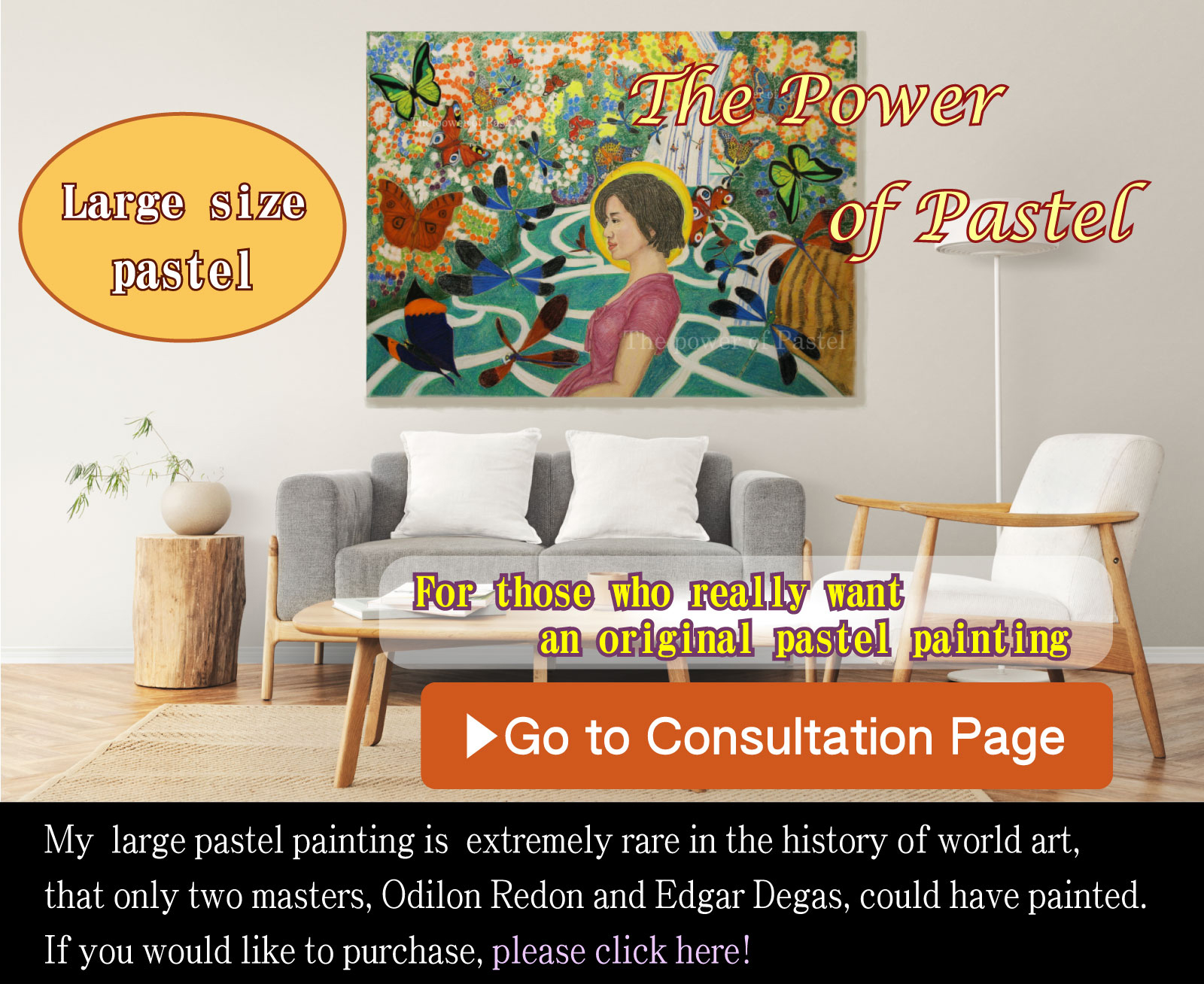
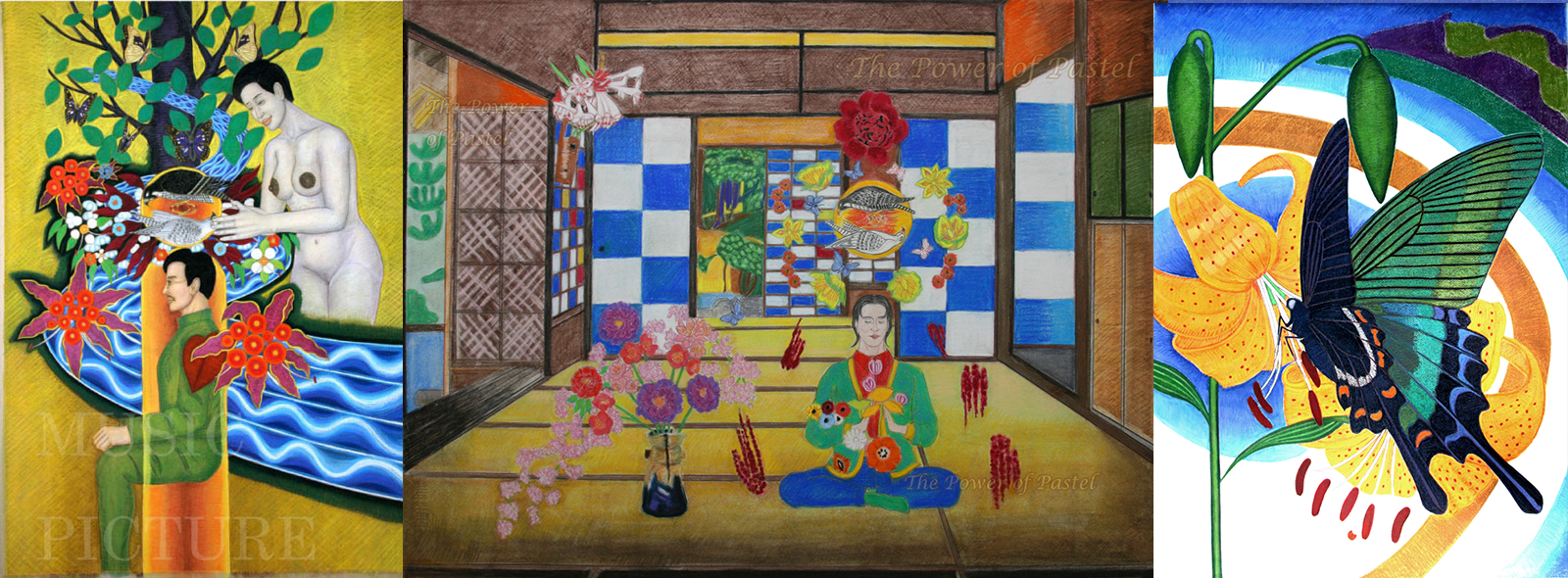
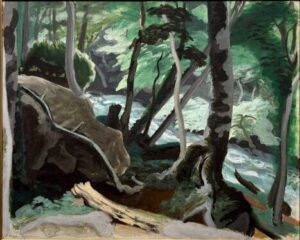
Painters who paint large works in pastels are very rare in the world.
Today, most painters work with acrylics because of their durability and Quick-drying and easy handling.
Historically, the masters of pastel painting are Odilon Redon and Edgar Degas. And Fantin-Latour,and very few others.
So, I can say that I am one of the leading pastel painters of our time.
Am I the Reincarnation of Odilon Redon or Leonardo da Vinci?
Of course, when someone says, “I am the reincarnation of a well-known historical figure,” it is fair to say that there is no way to prove such a claim.
There are books on reincarnation, such as Creating a Purpose in Life(『生きがいの創造』) by Fumihiko Iida, a former professor at Fukushima University(元 福島大学教授 飯田史彦), as well as ongoing debates over questions such as “Is the Dalai Lama really a reincarnation?” But that is not the direction I intend to take this discussion.
I do not have memories of a previous life, either.
So, if I were to say, “I am the reincarnation of Odilon Redon or Leonardo da Vinci,” there is, of course, no proof whatsoever.
However, when I look back on my life so far and on what I have created and left behind, I find myself feeling that this may be the case.
And even if it is not, my creative and intellectual life will continue without being hindered by that question.
So, from this point onward, I will explain why I have come to think this way.
If you are curious, I invite you to read on!
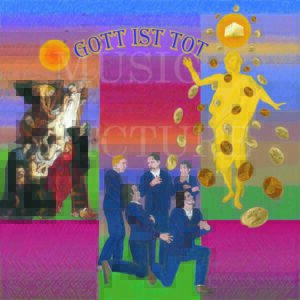
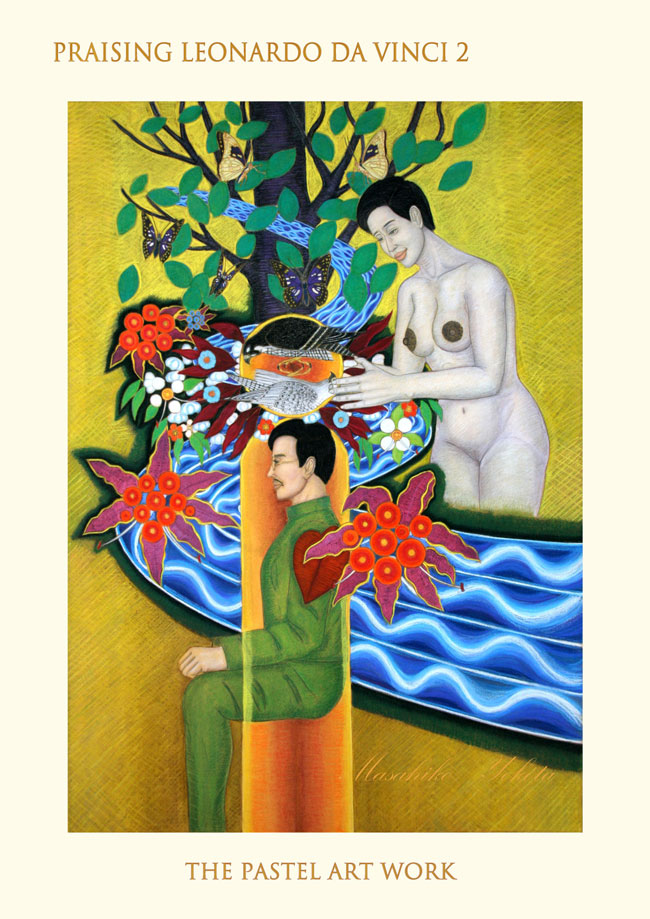
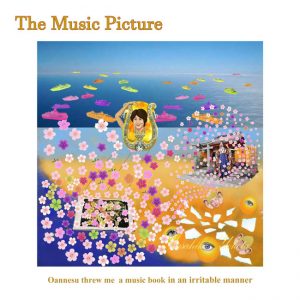
I became convinced that I was a reincarnation of Redon after the vision of "Homage to Leonardo da Vinci Ⅱ"and a dream I had as a college student in which Oannes, painted by Redon, suddenly appeared to me in a dream and threw at me an art book that looked like a color blindness checkbook, like a Kandinsky abstract.
"In a desolate land where nothing is pleasing to the eye, it was necessary to create something pleasing to the eye by imagination".
Six Years of Secrecy Finally Lifted — The “Physical Law for Translating Musical Scores into Painting” Is an Epoch-Making Development in 300 Years of History!
Is music really abstract? Does it become abstract art when it is turned into a painting?
No. Tonal music was representational painting all along.
This time, I, Masahiko Yokota, have fully released in a series of four articles one of my core theories, the “Physical Law for Translating Musical Scores into Painting,” which I publicly explained only to Mr. Toyotsu Yamamoto, representative of Tokyo Gallery, in Ginza six years ago and then kept sealed as a secret for six years.
All the latest information is posted on the screen.
The reasons why I decided to make it fully public are as follows.
- New theories and discoveries in physics and other fields cannot be patented.
- Over the six years, I was able to create and build up a collection of more than ten large-scale pastel paintings based on this law.
- Simply saying “I discovered it” was, in many cases, not enough to make people ultimately believe me.
So, why is Yokota's theory epoch-making? Because it solved the “major problem” that no one had been able to solve for 300 years, since Newton in 1704.
The primary source used as a reference for the historical overview in these articles is “Color Organ” by Jörg Jewanski!
◆Jörg Jewanski States the Following in This Paper!
[A major problem of all color organs introduced until now, was that they lacked the possibility to design forms artistically.」<Translation>None of the color organs that had been created could do more than turn point light sources on and off; they could not display artistic forms, let alone the landscapes or human body lines envisioned by a composer, at a glance. This remained the greatest challenge.
Please read the following four articles in order, in which I examine this 300-year history through programs and examples of their outputs.
① First Release — Full Disclosure of the Law and the Complete Python Program
“Finally Lifting Six Years of Secrecy: The Law for Translating Music and Painting” (Article 1)
This is the complete picture of my four laws.
- Musical scale = spectrum of light: Do = red to Si = violet, becoming brighter with each octave
- Main-key note = dominant color on the canvas: C major is dominated by red, while B major is dominated by blue
- Pitch = Y-axis, time = X-axis, timbre = texture, trumpet = yellow, darker below and white above
- Rhythm = length of the melody, chord = three-color color chord
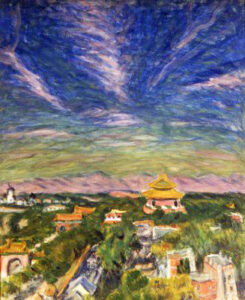
I have fully published the Python programs that translate Ryuichi Sakamoto's The Last Emperor and Eiichi Ohtaki's At the Canary Islands. When executed, landscapes such as the Forbidden City, Guilin, and a resort are automatically generated, as shown in the header image. Anyone can reproduce them simply by copying and pasting the code into IDLE.
② Second Proof — Geniuses Were Actually Using Color Chords!
“Examples of Paintings in Which Color Chords Are Actually Used: Ryuzaburo Umehara's Mount Fuji!” (Article 2)
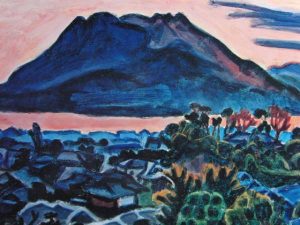
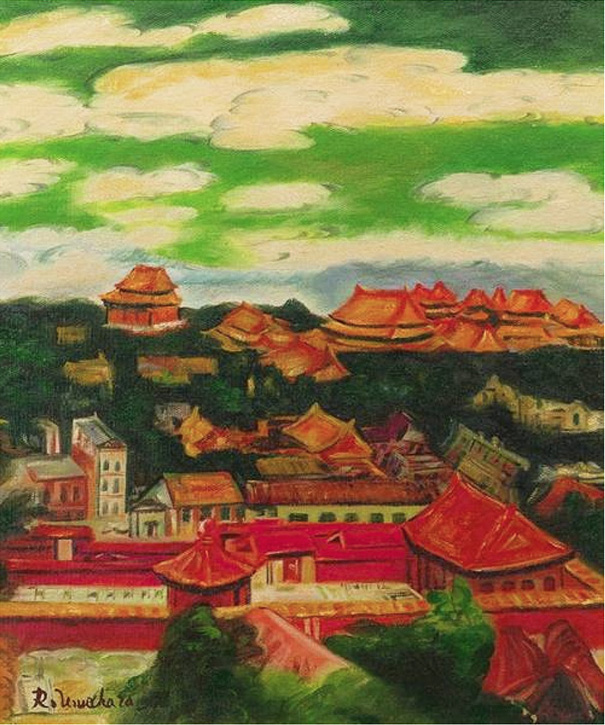
I demonstrate through images that my color chords—C major = red, yellow, and green; Dm = vermilion, yellow, green, and blue—were exactly the color combinations used in the mountain ranges and clouds of Mount Fuji by the national painter Ryuzaburo Umehara, a color scheme that the newspaper praised as a “grand slam home run out of the ballpark.”
Furthermore, I have established that Matisse's Harmony in Red and Portrait of Madame Matisse with a Green Stripe were also painted using the same C major and Dm color chords.
Matisse himself stated in his book Notes of a Painter, “Colors must harmonize like the chords in music. There is no reason why what can be done in music cannot also be done in painting.” I have taken the idea beyond this point and completed it as a theory of chords.
③ Third Examination — A Thorough Comparison with the History and Innovation of Previous Research
“My History of Previous Research on the ‘Physical Law for Translating Musical Scores into Painting,’ and an Examination of the Innovation and Value of My Theory” (Article 3)
Inspired by the correspondence table between sound and color in Newton's Opticks, Krüger proposed a correspondence table between the spectrum and sound in 1743, and Blavatsky proposed the same type of spectrum-and-sound correspondence table as Yokota's theory in 1888. Furthermore, including the principle that colors become brighter with each rise of one octave, Marion established the correspondence table in 1919.
In addition, in recent years there have been various performances involving organs and other systems that correspond sound and painting, including the following.
- Toshio Iwai, “Piano as Image Media”
- Iwai × Ryuichi Sakamoto, “Music Plays Images x Images Play Music”
- Ryuichi Sakamoto + Dumb Type 2022
- Chapman University 2022 Project Metamorphosis
After examining 300 years through primary sources, I demonstrated that the three representative Japanese attempts and Chapman's prototype all remained at the level of “displaying sound in real time as points of color.” They lacked structural correspondences such as main key = dominant color, chord = color chord, timbre = texture, and rhythm = periodicity, and contained a large amount of intervention by impression, sensation, arbitrariness, and imagination. As a result, they could not make a representational image emerge at a glance.
④ Fourth Symbol — Rimington as the Symbol of the 300-Year-Old “Problem of Being Unable to Create Any Form or Image”
“Rimington's Color Piano, Which Adopted the Spectrum Correspondence Table — As a Symbol of the 300-Year-Old ‘Problem of Being Unable to Create Forms’!” (Article 4)
Rimington's color organ was presented in London in 1895.
It was the first full-scale device using the spectrum correspondence table to generate colors with an arc discharge and prism and project color chords onto a screen using a keyboard.
However, its output was nothing more than a pure show of colored light, with no forms whatsoever. Its philosophy was to discard form, based on the idea that “color should be liberated from the constraints of form.”
Here lies the symbol of the 300-year-old limitation.
My theory has advanced from the projection of colored light over the passage of time to a law that ignores the passage of time and converts a musical score into a painting, automatically generating the same representational images for anyone who sees them—silhouettes such as the Forbidden City, Guilin, the female body, or the repeatedly surging waves on a tropical beach.
This Is an Epoch-Making Theory = an Innovation, Just Like Poincaré's Discovery of Topology!
As Poincaré said, “Mathematics is the art of giving the same name to different things,” innovation occurs when different things are regarded according to the same law.
My theory combines music and painting through a physical law, overcoming the assumption that they are fundamentally separate things. The era in which many abstract painters simply placed dots, lines, and planes somewhat intuitively based on the assumption that “music is abstract” is over.
Please read all four articles from beginning to end, and use your own PC to discover what kind of landscape that piece of music you are listening to with your own ears actually was.
My discovery of the law of translation of music into painting is an innovation for the ages!
As the great mathematician Poincaré said, "Mathematics is the art of regarding different things as the same thing." It is a truism that a good idea is a combination of finding a common law between things that were previously considered dissimilar and unrelated.
Such a good idea is called an innovation, and the person who initiates the innovation is called an innovator.
In the worlds of academia, the arts, and entrepreneurship, a genius is this innovator.
A good idea is a new combination of different things
When I was young, I was asked by a famous Japanese gallery owner.
He said, "Why do you want to combine music with painting? "
He would have said, "If you like painting, I just see an painting! If you like music, I just listen to music."
I was young and could not refute anything at that time.
But this question is the decisive one.
I Have Been Recognized by the President of Tokyo Gallery, One of Japan’s Leading Contemporary Art Galleries, as a Painter with Talent and Ability Comparable to Takashi Murakami!
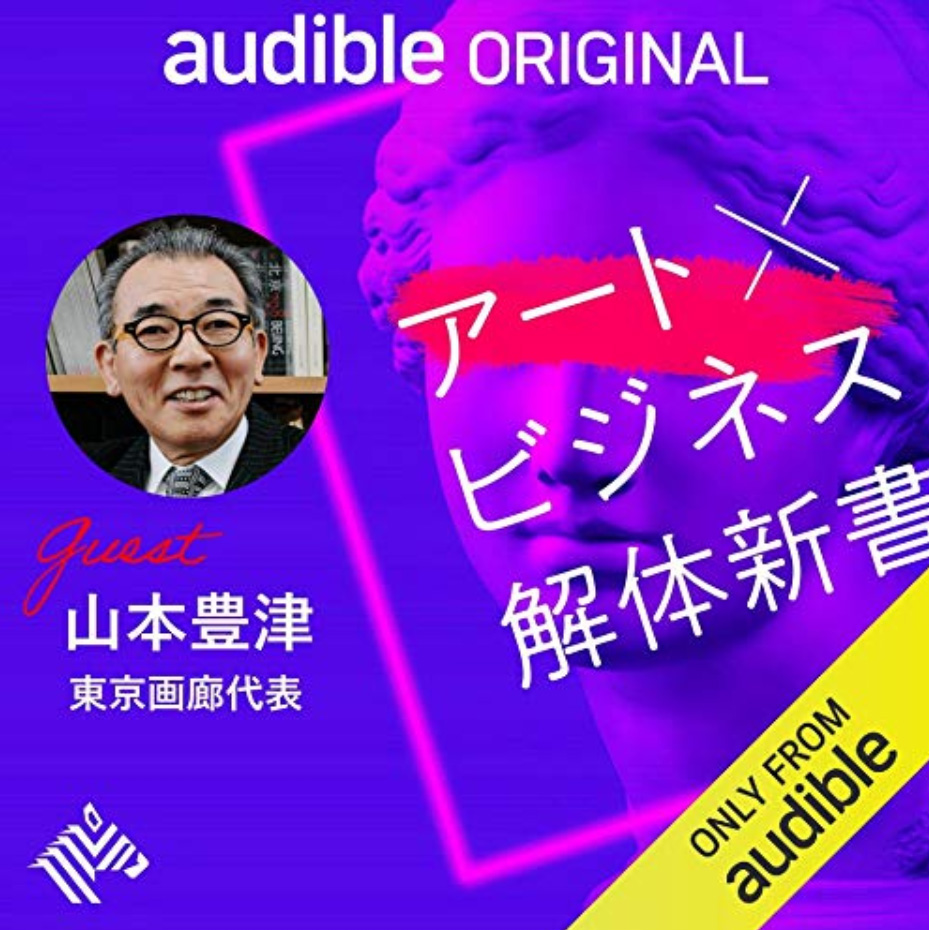
Japan's first contemporary art gallery, Tokyo Gallery.
Tokyo Gallery is one of Japan's leading commercial galleries and, alongside Taka Ishii Gallery, has been one of the only Japanese galleries to be selected repeatedly in recent years for Art Basel, one of the world's most prestigious art fairs, where the world's top galleries are selected to participate.
In automobile racing terms, galleries that are selected to exhibit at Art Basel could be compared to Formula One manufacturers such as Mercedes-Benz or Ferrari.
In that sense, Tokyo Gallery is something like Honda.
Consider, for example, Gagosian Gallery, which has remained at the pinnacle of the international art world for the past 30 years.
Takashi Murakami and Yoshitomo Nara, both of whom have been major artists represented by Gagosian, could be compared to Formula One drivers such as Michael Schumacher and Ayrton Senna.
For several years, Yutetsu Yamamoto, President of Tokyo Gallery, has recognized me, Masahiko Yokota, as an artist possessing talent and ability comparable to Takashi Murakami, one of Japan's leading contemporary artists.
Regarding this assessment, when I visited Tokyo Gallery on August 7, 2023, and had a conversation with Mr. Yamamoto that lasted approximately an hour and a half, he gave me his explicit approval, saying:
"It is true that you possess talent and ability comparable to Takashi Murakami. Therefore, there is absolutely no problem with you publicly stating that I have given you my strong endorsement, whether to the media or to anyone else!"
So, why am I not a contracted artist of Tokyo Gallery?

Discover What Art Really Is! YOKOTA Art School — Launched April 1, 2026
From April 1, 2026, I, Masahiko Yokota, officially launched the online art school that I had been planning for some time.
YOKOTA Art School is designed to meet the needs of people who want to deepen their understanding of art.
Among those who had previously subscribed to my email newsletter, many told me that their reason for subscribing was:
"I want to master contemporary art, world art history, and art theory!"
I had also long been impressed by the success of the online art school operated by JIN, a painter, whom I have known as one of Japan's leading experts in online marketing for artists. I had wanted to create an online school of my own based on a similar concept.
Furthermore, now that I am over 60, I have accumulated a considerable body of knowledge about art, practical know-how concerning artistic production, as well as skills for making appointments and negotiating with art dealers and other people in the art industry.
Rather than keeping all of this knowledge to myself and taking it to my grave, I have come to strongly feel that this know-how is extremely valuable because I acquired it through years of painstaking effort, and that I should pass it on to the next generation and cultivate successors.
If you are interested, please visit the YOKOTA Online Art School page.
What Kind of Painter Is Takashi Murakami?
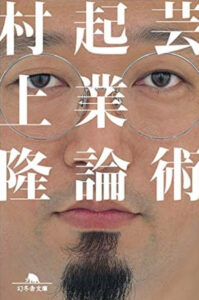
Takashi Murakami is a painter approximately the same age as me, Masahiko Yokota. He is an elite figure in the Japanese art world, having graduated from the Japanese Painting Department of the Faculty of Fine Arts at Tokyo University of the Arts, an institution known for its extremely competitive entrance examinations and difficult admissions process. He was also the first person to receive a doctoral degree from the Faculty of Fine Arts at that university.
While studying at Tokyo University of the Arts, Murakami studied in New York and created an innovation by combining Japanese manga and anime—which had become a global phenomenon—with the world of Western contemporary art.
For the past 30 years, he has achieved an exceptionally high level of recognition and commercial success in the European and American art worlds.
Alongside Takashi Murakami, another contemporary artist who achieved a similar level of recognition by creating an innovative fusion of Japanese manga and anime with Western art is Yoshitomo Nara.
For more details, please see the following page:
What Is Tokyo Gallery, One of Japan's Leading International Commercial Galleries? What Makes It So Exceptional?

First, let me explain what a commercial art gallery actually is.
A commercial gallery is essentially an agent that sells paintings, sculptures, and other works of art on behalf of artists.
Historically famous commercial galleries and gallerists include Ambroise Vollard, who discovered and promoted Cézanne, Degas, Van Gogh, Renoir, and Picasso.
Another was Daniel-Henry Kahnweiler, who had a close relationship with Picasso, supported Georges Braque—who, together with Picasso, developed the famous movement of Cubism—and organized the world's first Cubist exhibition.
Then there was Leo Castelli, who discovered and promoted such postwar American star artists as Frank Stella, Robert Rauschenberg, and Jasper Johns.
Among Castelli's protégés was Larry Gagosian, who trained under him before becoming independent and has gone on to dominate the international art world for the past two decades, representing major artists such as Damien Hirst, Takashi Murakami, and Yoshitomo Nara.
To put it boldly, Tokyo Gallery can be regarded as one of Japan's leading galleries, alongside Taka Ishii Gallery, positioned immediately below the global mega-galleries such as Gagosian, its emerging rival Hauser & Wirth, David Zwirner, and Pace, which is scheduled to open a Tokyo branch next spring.
Assumption that works of art are motionless like still life
Until now, most people have assumed that a painting is an artwork that does not move , with the exception of cartoons, movies, and mechanical sculptures and machines.
People assumed that art was to be appreciated by staring at the work from the front.
For example, Yoshitomo Nara's painitings (奈良美智)and the Mona Lisa are almost devoid of movement.
I am the first to clearly articulate "What is art?"
I have read many books on aesthetics and art, but I think almost no one has been able to answer the question "What is art? I think almost no one has been able to answer that question in a way that gets to the heart of the matter.
So what is art?
Art is "the expression of something.
What do you think? Can anyone refute this? It is impossible.
I have elucidated the significance of abstract painting, which aims at a musical state of painting.
Who is the founder of abstract painting? It is now known that a female painter, Hilma af Klint, painted abstract paintings that are symbolic representations of the unconscious as described by Jungian psychology before Kandinsky..
In this sense, Tibetan Buddhist mandalas are also abstract paintings, as arejapanese Jomon pottery and clay figurines, and humans have been painting abstract pictures for a long time.
Therefore, the theory that "abstract expression appeared because modern humans came to experience nature and things in a more indirect way" is also incorrect.
New Theoretical Series — Three Pillars of Yokota's Art Theory
After six years of secrecy shared only with Tokyo Gallery, Masahiko Yokota has publicly released his complete theoretical system. All 10 articles added in September 2026 are presented in three series: The definition of art, the physical law translating music into painting, and the essence of Japanese culture.
Series 1: What Is Art? — Art is an Expression and a Device for Dialogue
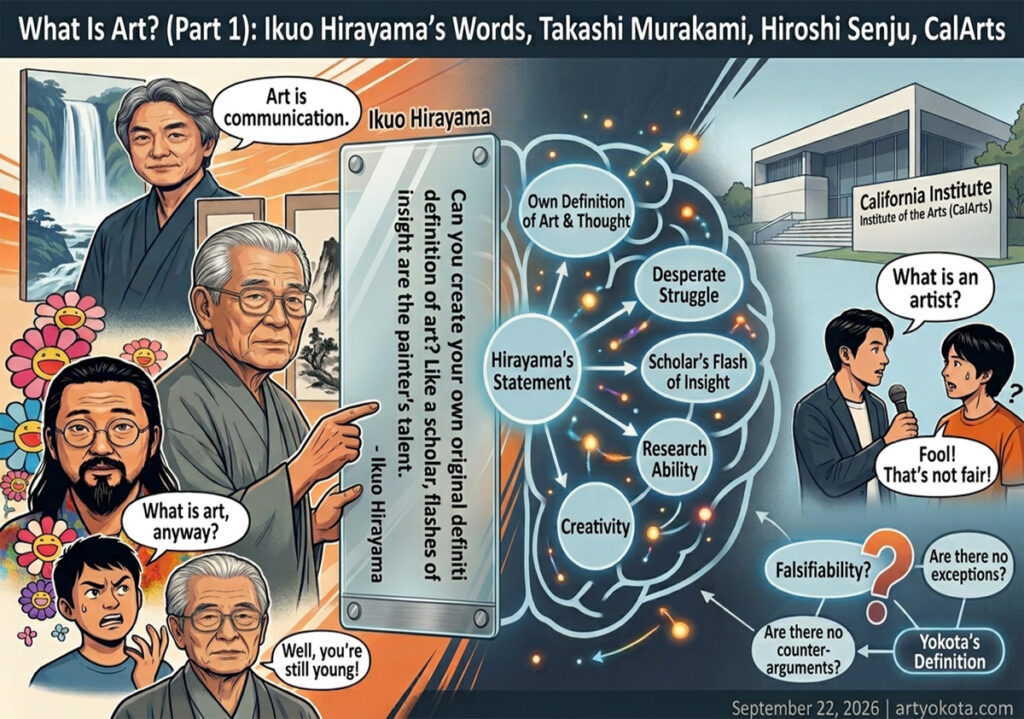
The definitive answer to a question no one could answer — "What is art?" — tested by Karl Popper's falsifiability. From CalArts to Kyoto University of Art, why art schools have never taught a valid definition.
- ◆What Is Art? (Part I) — Art Is an Expression of What the Artist Wants to Communicate, and a Device for Provoking Dialogue and Debate! (Part I)【Go to this page!】
Yokota's definition: "Art is an expression of what the artist wants to communicate. Or, a device created to provoke discussion and dialogue." Using Popper (1934), it falsifies Hiroshi Senju's famous "Art is communication" — if a 9/11 victim is an artist, then officials, volunteers and nurses all become artists. Includes the episode of 【entity-Takashi Murakami¦canonical_name=Takashi Murakami】 asking President Hirayama "What is art?" and the creative method as system development: concept → requirements → design → coding → debugging. - ◆What Is Art? (Part II)— I Investigated the Theories of Earlier Thinkers and Artists: Examining the Originality and Validity of My Definition【Go to this page!】
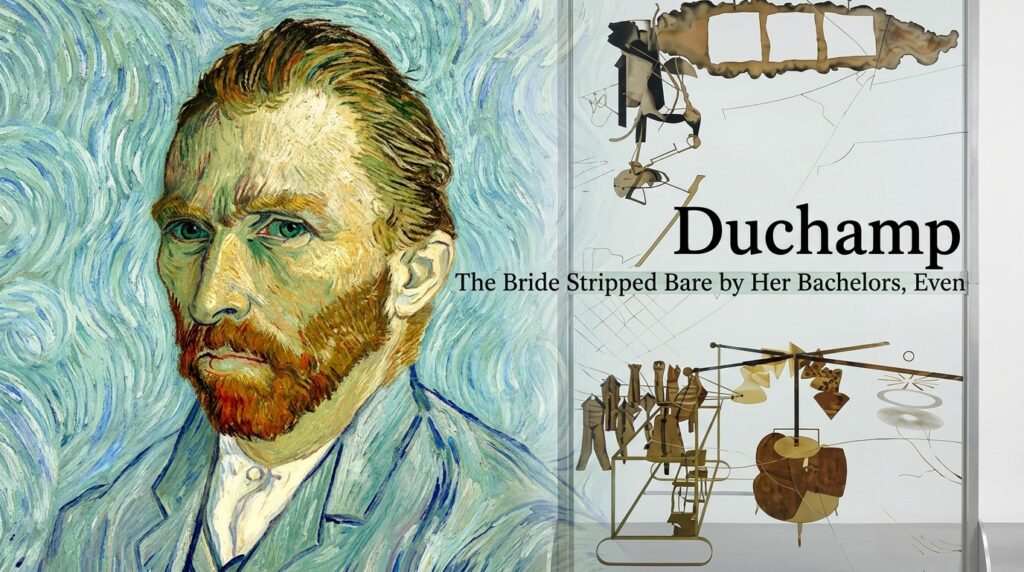
The Western lineage examined: Expression theories (Tolstoy 1897, Kant, Danto, David Davies, Noël Carroll) and Device theories (Duchamp 1957 viewer participation, Umberto Eco "Open Work" 1962, Alfred Gell "Art and Agency" 1998, Kester "Conversation Pieces", Claire Bishop antagonism). Contrasted with Institutional theory (Dickie), Historical theory (Levinson), Aesthetic definition (Beardsley), Cluster theory (Gaut), plus counter-arguments from Barthes and Rancière. No precedent combines "expression OR device" in this form. - ◆What Is Art? (PartⅢ) Japanese Art and Thought)— I Investigated the Theories of Earlier Thinkers and Artists【Go to this page!】
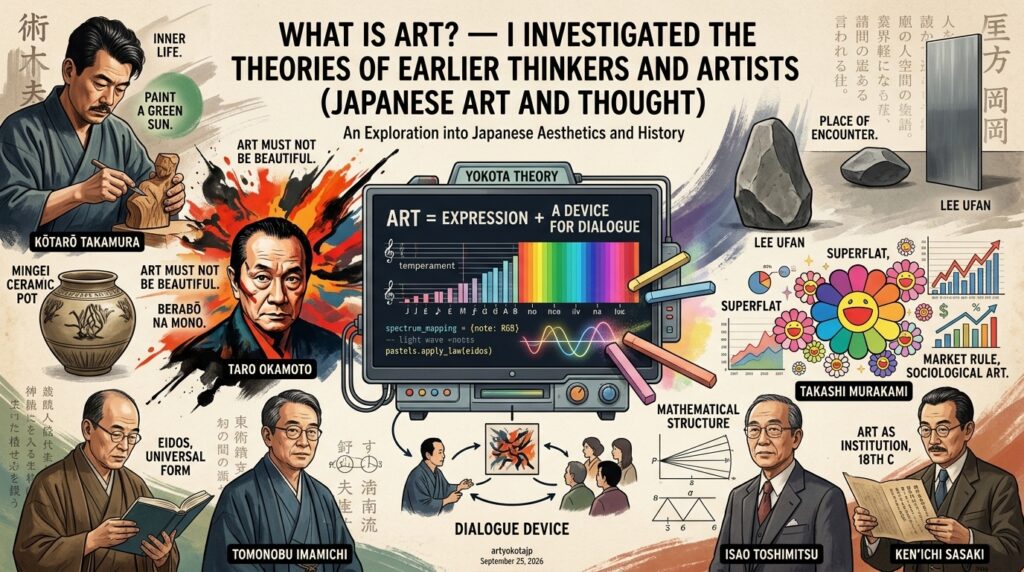
From Meiji subjectivity to post-war institutions: Kōtarō Takamura "green sun", Sōetsu Yanagi Mingei, Tarō Okamoto "Art must not be beautiful — berabō na mono", Lee Ufan Mono-ha encounter, Takashi Murakami Superflat market strategy. At the highest academic level: Ken'ichi Sasaki "Art is an 18th-century institution", Isao Toshimitsu "Beauty is objective mathematical structure", Tomonobu Imamichi "Creation is giving law (eidos)". Yokota's theory as translation of physical truth + activation of cognition. - ◆What Is Art? (Part IV) What Is Japanese Culture? Discovering the Characteristics of Japanese Art and Fine Art Through the Research of Earlier Scholars!【Go to this page!】
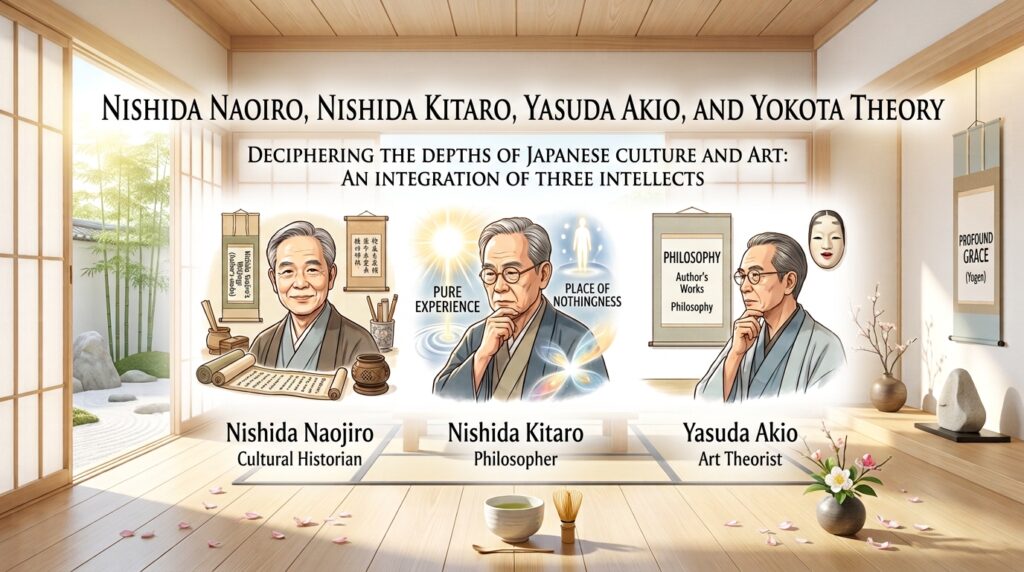
The foundation of Japanese aesthetics: Nojirō Nishida (1886-1964) — who first systematized Japanese cultural history in 1932 and argued Japan absorbs foreign influence and transforms it. Kitarō Nishida's "Place of Absolute Nothingness" and "Action-Intuition". Akio Yasuda's "Yūgen and Yojō" from "Japanese Theories of Art" (1957). Final integrated definition: "Japanese art creates Yojō and Yūgen through symbolism, omission, empty space, and simplicity, bringing a second world into the viewer's mind."
Series 2: Law for Translating Music into Painting — 6-Year Secrecy Lifted
For the first time in art history, a verifiable physical law connecting auditory art and visual art. Includes executable Python program and visual proof.
- ■【PartⅠ Law for Translating Music into Painting ・・・ Here is the Python program】 I have finally unveiled and publicly released This Law, ending six years of secrecy【Go to this page!】
The 4 laws revealed: 1) Do=C=Red, Re=D=Orange, Mi=E=Yellow, Fa=Yellow-green, So=G=Green, La=A=Blue, Ti=B=Purple — higher octaves become brighter. 2) Tonic = dominant color covering canvas. 3) Pitch = Y-axis, Time = X-axis, note length = squares. 4) Chords = color chords. Verified by running Ryuichi Sakamoto "The Last Emperor" — the Forbidden City, Guilin landscapes and resort beaches automatically emerged, proving tonal music is figurative painting, not abstract. - ■【PartⅡ Law for Translating Music into Painting 】— Examples of Paintings in Which Color Chords Are Actually Used: Ryuzaburo Umehara’s Mount Fuji!【Go to this page!】
C major = Red-Yellow-Green, Dm = Vermilion-Yellow-Green-Blue. Analysis of Umehara's Mt. Fuji praised as "bases-loaded home run" — red and green mountain range, yellow plain, vermilion clouds = perfect C and Dm. Same principle in Matisse "Red Harmony", "Portrait with Green Stripe" and early portrait. Why Matisse was called "magician of color" and Umehara praised by Renoir — they unconsciously used color chords. - ■【PartⅢ Law for Translating Music into Painting 】The History of Previous Research on this Law and an Examination of the Innovation and Value of My Theory【Go to this page!】
300-year survey based on primary sources: Newton Opticks 1704 (D=Red), Krüger 1743 (C=Red shift), Blavatsky Secret Doctrine 1888, Maryon Marcotone 1919 (29 octaves = audible range, brightness by octave). Toshio Iwai "Piano as Image Media" 1995, Iwai x Sakamoto 1997, Sakamoto + Dumb Type Venice 2022, Chapman University "Project Metamorphosis" 2022 Python/MIDI system. All lacked main-key dominance, color chords, timbre=texture / pitch=brightness / rhythm=periodicity, and figurative image generation. - ■【PartⅣ Law for Translating Music into Painting】As a Symbol of the “300-Year-Old Problem of Being Unable to Create Forms” — Rimington’s Color Piano【Go to this page!】
Alexander Wallace Rimington's Colour-Organ demonstrated at St. James's Hall, London 1895. Arc light → prism → filters → screen produced pure color light, but no mechanism for figures, buildings, or landscapes. His philosophy "Freeing Color from Form" stopped at abstract light. Yokota's shift from "point-to-point" to "structure-to-structure" (tonic=dominant color, chord=color chord, timbre=texture) finally solves what Jörg Jewanski called "the major problem" of all color organs.
Series 3: What Is Japanese Culture? — From Motoori to Nishida to Umehara
The underground current connecting Japanese aesthetics: rejection of abstract reasoning (Kara-gokoro) and unity with the life of the object itself.
- ★★★【What Is Japanese Culture? No1】・・・Discover the Characteristics of Japanese Art and Fine Art Through the Research of Earlier Scholars!【Go to this page!】
The Bukkyo University method: Start with Nojirō Nishida's cultural history (Japan transforms foreign influences), then Kitarō Nishida's "Place of Nothingness" (center empty like typhoon eye, so it can accept everything — Buddhism, Chinese thought, Western science), then develop your own theory. Why Japanese prefers simplicity, plainness, conciseness (waka, haikai, tea, dry garden, Kano hawks on fusuma) over formal logic — the root of Yūgen and Yojō. - ★★★【What is Japanese culture?No2】・・・Japanese Art and Aesthetics Theory — Motoori Norinaga, Its Succession by Nishida Kitaro, and the Influence on Umehara Ryuzaburo via the Shirakaba-ha【Go to this page!】
Edo scholar Motoori Norinaga's rejection of "Kara-gokoro" (Chinese reasoning) and concept of "Mono no Aware" — natural emotion moved by falling cherry blossoms in Yoshino. Kitarō Nishida sublimates it into "Pure Experience" ("When we see a flower, there is no self, no flower — only color") and "Place of Absolute Nothingness" (1926 paper "Basho") — the field that makes existence possible. Connection to yohaku (empty space) in ink painting, Lee Ufan, and Yukawa Hideki's meson theory (1934-35) and Zhuangzi's "chaos" (1966 elementary domain theory). Finally, Umehara Ryuzaburo's "Beijing Autumn" as visual proof of action-intuition — "The sky was like listening to music."
Why is a single painting sometimes surprisingly expensive?
It is because it is created with ideas, techniques, and know-how acquired through a great deal of trial and error and hard work.
The amount of books and materials I has read in order to paint a single picture is enormous, and the books in his studio today are kept at the minimum number required.
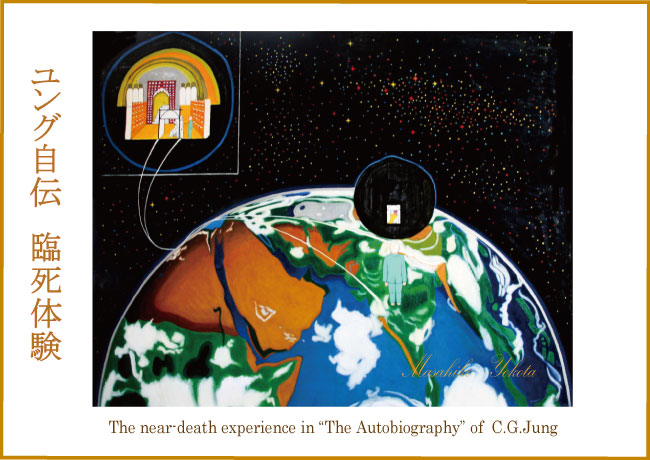
Jungian psychology and Goethe's Faustian worldview as central ideas for my production.
Of all the books I have read since college, psychoanalysis has been central to the formation of the self, especially Jungian psychology.
I became aware of Jungian psychology because a friend who likeda Japanese novelist Yasutaka Tsutsui (筒井康隆)introduced me to Tsutsui's books and because the world-class artistTadanori Yokoo (横尾忠則)was devoted to Jung for a time.
Consultation on the purchase of pastel original drawings and large size giclee prints
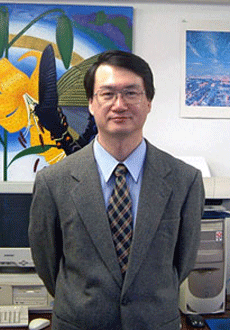
Hello, This is Masahiko Yokota(横田昌彦).
I am not currently selling original pastel drawings.
One reason is that I would like to have my drawings on hand for display at a solo exhibition that I will hold in the near future.
Another reason is that I have strong doubts about the fact that the artist will not receive even a thousand dollars in profit when the price of the sold work rises in the market.
However, we have received a small number of inquiries from people who wish to purchase original pastel paintings.
We also receive requests from people who would like to have a pastel drawing of this or that size painted in this or that way.
In addition, we have received quite a few inquiries from people who wish to purchase Giclee prints that are also large in size and stretched on canvas.
Therefore, we would like to sell these art works, including creating and delivering new art works, if both parties agree to the terms and conditions.
If you are interested, please feel free to contact us using this consultation form.
For giclee prints, please provide us with details such as the size of the work, desired materials, and location of use, and we will prepare and send you a quotation.
You can also view the original artwork at the ’Sapporo Web Programming School ’classroom in Japan, which we manage, so please feel free to use this form to contact us about this as well.
Prices start at 50,000 yen for the small size giclee prints without frames.
We expect pastel originals to start at 200,000 yen, and A0 size (841 x 1189mm) at 300,000 yen.