■【PartⅣ Law for Translating Music into Painting】As a Symbol of the “300-Year-Old Problem of Being Unable to Create Forms” — Rimington’s Color Piano, Which Adopted the Spectrum Correspondence Table!

In my previous post, I explained that it was Maryon, in 1919, who established the correspondence between the musical notes and the colors of the spectrum: C (Do) = red, D (Re) = orange, E (Mi) = yellow, F (Fa) = yellow-green, G (Sol) = green, A (La) = blue, and B (Si) = violet. The colors become brighter each time the pitch rises by one octave. Right?
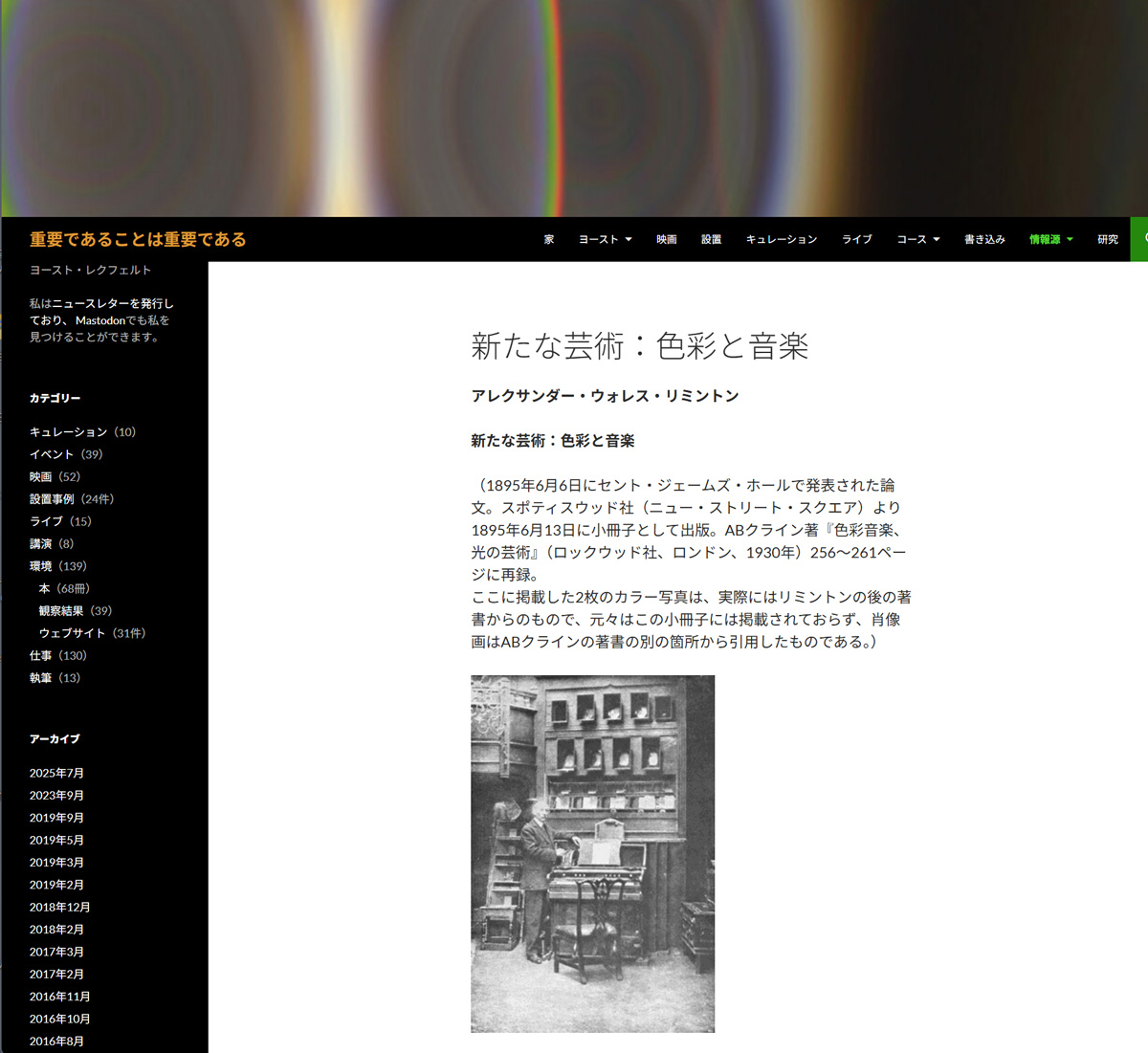
This time, I will discuss in detail the theory of Alexander Wallace Rimington, who, before Maryon's work in 1919, developed a color organ in 1895 based on the correspondence between music and color, but deliberately focused on projecting pure color rather than depicting concrete objects.
I will also explain how, as Jörg Jewanski said in my previous post, “the greatest challenge remained,” and how, essentially, color organs of this type have continued without fundamental change right up to the present day.
For a detailed explanation of Rimington's theory, please see this Rimington Paper!
◆What Was Alexander Wallace Rimington's “Color Organ”?
— As a Symbol of the “Problem of Being Unable to Create Forms” That Continued for 300 Years
At the end of the 19th century, Alexander Wallace Rimington sought to “perform colors like music” and developed one of the world's earliest large-scale color organs.
The device was publicly demonstrated at St. James's Hall in London in 1895, and it attracted considerable attention from scientists and artists of the time.
However, although Rimington's device succeeded in establishing a connection between music and color, it did not provide a mechanism for generating representational forms. This limitation can be regarded as one of the major problems that persisted throughout the history of color organs.
◆1. What Kind of Machine Was Rimington's Device?
Rimington's color organ operated according to the following mechanism.
| Component | Function |
|---|---|
| White light from an arc discharge | Generates intense light that serves as the source of the colors. |
| Prism | Separates white light into a spectral band ranging from red to violet. |
| Color points on the spectrum | Provides numerous “color positions” along the spectral band. |
| Filters / diaphragms | Selects colors at the designated positions and projects them onto the screen. |
| Keyboard (piano type) | Each key corresponds to a specific color, and pressing it projects that color. |
| Screen | The selected colors are displayed as areas of light. |
◆2. What Was Actually Displayed on the Screen?
What Rimington's device produced was essentially a display of pure colored light.
| Display | Description |
|---|---|
| Single-color projection | When a key was pressed, colors such as red, orange, yellow, green, blue, and violet appeared across the screen as areas of color. |
| Simultaneous combinations of colors | When multiple keys were pressed simultaneously, multiple colors could be displayed on the screen at the same time. |
| Temporal changes | The colors changed over time, producing changing sequences of colored light. |
| Rhythm | The timing and intensity of the projected colors could change in accordance with the musical performance. |
| Presence or absence of form | Basically, there was no mechanism for generating representational forms such as figures, buildings, or landscapes. |
◆3. Rimington's Philosophy — “Freeing Color from Form”
According to Rimington's 1895 paper A New Art: Colour-Music, he sought to establish a new form of art in which color could be associated with music rather than being restricted to the depiction of forms.
Rather than creating “form + color” as in conventional painting, he envisioned an art form in which color itself would be performed along a time axis, like music.
In this sense, his device was designed primarily to explore the expressive possibilities of color independently of representational form.
◆4. What Rimington Achieved — and What His System Did Not Achieve
●What he achieved
Treating color as an artistic medium analogous to music
Giving color temporal sequence, rhythm, and dynamics
Creating simultaneous combinations of colors
Creating abstract sequences and compositions of color
●What his system did not achieve
A structure in which the color corresponding to the musical tonic dominates the canvas
A systematic theory connecting musical chords with combinations of colors
Structural correspondences such as timbre = texture, pitch = brightness, and rhythm = periodicity
A law by which representational images (the Forbidden City, Guilin, the human body, etc.) are automatically generated from a musical score
A physical translation system designed to minimize arbitrariness, sensation, and subjective impression
In other words, Rimington stopped at the abstract stage of treating color like music, whereas
I reached the “physical law for completely translating musical scores into representational paintings.”
This is the decisive difference.
◆5. Why Can't Rimington's Device Produce Representational Images?
The main reasons can be summarized as follows.
●① Color is primarily handled as projected light
→ There is no mechanism in the system for automatically generating representational forms.
●② There is no structure corresponding to a musical tonic or a systematic theory of color chords
→ The arrangement of colors is not connected to the structural organization of a musical composition in the way proposed by my theory.
●③ There is no visual structure corresponding systematically to timbre, pitch, or rhythm
→ There is no defined mechanism that converts these musical parameters into the components of a representational image.
●④ There is a high degree of arbitrariness in the relationship between the musical performance and the resulting visual composition
→ The visual output depends substantially on how the performer operates the device.
●⑤ The system does not constitute a physical law that uniquely determines a representational image
→ There is no mechanism ensuring that the same musical score will generate the same representational image independently of the performer.
◆6. The Innovation of My Theory — A Shift to “Correspondence Between Structures”
My theory addresses the “problem of being unable to create forms” that remained unresolved in earlier attempts to translate music into visual art.
Main key / tonic = dominant color
Chord = color chord
Timbre = texture
Pitch = brightness
Rhythm = periodicity
By introducing this correspondence between structures, simply following the defined rules for translating a musical score makes it possible for the same representational image to emerge from the same musical input, regardless of who applies the rules.
This can be compared, in a broad sense, with Poincaré's work connecting geometry and algebra in the development of topology.
◆7. Final Conclusion — The Long-Standing Problem of Creating Forms
The spectrum correspondence table was developed through a historical lineage extending from Newton → Krüger → Blavatsky → Maryon.
However, I was the first, to my knowledge, to propose a “physical law by which a musical score can be completely translated into a representational image.”
This is the decisive difference between my theory and earlier approaches to music–visual translation, including the works of Toshio Iwai and Ryuichi Sakamoto, as well as projects such as Project Metamorphosis at Chapman University. It is also the significance I attach to my attempt to address the long-standing “problem of being unable to create forms.”
Click here for other pages in this series!
■【PartⅠ Law for Translating Music into Painting ・・・ Here is the Python program】 I have finally unveiled and publicly released This Law , ending six years of secrecy surrounding it. Here is the Python program that demonstrates and verifies the law.【Go to this page!】
■【PartⅡ Law for Translating Music into Painting 】— Examples of Paintings in Which Color Chords Are Actually Used: Ryuzaburo Umehara’s Mount Fuji!(梅原龍三郎 富士山)【Go to this page!】
■【PartⅢ Law for Translating Music into Painting 】The History of Previous Research on this Law and an Examination of the Innovation and Value of My Theory【Go to this page! 】