★[Part IV] A Venice Biennale Award-Winning Exhibition Born from Large-Scale Disasters and War What Is Buddhist Enlightenment? — Exhibitions That Were Created from Large-Scale Disasters and War and Became the Focus of Attention at the Venice Biennale!

What Is Buddhist Enlightenment?
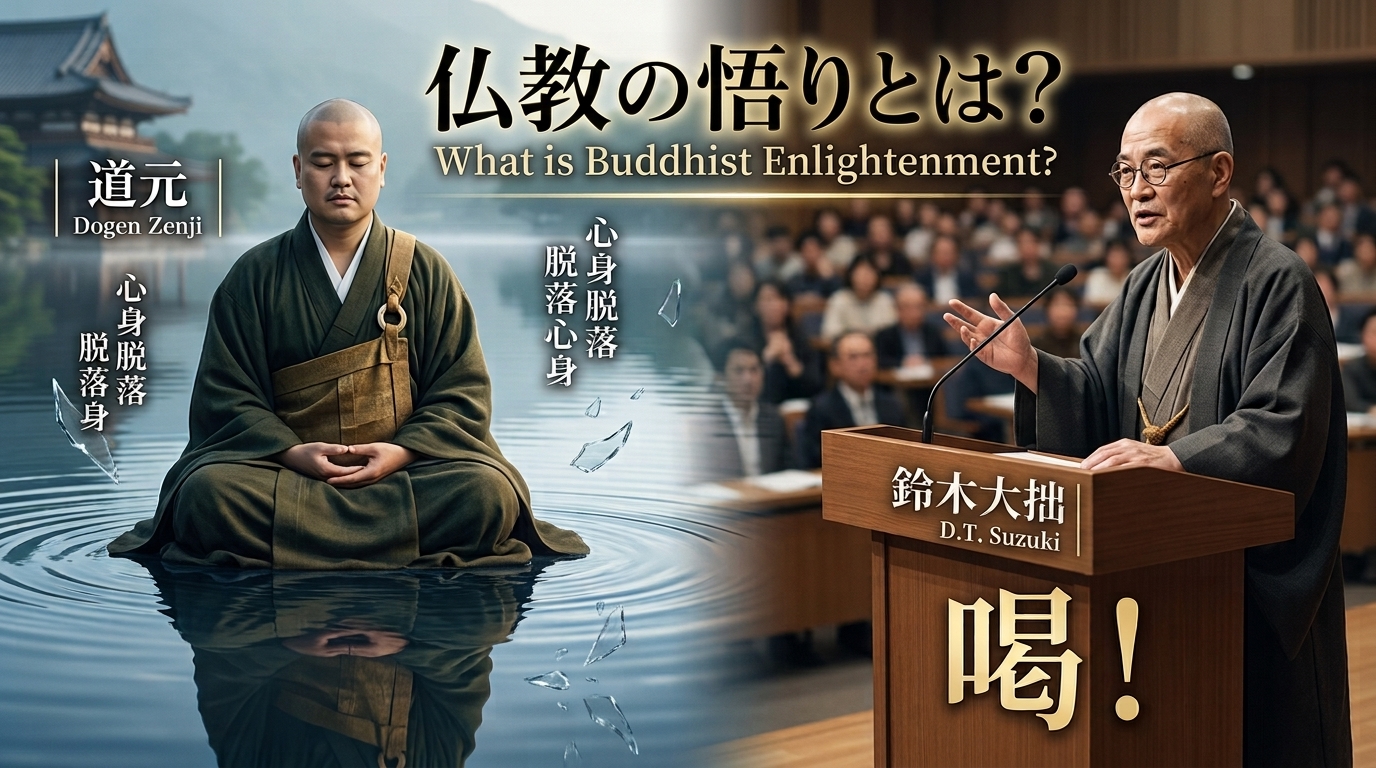
Dougen (道元)’s *“Shinshin Datsuraku, Datsuraku Shinshin”* (心身脱落 脱落心身) was something he learned from his Chinese teacher, Tendō Nyojō (天童如浄). It refers to allowing all the emotions and impulses that arise—anger, jealousy, sexual desire, aggression, loneliness, greed, anxiety, and sadness—to surface during zazen meditation, while letting go of them one by one. The aim is to attain a state of perfect mental stillness, like a clear mirror and still water, in which the mind is no longer constantly driven by desire, thereby freeing oneself from suffering.
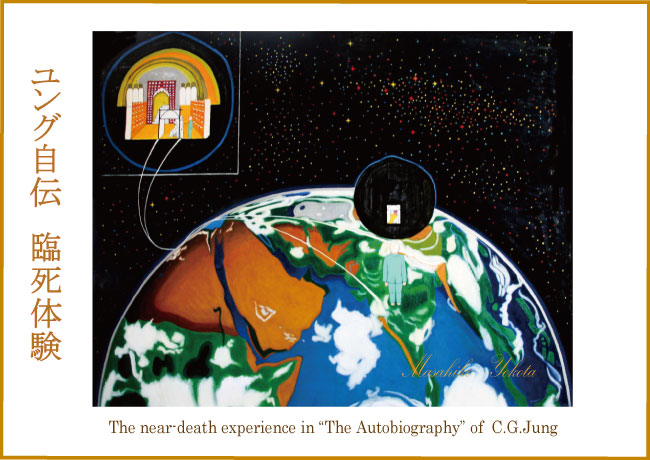
Carl Gustav Jung says, “The Buddha is said to have been a man who shattered to pieces his desire to be reborn into this world in order to escape the cycle of reincarnation. But such a thing is beyond what we would normally consider human.”
Is such a thing really possible? Certainly, it seems almost superhuman!
Many Buddhist scholars and practitioners, including Daisetsu Suzuki (鈴木大拙), have offered their own theories about enlightenment over the years, but most have remained vague.
C. G. Jung argues that one aspect of enlightenment in early Buddhism is “deliberately shattering one’s own spiritual essence into pieces, like a glass marble, and reducing it to nothingness.” No one other than Jung has articulated this view in quite this way.
Daisetsu Suzuki (鈴木大拙) said, “The Buddha is said to have suddenly attained enlightenment when he was sitting in zazen and saw the dawn. Buddhist scholars up to now have neglected this account of enlightenment and have rarely discussed it. But Buddhist scholars must, at all costs, clarify what actually happened in this moment of enlightenment. Katsu!”He said this in a lecture to a foreign audience. He also challenged his listeners, saying, “You probably understood my English very well, but you probably did not understand the content of what I was saying! ... Katsu!”
Yet, in the end, he himself never managed to explain precisely what enlightenment actually is.
His discussion then continued as follows: “Well, anyway, to understand something, it is important to become completely one with it.” (*What Is Zen?* by Daisetsu Suzuki, p. 88)
In other words, was this simply an evasion? Ultimately, no one seemed able to explain enlightenment clearly.
I believe that Buddhist enlightenment consists of intuitively recognizing a truth that accompanies this self-annihilation. To attain enlightenment means to understand something clearly.
Examples of People Who Experienced Enlightenment!
Let us look at some actual examples of people who experienced enlightenment—that is, moments when something suddenly became crystal clear to them.
The genius shogi player Hifumi Katō (加藤一二三), a ninth-dan professional, reportedly experienced his first moment of enlightenment when he was in the fourth grade of elementary school. He was reading the shogi section of the *Asahi Shimbun* newspaper when he suddenly realized, “Oh, I see! Shogi is essentially a game in which you win by making nothing but good moves.”
On another occasion, while looking at a record of a shogi match, he suddenly realized, “Ahhh! I love shogi!” At that moment, he intuitively felt that he could become a professional, thinking, “This is the world I am most suited for.” (Reference page)
This, too, is enlightenment. That is why Zen teaches that there are both great enlightenment and small enlightenment!
When I was in my first year of junior high school, I saw a photograph of Ryūzaburō Umehara (梅原龍三郎)’s *“Sakurajima: Blue”* (櫻島 青). I was so deeply moved that tears came to my eyes, and I realized, “Art is something that can move us emotionally.”
The nationally renowned painter Takeshi Hayashi (林武), who later became a professor at an art university, once fell off his bicycle while delivering milk along a snowy road, smashing the milk bottles and scattering the contents everywhere. A police officer who happened to be there reportedly looked at him with disgust and said, “You are a terrifying fellow!”
At that moment, it was as though a golden light had shone from the sky into the deepest part of his mind. He intuitively felt that someone was telling him, “Do not worry. You will certainly become someone important. You have genius within you. You are under divine protection.”
He wrote in his book *Living for Beauty: My Experiential Theory of Painting* (美に生きる―私の体験的絵画論, Kōdansha Gendai Shinsho, 1965) that this experience encouraged him and strengthened his conviction whenever he faced difficulties while pursuing his career as a painter.
This, too, was a form of enlightenment.
As these examples demonstrate, intuition plays an essential role in enlightenment. When we reach a judgment through logical analysis, the truth may remain uncertain. Intuition, however, can give us an unmistakable sense that something is true—that there is no doubt about it. I believe the Buddhist teaching is that human beings should strive diligently to attain these moments of enlightenment and accumulate such insights throughout their lives.
What Does the Analects Mean by “If I Hear the Way in the Morning, I Can Die Content in the Evening”?
It is said that Dougen (道元) also quoted the following passage from the *Analects* (論語) twice in his *Shōbōgenzō Zuimonki* (正法眼蔵随聞記):
“If one hears the Way in the morning, one may die content in the evening.”
Some people apparently connect this saying to the question of what Buddhist enlightenment is, interpreting it as meaning, “If one attains enlightenment in the morning ...”
I think this interpretation is utterly nonsensical. Would it not strip life of its meaning? Does it mean that once you have attained enlightenment, you have achieved the ultimate goal of life and have nothing left to live for?
Incidentally, the term
Buddha
means “the awakened one” or “one who has awakened” in Indian philosophy.
According to materials used in correspondence courses at Bukkyo University (佛教大学), there appear to have been several people who were regarded as awakened ones during the lifetime of Shakyamuni Buddha (釈迦).
Why, then, did Shakyamuni alone become so famous in later generations? Why did the other awakened individuals leave no comparable mark on history? The university's course materials offer the following explanation.
“Among the several awakened individuals, no one other than Gautama Siddhartha became a teacher and taught others the content of his awakening.”
It was this distinctive quality of being an educator that set Shakyamuni apart.
An excellent teacher would naturally attract many disciples. After Shakyamuni's death, beginning roughly a century later, his disciples and their own followers began recording various scriptures based on what they believed his teachings had been.
These scriptures were written down starting about a hundred years after his death, and their contents were transmitted through oral tradition. Consequently, we cannot know everything with certainty. Naturally, this has led to the conclusion that Buddhist scriptures are a matter of “varying interpretations and theories.”
As postwar research progressed, scholars increasingly came to regard the scriptures of Theravada Buddhism (上座部仏教), preserved by monks in countries such as Thailand and Myanmar, as being closer to the original teachings.
Before the war, however, many scholars and monks had focused primarily on Mahayana Buddhist (大乗仏教) scriptures. They reacted strongly against this new theory and, apparently, sometimes became quite emotional toward younger researchers.
The underlying objection was something like this: “How could the self-centered Theravada tradition, which emphasizes one's own enlightenment rather than saving others, possibly represent the mainstream of Buddhism?”
These historical circumstances help explain why Buddhism has no single, universally authoritative scripture comparable to the Bible or the Quran.
As Hayao Kawai (河合隼雄) and others have strongly emphasized—and as Heidegger's philosophy may also suggest—the core of Buddhism has an “empty-center structure.”
In other words, Buddhism does not reject a wide variety of opinions and interpretations. That openness is one of its great strengths!
“Ohhh, so that's another way of looking at it! Ahhh, that makes sense, too! I get what you mean! 🎵”
(Laughs.)
Well, you could call that being easygoing or even rather lax. But as Sōichirō Honda (本田宗一郎) famously put it, being “easygoing” can mean finding the “right degree” of something.
The guiding principle of the president of Bukkyo University when I was taking correspondence courses there was:
“Where Christianity spreads, blood is shed; where Buddhism spreads, peace arrives.”
What do you think? Broadly speaking, that seems about right, doesn't it?
Consider the Crusades, for example. Even today, in Gaza, we are witnessing massacres on a scale that recalls the Holocaust, committed by those who follow Judaism, a religion that shares the Bible with Christianity.
In other words, the argument is that teachings outside those written in the Bible are categorically rejected, to the extent that killing people through armed force is considered acceptable. Jesus himself said something along those lines, did he not—telling his followers to take up the sword when necessary to spread the faith?
Incidentally, Bukkyo University's Indian philosophy course materials also addressed the question: What did the Buddha awaken to? What did he realize?
The answer was reportedly based on the principles that all conditioned things are characterized by “impermanence” (諸行無常) and that “all phenomena are without an independent self” (諸法無我)—meaning that nothing possesses an independent, self-sufficient essence and nothing exists entirely on its own. (Here, “self” does not mean a person such as myself, but rather an independently existing entity or material substance.)
These ideas correspond remarkably closely to theories in modern physics.
After all, can you imagine a situation in which absolutely nothing exists apart from yourself? No matter, no gravity, no forces, no atoms, no molecules, no electricity—nothing whatsoever other than you? Such a situation is impossible, isn't it?
When someone points this out and we stop to think about it, it seems obvious. Yet that moment of realizing, “Oh, so that's how it is!”—recognizing a truth that has been right in front of us all along—is what Indian philosophy calls *paññā*, or wisdom.
In Japan, this concept was translated as “the wisdom of Prajñā” (般若の知恵) to make it more familiar and accessible to ordinary people.
The conclusion is this: the Buddha is someone who became aware of various truths and realities.
Returning to the concept of *Shinshin Datsuraku* (心身脱落) introduced at the beginning, Dougen (道元) may have carried within him the bloodline of the Minamoto clan, a lineage associated with figures such as Minamoto no Yoritomo (源頼朝) and Minamoto no Yoshitsune (源義経). Perhaps he could not help but recognize within himself the potential for violence and greed associated with that lineage.
According to one account, his mother was the wife of Minamoto no Yoshinaka (源義仲), also known as Kiso Yoshinaka, and later became a concubine of Minamoto no Michichika (源通親), with Dougen being born from that relationship. There is also a story that Yoshinaka remained passionately absorbed in his relationship with her even amid the turmoil of war. Some researchers suggest that Dougen's ideas may have been influenced by his mother's suffering and his sympathy for Yoshinaka.
It is also said that Dougen slept under thin bedding even in the bitterly cold winters of Fukui, and that this ultimately contributed to his premature death. He was reportedly a strict ascetic who demanded the same degree of self-discipline from his disciples.
Perhaps one reason for this was his inner struggle with the turbulent desires, jealousy, and loneliness within himself, together with his determination to extinguish them.
This form of mindfulness cultivated through zazen seems to have acquired tremendous value and to be shining with renewed significance precisely because we live in the modern age.
Click here for other pages in this series!
★【PartⅠ】 A Venice Biennale Award-Winning Exhibition Born from Large-Scale Disasters and War and the Controversy They Generated! — The “Trauma Olympics” and the Reality of International Art Exhibitions! 【See this page】
★【Part II】A Venice Biennale Award-Winning Exhibition Born from a Major Disaster and War and Becoming a Topic of Discussion! What Happened to “Home-for-All” Afterwards? — What Toyo Ito and Koki Tanaka Exhibited, and Their Impact on Disaster-Affected Areas!【See this page】
★【Part III】 A Venice Biennale Award-Winning Exhibition Born from Large-Scale Disasters and War In the Rubble and on the Battlefield, People Seek Flowers!【See this page】