★【Part II】A Venice Biennale Award-Winning Exhibition Born from a Major Disaster and War and .What Happened to “Home-for-All” Afterward? — Toyoo Itou(伊東豊雄)and Koki Tanaka(田中功起): Their Exhibited Works and Their Impact on the Disaster-Affected Areas!

I will discuss in greater depth the definition of art given by Hiroshi Senju(千住博), which I also mentioned in my previous article.
What Happened to “Home-for-All” After It Won at Venice? — The Exhibits by Toyoo Itou(伊東豊雄) and Koki Tanaka(田中功起) and Their Impact on the Disaster-Affected Areas
Introduction
Immediately after the Great East Japan Earthquake, we examined the reality behind the awards at the Venice Biennale. The project was “Home-for-All,” which won the highest award for the Japanese Pavilion at the 2012 International Architecture Exhibition.
This time, I will go one step further and trace only what can be confirmed through available records:
- What did Toyoo Itou(伊東豊雄) exhibit?
- What did Koki Tanaka(田中功起) exhibit the following year, in 2013?
- What actually happened in the disaster-affected area of Rikuzentakata after the exhibitions?
I will follow only the records that allow these questions to be confirmed.
2012: What Toyoo Itou(伊東豊雄) Exhibited(International Architecture Exhibition・Japanese Pavilion)
The 13th Venice Biennale International Architecture Exhibition(2012). The commissioner, or person responsible, for the Japanese Pavilion was Toyoo Itou(伊東豊雄).
The theme was “Architecture. Possible Here? ― Home-for-All” (Japanese title: “ここに、建築は、可能か”).
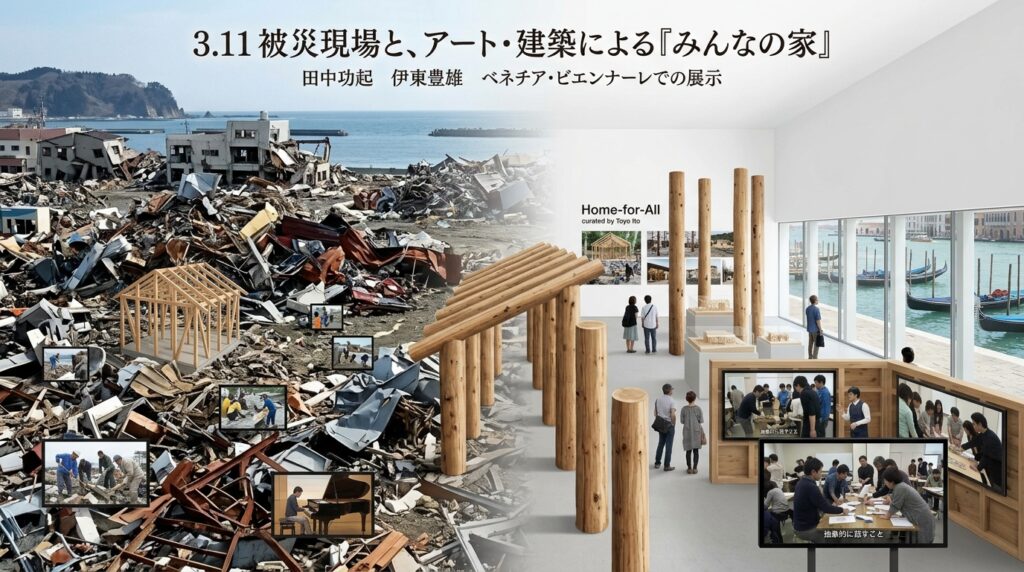
What was exhibited was a record of the design process for “Home-for-All,” a temporary community center built in Rikuzentakata, a city that had lost its town to the tsunami.
“Home-for-All” was jointly designed by four architects(Toyoo Itou(伊東豊雄), Kumiko Inui(乾久美子), Sou Fujimoto(藤本壮介), and Akihisa Hirata(平田晃久))in response to a call from Toyoo Itou(伊東豊雄). Photographer Naoya Hatakeyama(畠山直哉), who was from Rikuzentakata, also joined the project, and the building was constructed through discussions with local residents. Nineteen Kesennuma cedar trees that had died standing because of salt damage from the tsunami were used as pillars, and the building was constructed through donations from individuals and organizations in Japan and abroad, including Hidetoshi Nakata(中田英寿). A total of 16 such buildings were constructed throughout Tohoku as part of the overall project.
This Japanese Pavilion won the highest honor, the “Golden Lion Award(金獅子賞/Best National Participation Award).”
Here is an explanatory video summarizing the background and significance of this project.
It describes a shift away from top-down architecture that “gives” something to people toward architecture that is “created” together with the community.
In 2013, at the Japanese Pavilion of the Venice Biennale International Art Exhibition, headed by Koki Tanaka(田中功起), materials such as the log pillars and stools used in Toyoo Itou’s(伊東豊雄)exhibition the previous year were intentionally carried over and reused. It seems to have been intended as a symbolic passing of the baton from architecture to art, with the theme of “the earthquake disaster and collaboration among people” being handed on.
(https://artyokota.com/wp-content/uploads/2026/09/Gemini_Generated_Video.mp4%22][/video)]2013: What Koki Tanaka(田中功起) Exhibited(International Art Exhibition・Japanese Pavilion)
First, there is one important point to confirm. This exhibition was a different edition from the 2012 Architecture Exhibition(the International Art Exhibition held the following year), and the awards were also separate. In 2012, it was the Golden Lion Award at the Architecture Exhibition; in 2013, it was a Special Mention at the Art Exhibition. These two are often confused.
The 55th Venice Biennale International Art Exhibition(2013).
The Japanese Pavilion was a solo exhibition by Koki Tanaka(田中功起)(curator: Mika Kuroya(蔵屋美香)).
The title was “abstract speaking - sharing uncertainty and collective acts.”
The exhibition consisted of works such as these:
- “Nine barbers simultaneously cutting one person”
- “Five pianists simultaneously playing one piano”
- “Five poets simultaneously writing one poem”
- “Five ceramic artists silently making one pot”
In other words, these are video records of strangers attempting to do one thing together at the same time. There were also records of small experiments, such as talking about their own names while eating emergency food and walking along a road at night while waving flashlights.
Therefore, these were not works that directly depicted 3.11.
However, the curator’s explanation describes the exhibition as an attempt to indirectly ask what “collaboration” means in a society after the earthquake disaster.
The award was a “Special Mention(特別表彰).”
The reason given for the award was “for a poignant reflection on collaborative work and its failures.”
At the venue, some of the log pillars and display stands used in the Japanese Pavilion of the previous year’s 2012 Architecture Exhibition were also reused. This created a symbolic connection based on the significance of carrying over the same earthquake-disaster theme from the Architecture Exhibition.
Between Strategy and Aesthetics — Contemporary Art’s “Cleverness” and the ‘Flowers’ That Bloom Amid Disaster
Contemporary Art as Strategy — Koki Tanaka(田中功起) and the “Cleverness” of Venice
The owner of the gallery Aoyama|Meguro, who had become independent from Mizuma Art Gallery, was energetically trying to promote Koki Tanaka(田中功起)—that was what first made me pay attention to Tanaka.(However, I could not confirm any source supporting the claim that the owner of Aoyama|Meguro had come from Mizuma Art Gallery. This is an impression based on my memory. I was able to confirm that Aoyama|Meguro moved to its present address in 2007 and that its owner is Hideki Aoyama(青山秀樹) Source)
Tanaka, who graduated from the Department of Painting at Tokyo Zokei University in 2000 and completed the master’s program at the Graduate School of Fine Arts, Tokyo University of the Arts, in 2005 Source, struck me at the time as a contemporary artist skilled at creating conceptual works that would appeal to judges, much like Yutaka Sone(曽根裕).
Then, on March 11, 2011, the Great East Japan Earthquake occurred.
My premonition that “the next Japanese Pavilion at the Venice Biennale will surely take as its theme communication with disaster victims, collaborative work, and fieldwork exploring what volunteers and artists can leave behind, and they will aim for an award” turned into a certainty.
Koki Tanaka(田中功起) was selected to represent Japan at the Japanese Pavilion of the 55th Venice Biennale in 2013.
The curator was Mika Kuroya(蔵屋美香) of the National Museum of Modern Art, Tokyo. The exhibition was titled “abstract speaking - sharing uncertainty and collective acts(抽象的に話すこと ― 不確かなものの共有とコレクティブ・アクト),” and it was organized by the Japan Foundation Source.
I was absolutely convinced that they were going for the award and that they would definitely win one.
And the Japanese Pavilion received a Special Mention(特別表彰) Source.
I see it as a cunning, even crafty strategy, and an inevitable tactic: backed by a gallery, the exhibition captured the demands of the times(3.11)and achieved a result at an international exhibition, demonstrating an understanding of the criteria by which such exhibitions are judged.
(However, the claim that “the gallery’s backing directly led to the award” is my speculation, not a confirmed fact. Also, the exhibition itself did not directly address the earthquake disaster Source。)
Even so, at the same time, I could not suppress a feeling resembling an amused, slightly bitter smile: “How incredibly clever of him.”
I imagine that exhibitors and people involved in the Venice Biennale from other countries may have felt the same way.
“Well, of course.”
“I’ll Surpass Takashi Murakami(村上隆)” — Young Ambition and the Reality of the Profession
After Tanaka won the award, while researching him, I remember coming across an anecdote.
Apparently, at a party for a Takashi Murakami(村上隆) exhibition, Koki Tanaka(田中功起) confronted Murakami like a “no-nonsense terrorist”, much like Riki Choshu(長州力) or Yoshiaki Fujiwara(藤原喜明) of New Japan Pro-Wrestling, and took him on.
“I’m going to surpass Murakami-san. I’m going to overtake him soon!”
Murakami, a sensible man who was suddenly confronted in this manner,
is said to have admonished him: “What are you doing, suddenly coming up to me like this? Isn’t that rude?”
It is said that Tanaka, who later won an award in Venice, directly apologized for his immature and presumptuous behavior at the time.
I remember seeing this in an online article, so if it was not true, I apologize. But I remember that this is what happened.
If I were to speculate on this, the path toward exhibiting at Venice may already have been visible to some extent before 3.11.
So, what would I do if I were approached and told, “Would you like to create a work as Japan’s representative at Venice?”
There would be only one answer: “Of course I’d accept!”
Former professional baseball player Isao Harimoto(張本勲)said during his lifetime, as he wrote in his book *The Strongest Batting Power: A Batter’s Character Is Determined by Numbers*(『最強打撃力 バットマンは数字で人格が決まる』), regarding trying his hand at Major League Baseball, “Even so, I’d go. Because the salary is ten or fifteen times higher” Source(Harimoto died at the age of 86 on September 9, 2026 Source Source)。
If you win an award at Venice, offers will undoubtedly flood in from galleries and curators around the world from that very moment, and the prices of your works will jump several times over, perhaps even dozens of times.
But the problem is whether you can endure continuing to create works that fit a “political and social context” in order to win awards, even though they are not really what you want to create. Given my personality, I might give up halfway through. Even so, I would try somehow to find a point of compromise.
Even if I managed to see it through, would I end up completely exhausted, or would I end up shouting and having a furious argument with the commissioner or director?
What Do People Seek Amid Rubble and on the Battlefield?
If I were placed in the same position, I believe I would create “beautiful things” like the Japanese painter Hiroshi Senju(千住博)presented after disaster, rather than creating expressions intended as protests against the government or administrative authorities.
Hiroshi Senju(千住博)looked back on the period after 3.11, saying, “Everyone in Japan had been hurt. Artists, too, were dispirited, thinking, ‘Perhaps we are powerless,’” and he said that his series of cliffs and waterfalls emerged from that shock
Source.
As part of reconstruction support for disaster-affected areas, there were projects centered on Mt. Fuji, great trees, springs, and deer, and for the great-tree works, a project was also undertaken to solicit designs for “flowers” from across Japan Source.
Even with regard to the ongoing tragedy in Gaza, I cannot make it my own method to directly depict the brutality of the scene and protest against Israeli Prime Minister Benjamin Netanyahu or the United States.
It is unbearable to be confronted every day with the reality that “human nature can be this cruel and ugly—indeed, a hundred million times more foolish and evil than any animal.”
It is precisely because there is “nothing beautiful.”
I have a work titled “The Wealthy Sometimes Long for War,” but it took me nearly three years to paint.
That is because I did not want to look at the weapons and scenes of combat that I was painting, and every time I faced the canvas, I would avert my eyes in less than 30 seconds.
Stopping the Mind Through ‘Flowers’ and Zen Is an Effective Form of Resistance
For example, if a Japanese ikebana “flower” were presented on a table, Prime Minister Benjamin Netanyahu, National Security Minister Itamar Ben-Gvir, and Finance Minister Bezalel Smotrich, who constantly set out their logic of slaughter and self-preservation, would probably destroy it instantly with their hands while continuing to talk toward the cameras.
Those in power who repeatedly carry out destruction and killing would brush it aside with their hands as “something like this” and continue talking breathlessly about politics and methods of self-preservation.
As for works protesting Israel and the United States, rather than creating works objecting to the disaster itself or to the government’s or prefecture’s administrative policies and responses, I would create “beautiful things,” just as the disaster victims told Hiroshi Senju(千住博).
For example, paintings or installations of ikebana created through my own artistic practice.
As I wrote above, I cannot bear, as my own method, to directly depict Gaza and protest against Netanyahu, Israel, and the United States.
I do not want to look every day at the question of how ugly disasters and human beings can be, and to be told that this is simply human nature.
When disaster victims say, “I want to see beautiful things” and “I want to see beautiful works of art,” this is precisely what they mean. There is absolutely no doubt about it.。
Amid battlefields and ruins, mountains of rubble, and scenes writhing with suffering and despair, what people want to see is a “flower.”
And to show the world Netanyahu, Itamar Ben-Gvir, and Bezalel Smotrich looking at that “flower,” brushing it aside with their hands as “something like this,” and then endlessly talking breathlessly about ways of preserving their political power and their own survival—is that not the true form of resistance?
The fact that their minds never stop, that their thoughts are endlessly consumed by their own survival, power struggles, money, and the passions for praise, while they ceaselessly communicate with one another in Hebrew—a postwar artificial language created by scholars—is, I believe, the “lack of education” of an artificial group of people that should bring them profound shame before the world.
A group whose history is only about 90 years long, and which has no long-standing literary or other cultural traditions outside the Bible, and whose origins are ambiguous.
Afterwards ①: What Happened to “Home-for-All” in Rikuzentakata?
While the temporary housing complex was still in use, the two-story building equipped with a kitchen was used by local residents as a community gathering place and a place for relaxation.
In 2016, it was dismantled because of the “land-raising construction” that was one of the central projects of reconstruction. Through the reconstruction project itself, “Home-for-All” disappeared for a time.
However, its components(including the Kesennuma cedar pillars)were not discarded and were preserved.
Then, in 2022, it was rebuilt in the central urban area near Rikuzentakata Station, centered around Akihisa Hirata(平田晃久). Next to it, a prepared-food takeout shop called “Wawarowa(和笑輪)” was newly established, and the site began a new life as an eat-in space, resting place, and place for passing on the memories of the earthquake disaster. The cost of reconstruction was supported by the city’s relocation compensation and donations from Hidetoshi Nakata(中田英寿)and others.
However, the observation tower and balcony, which are more than 10 meters high, could not obtain metal flooring materials, so approximately 2 million yen in donations were solicited, and the building was completed “with the floor left unfinished for the time being.” The maintenance of this “building that attracted the attention of the world” ultimately depends on the hands of local people and donations.
Afterwards ②: The Idea of “Home-for-All” Spread to Kumamoto
Kumamoto Prefecture incorporated the idea of “Home-for-All” from the Great East Japan Earthquake as part of the Kumamoto Artpolis project.
Then, following the Kumamoto Earthquake(2016), all 84 communal rooms and meeting halls in 110 temporary housing complexes containing 4,303 housing units were developed as wooden “Home-for-All” buildings.
Of the eight buildings constructed in large-scale complexes with more than 80 housing units, Itou(伊東)himself selected the architects, and the designs were developed through workshops with residents.
After the temporary housing complexes were closed, the buildings were relocated to community centers, after-school children’s clubs, and other facilities, where they continue to be used.
“Did the Award Promote Reconstruction?” — Let Me Be Honest Here
On the Internet, people sometimes say that “reconstruction progressed thanks to the award,” but the records that can actually be confirmed are somewhat more cautious.
- What can be confirmed: The practice of Toyoo Itou(伊東豊雄)and others—that temporary housing complexes need places where people can easily gather—was institutionalized as a project of Kumamoto Prefecture and spread to all 84 buildings. Even after the buildings were dismantled, their components were passed on, and ten years later one was rebuilt in the city center.
- What cannot be confirmed: A causal relationship such as the Golden Lion Award increasing donations or accelerating reconstruction. None of the primary sources I examined this time(official blogs of the organizations involved, local newspapers, and Kumamoto Prefecture)contained such a statement. Kumamoto Prefecture’s materials mention “a proposal by Mr. Itou” but do not mention the award.
In other words, it was not that “reconstruction progressed because the project won an award.” Rather, the practice itself—continuing dialogue on the ground and creating buildings together—became a model for the next disaster.
The award provided an opportunity to communicate that practice to the world. The actual force that drove reconstruction was not Venice, but Rikuzentakata and Kumamoto.
Did the “Zero Landmine Song” Change the World? — 25 Years After ZERO LANDMINE: Confirmed Results and Unconfirmed Effects
Introduction: 25 Years Since That Song
In my previous article, I quoted these words by Ryuichi Sakamoto(坂本龍一):
“Even if people criticize it as hypocrisy, if it makes society even a little better, then I think that’s fine. Whether it is my efforts toward ecology or my activities after the earthquake disaster, they are supported by that belief.”
A concrete example often cited in connection with these words is the 2001 “Zero Landmine Campaign” and the charity song “ZERO LANDMINE.”
There is a commonly repeated story: “Thanks to this event, awareness of and opposition to landmines increased around the world, donations for demining increased, and even the attitudes of national leaders and militaries changed.”
Now, 25 years later, is that really true? Let us separate the results that remain in the records from the effects that do not, and examine them.
What Was ZERO LANDMINE?
First, let me lay out the basic facts that can be confirmed.
- Trigger:The “Zero Landmine Campaign” was carried out as a commemorative project for the 50th anniversary of the founding of TBS.
The organizing body was the “Zero Landmine Campaign Committee,” whose members included TBS, Warner Music Japan, Nichion, and the NGO AAR Japan(Association for Aid and Relief, Japan).
- Program:On April 30, 2001, a special live program, 『Zero Landmine: The First Prayer of the 21st Century(『地雷ZERO 21世紀最初の祈り』)』, was broadcast on the TBS network(simultaneously across 28 JNN stations).
- Song:At the initiative of Ryuichi Sakamoto(坂本龍一), the charity unit “N.M.L.(NO MORE LANDMINE)” was formed, and the single “ZERO LANDMINE” was released on April 25, 2001. Musicians from Japan and abroad gathered for the project, and in Mozambique, a mine-clearance headquarters was temporarily converted into a recording studio, where the recording itself took place.
- Hit:“ZERO LANDMINE” debuted at No. 1 on the Oricon weekly singles chart dated May 14, 2001, and remained No. 1 for two consecutive weeks. It ranked No. 28 for the year.
- Flow of money:All proceeds from CD sales were donated and used for mine clearance. Warner Music Japan presented the Zero Landmine Campaign Committee with a certificate of donation for “approximately 100 million yen confirmed to date.”
The donations were entrusted through AAR to the British specialist mine-clearance organizations “The HALO Trust” and “MAG,” and were used for mine-clearance operations in Cambodia, Angola, Georgia, and Mozambique.
The program was broadcast, the song reached No. 1 on Oricon, all proceeds were donated, and the money was used for mine clearance in four countries—everything up to this point can be confirmed as fact through records.
Now let us turn to the questions.
Verification ①: Did Opposition to and Awareness of the Danger of Landmines Increase?
There is no doubt that in Japan in 2001, the landmine issue became familiar to people on an unusually large scale.
The fact that a charity song debuted at No. 1 on Oricon also means that the landmine issue occupied the top of Japan’s music charts for several weeks.
I believe there is no doubt that there was a moment when the issue became visible throughout Japan and people’s awareness was collectively illuminated.
However, the difficult question comes next.
In my research this time, I could not subsequently verify the state of “increased awareness” with numerical data. I could not find comparative data with awareness surveys from the time, nor research connecting the campaign with changes in public awareness, within the range I examined.
Furthermore, the current situation in the world is severe.
According to the latest report by the landmine and explosive ordnance monitoring organization(Landmine Monitor 2025), 6,279 people were killed or injured by landmines and explosive remnants of war during 2024, and 52 countries and territories are still affected. The countries with the highest numbers of casualties were Myanmar(2,029), Syria(1,015), Afghanistan(624), Ukraine(293), and Yemen(247).
Countries using anti-personnel mines include non-signatories to the treaty such as Myanmar, Russia, Iran, and North Korea.
In other words, something that the world supposedly agreed 25 years ago to “reduce from now on” is once again spreading.
“Opposition and awareness” do not simply remain once they have risen. Unless they are maintained across generations, they do not survive on their own—that is the reality of the 2020s.
Verification ②: Did Awareness of Mine Clearance and Donations Increase?
This is the area where the results are most clearly visible.
- The donations existed:All of the proceeds from CD sales and the donations received were actually used for mine clearance in four countries.
- An example of the results:In Mozambique, one of the areas where campaign funds were used, “zero landmines” was achieved in September 2015. Landmines were eliminated from a country that had once been one of the world’s most heavily mined countries.
- The donation channel continued for approximately 19 years:The financial reports of the Zero Landmine Campaign Committee remain available from April 2001 through March 2020. In other words, the campaign did not end as a one-off event; a channel for receiving donations continued to exist for nearly 20 years.
At the same time, there is a point that should be stated honestly. I did not find comparative data showing that “donations increased compared with before the campaign.” We can confirm that the campaign created approximately 100 million yen in donations from zero and that these donations were converted into actual mine-clearance operations on the ground. Beyond that, however, there is insufficient data to speak of an “increase.”
It should also be accurately noted that the figures often cited for Mozambique’s mine-clearance achievements(The HALO Trust employing more than 1,600 local staff, making more than 17 million square meters of land safe, and removing 171,000 landmines)represent the organization’s overall achievements in Mozambique and were not accomplished solely through donations from the Zero Landmine Campaign.
The campaign’s funds were one source of support within this much larger process.
Verification ③: Did the Attitudes of National Leaders and Militaries Change?
There is a “time trap” here that is easy to overlook.
The international treaty banning landmines, the Anti-Personnel Mine Ban Convention(Ottawa Treaty), opened for signature in December 1997 and entered into force on March 1, 1999, after ratification by 40 countries. Japan signed it on December 3, 1997, and ratified it on September 30, 1998.
In other words, both the treaty and its ratification came before ZERO LANDMINE.
The claim that “this campaign moved countries and led to the creation of the treaty” does not hold up chronologically.
What the campaign did was contribute to the “dissemination and funding” that came after the treaty had been created. I think this distinction is important.
So, did awareness after the treaty proceed in the right direction? Here too, there is a significant headwind.
Citing changes in the security environment following Russia’s invasion of Ukraine, five European countries—Estonia, Latvia, Lithuania, Poland, and Finland—decided in succession during 2025 to withdraw from the Ottawa Treaty(Estonia and others announced their withdrawal on March 18, and Finland also announced preparations for withdrawal on April 1). There are 165 states parties to the treaty, but the framework itself is now being shaken.
The greatest force driving the attitudes of leaders and militaries is not beautiful music or public-awareness campaigns, but the threat posed by neighboring countries—that is what Europe in 2025 seems to demonstrate. I could not find evidence that the campaign changed national leaders.
Even when attitudes change, they can change in a negative direction in an instant.
Conclusion: What the “Device” Can Leave Behind, and What It Cannot
On this website, I define art as follows:
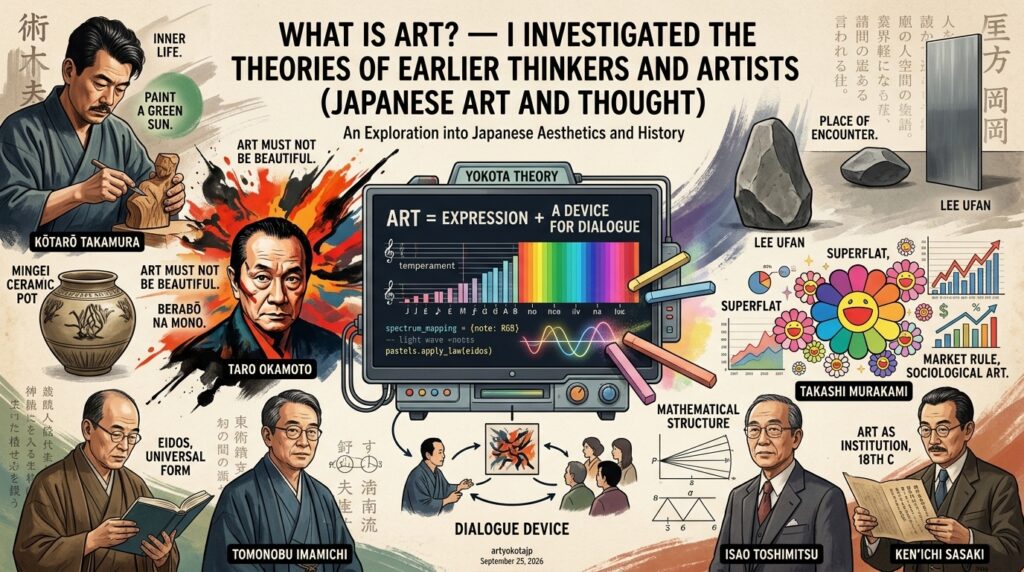
“Art is an expression of what one wants to say, and a device for generating dialogue and discussion!”
We have examined the power of this “device” through two examples.
The architectural project “Home-for-All”(Toyoo Itou(伊東豊雄)and others, Golden Lion Award at the Venice Biennale in 2012)and the musical project “ZERO LANDMINE”(produced by Ryuichi Sakamoto(坂本龍一), 2001).
First, let me talk about what the device could not leave behind.
There is no record anywhere showing that the “award” that brought Home-for-All to the world directly accelerated reconstruction in the disaster-affected areas.
ZERO LANDMINE reached No. 1 on Oricon and brought the landmine issue to the ears of people throughout Japan for several weeks.
However, I could not verify numerically whether people’s awareness had become “more enlightened.”
Now, 25 years later, the damage caused by landmines is actually expanding again, and European countries are withdrawing from the treaty. Awareness is not automatically saved. What moves leaders and militaries is not beautiful music or public opinion, but the threat of neighboring countries.
So, what can the device leave behind?
Architecture left behind a “place.”
The dismantled Home-for-All was preserved as components such as the Kesennuma cedar pillars, rebuilt in the city center ten years later, and its concept was reproduced in all 84 temporary housing complexes in the Kumamoto Earthquake as “Home-for-All.”
Koki Tanaka’s(田中功起)2013 exhibition also carried over the same question of “collaboration” from the perspective of art by borrowing materials from the previous year’s venue.
Music left behind “actual money and a channel.” A mechanism in which all CD proceeds were donated, actual funds totaling approximately 100 million yen, and a donation channel that continued for approximately 19 years. And in 2015, there was a verifiable achievement: landmines reached “zero” in Mozambique.
In other words, we can summarize it like this.
It is unknown whether the device was able to enlighten or improve people’s awareness.
What the device can preserve is a place, a form, actual funds—and a channel for passing them on to the next generation.
The land lost in an earthquake disaster does not return. How do we preserve a “place for dialogue” that was created once as a memory and pass it on to the next disaster? That was the answer found over these ten years.
As a result of making a song while saying, “Even if it is hypocrisy, if it makes society even a little better,” landmines were reduced in four countries and reached zero in one. A device that generates dialogue leaves something tangible behind in place of awareness that eventually fades.
That is what these two stories have taught us.
Again, art itself is not the same thing as the “communication” defined by Hiroshi Senju(千住博).
The examples discussed here are expressions of an intention aimed at improving relief for disaster victims and victims of harm, increasing our awareness of the psychological state of disaster victims, and of the tragic mindset of perpetrators of war; they are, in other words, “devices for promoting and generating communication,” are they not?
Is Art Powerless to Move Politics and Society?
The Proposition That “Music Cannot Change the World”
“Music cannot change the world, you know. Songs follow the times, but the times do not follow songs.”
These words spoken by Tatsuro Yamashita(山下達郎)on NHK-FM in 2022 express a sharp perspective on the limits of art. He went on to explain his own principle that music should remain music, and that he does not want to turn it into a tool for moving society as propaganda.
In fact, regarding the charity activities he actually carries out, he says that they are “not something to tell other people about” and that he simply continues doing them quietly Source.
Immediately after a major disaster, in the face of danger to life or intense physical pain, music and painting cannot directly satisfy hunger or heal wounds. In that sense, art is indeed powerless.
There is an artist who knows this “powerlessness” more painfully than anyone. Ai Weiwei(アイ・ウェイウェイ), the contemporary artist who has spent many years producing political works and has been detained by authorities, states this explicitly:
“Artists cannot stop wars.(omitted)In that sense, art might be said to be powerless.” Source
But if art were really nothing more than such a weak and powerless presence, a major contradiction would arise.
Why, then, have those in power throughout history feared and suppressed artists so intensely?
Why Do Those in Power Fear Art? — The “Influence” Shown by History
Looking back through history, it is clear that art possesses enormous “power” to change human consciousness and behavior.
- John Lennon(ジョン・レノン)and the FBI: John Lennon, who sang of love and peace and became a symbol of the anti-war movement, was persistently monitored and followed by the Nixon administration and the FBI, and even faced deportation proceedings by immigration authorities Source.
And in the end, he was killed by gunfire. If his songs had been merely “powerless,” there would have been no need for state authorities to establish a surveillance network.
- Hitler’s “Degenerate Art Exhibition”: Nazi Germany labeled avant-garde artists such as Wassily Kandinsky(ワシリー・カンディンスキー), Paul Klee(パウル・クレー), and Max Ernst(マックス・エルンスト)as “degenerate artists” and suppressed their work, holding a propagandistic exhibition in Munich in 1937 Source.
Kandinsky was forced to flee to France, while Klee was forced to emigrate to Switzerland Source.
Dictators understood very well that modern art, which generated diverse values, could threaten totalitarianism. - Dictatorships That Suppressed Words and Expression: The former Soviet Union stripped Nobel Prize-winning writer Aleksandr Solzhenitsyn(アレクサンドル・ソルジェニーツィン), who exposed the realities of the forced-labor camp system, of his citizenship in 1974 and expelled him to West Germany Source.
The Chinese Communist Party also imprisoned Nobel Peace Prize laureate Liu Xiaobo(劉暁波), who advocated democratization, and he died in prison in 2017 without being released Source.
- The Detention of Ai Weiwei(アイ・ウェイウェイ): Chinese contemporary artist Ai Weiwei(アイ・ウェイウェイ) independently investigated and documented victims of school buildings that collapsed in the Sichuan Earthquake because of shoddy construction(the so-called “tofu-dreg construction”), and developed his criticism of the political system through art Source.
As a result, he was arrested in 2011 on suspicion of tax evasion and detained for 81 days, and later was forced to move his base of operations abroad Source.
These facts demonstrate that artists and creative figures can possess enough influence as “educators” or “journalists” who awaken public consciousness to shake political power structures.
We should pay attention to the paradox that Ai Weiwei(アイ・ウェイウェイ)himself, who called art “powerless,” was in fact regarded as dangerous by the state precisely because he was influential.
As producers of “devices” that can change consciousness, artists must accurately recognize the influence they exert on society rather than being swept along by the discourse that “art is powerless.”
The Artist as an “Educator,” as Pointed Out by Jung
The psychologist Carl Gustav Jung(カール・グスタフ・ユング)left profound insights into the relationship between artists and society.
In Jung’s writings on literature and art, the artist is described as a person who “brings forth from the unconscious an archetype(primordial image)best suited to compensate for the biases and one-sidedness of the spirit of the age” Source.
Based on Jung’s perspective in this passage, an artist is “someone who scoops up, in the form of a work of art, what an era or society unconsciously seeks at the deepest level.”
Jung says that “the artist is the only person capable of expressing and presenting the truth and reality of things to the public without angering politicians or those in power,” and that when existing politics and power become rigid and society loses its psychological balance, the artist assumes the important responsibility of an “educator” who enlightens humanity by expressing the truth.
The mission of the artist is education, and the burden carried by the artist is heavy!
At times, this becomes a dangerous act that provokes the wrath of those in power—the history of suppression described above is evidence of that.
Even so, there is no one other than the artist who can present the essence of humanity and the deeper layers of an era as “universal expression” that transcends direct political confrontation.
Conclusion
Art may be powerless in the sense that it has no immediate effectiveness as a medicine that heals physical wounds.
However, as “spiritual infrastructure” that plants seeds deep within people’s consciousness, shakes political systems, and points toward the direction in which society should move, there is perhaps nothing more powerful.
The charity song for mine clearance 25 years ago and the exhibitions at the Venice Biennale after the earthquake disaster are both unquestionably situated within this vast historical context.
Click here for other pages in this series!
★【PartⅠ】 A Venice Biennale Award-Winning Exhibition Born from Large-Scale Disasters and War and the Controversy They Generated! — The “Trauma Olympics” and the Reality of International Art Exhibitions! 【See this page】
★【Part III】 A Venice Biennale Award-Winning Exhibition Born from Large-Scale Disasters and War In the Rubble and on the Battlefield, People Seek Flowers!【See this page】
★[Part IV] A Venice Biennale Award-Winning Exhibition Born from Large-Scale Disasters and War What Is Buddhist Enlightenment? — Exhibitions That Were Created from Large-Scale Disasters and War and Became the Focus of Attention at the Venice Biennale!【See this page】
Main Sources
- Japan Foundation(国際交流基金), “Japan Pavilion at the 13th International Architecture Exhibition of La Biennale di Venezia(第13回ヴェネツィア・ビエンナーレ国際建築展 日本館)” (2012, Golden Lion Award):jpf.go.jp
- Japan Foundation(国際交流基金), “Japan Pavilion at the 55th International Art Exhibition of La Biennale di Venezia(第55回ヴェネツィア・ビエンナーレ国際美術展 日本館)” (2013, Special Mention):jpf.go.jp
- 2013 Japan Pavilion Curator's Commentary(2013年日本館キュレーター解説)(Mika Kuraya(蔵屋美香), PDF):2013.veneziabiennale-japanpavilion.jp
- Official “Home For All” Blog(Home For All 公式ブログ)(Reconstruction and Request for Donations, 2022):home-for-all.org
- Tōkai Shinpō(東海新報), “Home-for-All Moves into the City Center: Reconstruction After Six Years(みんなの家まちなかへ 6年越しの再建)” (September 1, 2022):tohkaishimpo.com
- Kumamoto Prefecture(熊本県), “Home-for-All Relocation and Utilization Project(「みんなの家」移築利活用プロジェクト)”:pref.kumamoto.jp
- Kyushu Gihō No. 77(九州技報77号), “The Kumamoto Model(熊本モデル)” (description of the 84 facilities):k-keikaku.or.jp
- StoryNews, Interview with Toyoo Itou(伊東豊雄)(16 facilities in Tohoku, April 2023):storynews.jp
- Government Public Relations Online(政府広報オンライン), November 2017 issue (16 “Home-for-All” facilities):gov-online.go.jp
- OPENERS, “Japan Pavilion at the 13th International Architecture Exhibition of La Biennale di Venezia(第13回ヴェネツィア・ビエンナーレ国際建築展 日本館)”:openers.jp
- Wikipedia, “ZERO LANDMINE(ZERO LANDMINE)” (release date, chart rankings, and destination of proceeds):ja.wikipedia.org
- TBS, Official “Landmine Zero Campaign: 50th Anniversary of TBS Broadcasting(開局50周年記念・地雷ゼロキャンペーン)”:tbs.co.jp, and its financial reports:tbs.co.jp/repo
- TBS, “Donation Certificate for Approximately 100 Million Yen from Warner Music Japan(ワーナーミュージック・ジャパンから約1億円の寄付目録)”:tbs.co.jp/info_m
- AAR Japan [Association for Aid and Relief, Japan / 難民を助ける会], “Mozambique Achieves ‘Zero Landmines(モザンビークで『地雷ゼロ』を達成しました)’” (2015):aarjapan.gr.jp
- BARKS, Broadcasting information for the TBS 50th Anniversary Special Program “Landmine ZERO: The First Prayer of the 21st Century(地雷ZERO 21世紀最初の祈り)”:barks.jp
- Ministry of Foreign Affairs of Japan(外務省), “Overview of the Landmine Issue and the Convention on the Prohibition of Anti-Personnel Mines (Ottawa Treaty)(地雷問題・対人地雷禁止条約(オタワ条約)の概要)”:mofa.go.jp, and “Japan's Signature and Ratification(日本の署名・批准)”:disarm.emb-japan.go.jp
- Landmine Monitor 2025(Landmine Monitor 2025) (6,279 casualties in 2024 and countries using landmines):icblcmc.org, the-monitor.org
- Country-by-country breakdown of casualties (including 2,029 people in Myanmar): Human & Inclusive(ヒューマン&インクルーシブ)
- Human Rights Watch, “Five European States Withdraw from Mine Ban Treaty” (2025):hrw.org
- UK Parliament Research Briefing(英国議会研究資料) (Estonia and other countries announce withdrawal on March 18, 2025):commonslibrary.parliament.uk
- Landmine Monitor(Landmine Monitor) (Finland announces preparations for withdrawal on April 1, 2025):the-monitor.org