◆What Is Art? (Part IV)What Is Japanese Culture? Discovering the Characteristics of Japanese Art and Fine Art Through the Research of Earlier Scholars!

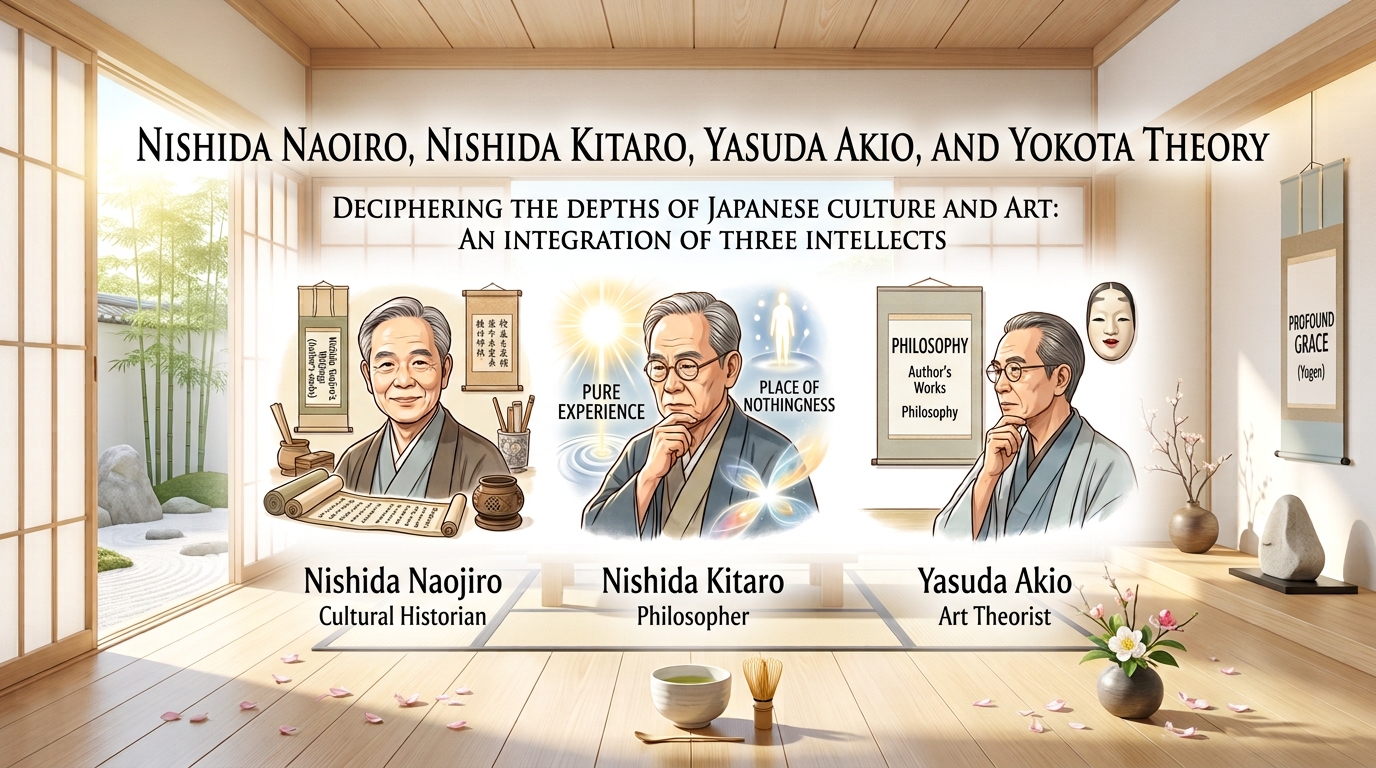
Nojirou Nishida(西田直二郎), Kitarou Nishida(西田幾多郎), Akio Yasuda(安田章生), and the Yokota Theory
What I was taught by my professor in the correspondence course “History of Japanese Culture” at Bukkyo University was the following way of thinking:
“To understand Japanese culture, first learn from Nojirou Nishida. Next, study Kitarou Nishida, and then, using that as your foundation, develop your own ideas and theories.”
So today, starting from this point, I would like to consider the questions, “What is Japanese culture?” and “What characteristics can be found in Japanese art and fine art?” using the research of earlier scholars as a guide.
① Nojirou Nishida(西田直二郎)――First, Understand Japanese Culture as a Whole
Biography and Profile
Born–died: December 23, 1886 (Meiji 19) – December 26, 1964 (Showa 39)
Place of birth: Osaka Prefecture
Education: Graduated from the Department of History, Faculty of Letters, Kyoto Imperial University (1910, first graduating class of the Department of History)
Career: Served successively as lecturer, associate professor, and professor at Kyoto Imperial University. Later became Professor Emeritus of Kyoto University
He was a historian who pioneered the teaching of “Japanese cultural history” in Japan and laid the foundations for modern Japanese cultural-history studies.
Through works such as his major book An Introduction to the History of Japanese Culture (1932), he developed a theory of cultural history influenced by scholars such as Wilhelm Dilthey and Jacob Burckhardt, seeking to understand the historical development of Japanese culture in a comprehensive and systematic manner.
The Innovation and Content of An Introduction to the History of Japanese Culture
Published in 1932 (Showa 7), this book was an important work that sought to understand Japanese history from the perspective of culture, in contrast to historical views that had previously focused primarily on “political history” and “the history of events.”
He Pioneered the Academic Field of “Japanese Cultural History”
It was Nojirou Nishida who began offering lectures on Japanese cultural history at Kyoto Imperial University.
His achievement in establishing the perspective of “cultural history” in Japan, in contrast to historical studies that had previously centered on philology or political events, was significant.
Nishida believed that one of the characteristics of Japanese culture was that it did not resist influences from foreign countries, but instead incorporated them as its own and further transformed them into something original.
This still applies remarkably well today, doesn't it?
In particular, the influx and adoption of American and European culture after World War II was enormous.
Even in contemporary Japanese, large numbers of foreign words, especially English words, have entered the language, and there are many expressions that have come to resemble a “mixture of English.” Japanese people also seem to have relatively little resistance to foreign languages. Haha.
② Japanese People Tend to Express Emotion and Sensibility Rather Than Reason and Logic――Keeping Things as Simple, Plain, and Concise as Possible
Takukai Etani, a professor at Bukkyo University, states the following on page 143 of his book An Outline of the History of Oriental Culture.
“In Japan, formal logic such as the Indian logic of Inmyo was accepted, but it did not develop. ……This was probably because of the Japanese character, which dislikes arguing over logic and dislikes quibbling over matters. The Japanese possess a traditional and inherent spirit that favors simplicity, conciseness, purity, and straightforwardness to the utmost degree.”
He states that one characteristic of Japanese culture is a tendency to prefer expressing emotions and sensibilities in a simple, plain, and concise manner rather than engaging in elaborate logical arguments.
This also appears to be presented as one way of understanding Japanese culture at Bukkyo University, and a similar idea is found in the textbook History of Oriental Culture.
For Japanese people who rapidly developed science and technology as an Asian nation both before and after World War II, achieved rapid economic growth after the war, and eventually became the world's second-largest economy in terms of GDP, this idea may not immediately resonate.
However, Japanese has expressions such as, “You're too argumentative. People will dislike you!”, “Don't make sophistic arguments!”, and “Regardless of the logic……” My parents' generation, people born in the early years of the Showa era, often used expressions like these.
Looking back, we can indeed see the characteristics of “simplicity, plainness, and conciseness” in Japanese cultural forms such as waka poetry, haikai poetry, the tea ceremony, gardens, and dry landscape gardens.
Even in architecture, rather than covering an entire space with golden decorations like a European palace, Japanese architecture might place paintings of hawks by the Kano school on sliding doors, while the rest consists of wooden pillars and beams, walls, and so on. Isn't this also the ultimate expression of simplicity?
③ Kitarou Nishida(西田幾多郎)――Next, Consider “Human Beings and the World”
Biography and Profile
Born–died: May 19, 1870 (Meiji 3) – June 7, 1945 (Showa 20)
Place of birth: Unoke Village, Kahoku District, Ishikawa Prefecture (present-day Kahoku City)
Education: Completed the special course in philosophy at the Faculty of Letters, Tokyo Imperial University (1894)
Career: After serving as a professor at Fourth Higher School and elsewhere, served successively as associate professor and professor at Kyoto Imperial University. Later became Professor Emeritus of Kyoto Imperial University
Kitarou Nishida(1870–1945)was one of Japan's leading philosophers.
He developed ideas such as “pure experience” and “place,” and in his later years proposed the important concept of “action-intuition.”
Here, seeing and acting, knowing and creating, are not separated from one another.
The self acts upon the world, while at the same time the world also shapes the self.
This “unity of action and intuition” is also important in artistic creation.
In other words, we do not merely look at the world; through our relationship with the world, we ourselves are also created. This is the philosophy that should be studied next.
I believe that the achievement of the philosopher Kitarou Nishida(founder of the Kyoto School)in his research into Japanese culture, and his contribution to taking that research further, lies in the fact that he “used Western logic and philosophy to translate and systematize the spirit of the East and Japan into language that could be understood throughout the world.”
While the historian Nojirou Nishida(西田直二郎)approached Japanese culture through historical processes and facts, the philosopher Kitarou Nishida(西田幾多郎)presented the underlying “way of seeing and logic” itself as philosophy.
Using his major work The Problem of Japanese Culture (1940) and other writings as clues, I would like to organize his achievements into three points.
1. Explaining Japanese Culture Through “the Logic of the World”――The Philosophical Development of Eastern Thought
Until then, discussions of Japanese culture tended to become subjective arguments based on emotion and intuition, such as “Japan is wonderful” or “Wabi and sabi are profoundly meaningful.”
After absorbing the sophisticated logical systems of Western philosophy, Kitarou Nishida sought to understand the Japanese and Eastern aesthetic sensibilities and Zen thought through the universal language of philosophy.
As a result, research into Japanese culture progressed from simply being an “explanation of local tastes and traditions” to becoming a philosophical field capable of engaging in dialogue with thinkers around the world.
2. Presenting the “Place of Nothingness” at the Foundation of Culture
We can understand Kitarou Nishida's idea that Japanese culture does not resist foreign influences but can incorporate them as its own by relating it to one of his representative philosophical concepts, the “place of nothingness.”
The concept of “nothingness,” or “absolute nothingness,” is important when considering the nature of Japanese and Eastern culture.
Keep the center “empty.”
This also overlaps with the explanation of Buddhism given by Jungian psychologist Hayao Kawai, who describes it in terms of there being “neither a scripture like the Bible nor a definitive doctrine; like the eye of a typhoon, the center is empty.”
The idea is that precisely because the center is not fixed, different ideas can be accepted and allowed to coexist.
Nishida's close friend was the Buddhist scholar Daisetsu Suzuki, and the two devoted themselves enthusiastically to zazen meditation.
It has also been argued that the ideas of Kitarou Nishida and Daisetsu Suzuki influenced the intellectual development of Hideki Yukawa and others who were also at Kyoto University.
Precisely because the center is empty, Buddhism, Chinese thought, Western science, and many other things can be accepted, freely combined, and used to create something new.
Nishida attempted to understand this “quality of accepting every form while having no fixed form itself, and then defining itself” through the concept of “absolute contradictory self-identity.”
This provides a philosophical clue for considering the mechanism behind the “power to transform what has been accepted from foreign countries into something original” that Nojirou Nishida(西田直二郎)pointed out.
3. A Perspective Toward a “Global Culture” Beyond Nationalism
From the early Showa period, when Nishida actively discussed Japanese culture, through the years of war, Japan was entering an era in which narrow nationalism centered on “Long live Japan!” was becoming increasingly strong.
Within this context, Nishida argued that it was necessary not merely to respect what was unique to Japan, but to develop it into a global culture.
As expressed in Nishida's words, “We must not be content with a culture for our own use. We must create a culture that is truly global.”
Rather than shutting itself away by boasting about the superiority of Japanese culture, there was a perspective that sought to create a global culture by making use of the distinctive characteristics of Japanese culture.
In other words, Japanese culture should not be closed off as a “special culture belonging only to Japan,” but reconsidered in relation to the wider world.
④ Akio Yasuda(安田章生)――“Yugen” and “Yosei”
Through a book by Hiroshi Senju, I came to know Japanese Theories of Art by Akio Yasuda(安田章生), published by Tokyo Sogensha.
The first edition was published by Tokyo Sogensha in 1957, and a new edition was published in 1972.
Mr. Senju states, “Much of my view of art owes itself to this book.”
So I read it, and I found it to be a truly fascinating and deeply rewarding book.
Its scope extends far beyond fine art, covering a wide range of artistic fields including calligraphy, flower arrangement, music, and literature.
And the two concepts that appear as important ideas across these various fields are “yugen” and “yosei.”
“Yosei” refers not only to what is directly expressed in a work, but also to the emotions, imagination, and meanings that remain in the viewer's mind after encountering the work and continue to expand from there.
This connects to the idea mentioned earlier: by creating works in a simple, plain, and concise manner and valuing empty space, what is not depicted can actually evoke new emotions and poetic sensibilities within the viewer.
This reminds me of the works of the Mono-ha artist Lee Ufan(李禹煥).
One of Lee's books is The Art of Empty Space, and his works include concepts such as “relatum.”
Lee is Korean, but through his activities in Japan he became deeply involved with Japanese aesthetic sensibilities, demonstrating a sensitivity that reduces expression to its essential minimum.
Then, what is “yugen”?
When we hear the word “yugen,” we may imagine the solemn and static world seen on the Noh stage. But it is not limited to that.
The meaning of the word “yugen” has changed depending on the period and context. In Japanese Theories of Art as well, various figures use the term “yugen” in different senses, making it difficult to understand the word as having one fixed meaning.
However, when we examine these various usages, we can understand it as a term referring not to simple beauty, but to a beauty possessing depth and implication, and to a profound aesthetic quality that cannot be fully expressed directly.
“Simplicity” Does Not Mean Poor or Weak Expression――An Aesthetic That Lets Empty Space Speak!
Japanese “simplicity” does not simply mean that there is nothing there.
Remove what is unnecessary and leave what is essential.
And leave what is not expressed to the viewer.
As a result,
Simplicity → Omission → Empty Space → Imagination → Yosei
a process like this emerges.
One of the important modern figures who clearly discussed this “beauty of simplicity” was Muneyoshi Yanagi.
In The Way of Craft, Yanagi argued to the effect that “simplicity is a major element of beauty in craftsmanship,” believing that profound beauty can arise from simplicity.
Therefore, I believe that the characteristic of Japanese beauty represented by “simplicity and conciseness” is one of the important concepts that has been discussed not only by Muneyoshi Yanagi but also by Nojirou Nishida and many other scholars.
An Integrated “Definition of Japanese Art”
Based on the theories of the scholars who came before us, which we have examined here, I believe that Japanese art can perhaps be defined as follows.
“Japanese art is an art that creates yosei and yugen through symbolism, omission, empty space, and simplicity, thereby bringing a second world into being within the mind of the viewer.
The work is an expression of a cultural spirit and, as a ‘place’ where the artist, viewer, and world interact with one another, it is a device that creates dialogue.”
This also deeply corresponds with my own definition of art,
“Art is expression and a device that creates dialogue.”
Even today, I am passionately devoted to creating small works that, through expressions reduced as much as possible to “simplicity, plainness, and conciseness,” evoke a wide variety of yosei—that is, poetic feeling and thought.
★ [Appendix] Theories of Art from the Heian Period to the Edo Period!
I have researched and compiled theories of art and fine art from the Heian period through the Edo period. Please use this as a reference.
From here, I will examine how the essence of Japanese art has been embodied through representative works from each period.
Heian Period (794–1185)――An Era When Forms of Expression Connected to “Yosei” and “Yugen” Had Already Matured
```
The Heian period was an era in which the spiritual structure of Japanese art underwent significant maturation. Forms of expression connected to the aesthetic sensibilities later described as “yosei” and “yugen” also developed to a high degree during this period.
The Tale of Genji Scrolls
- Compositional use of empty space
- Guiding the viewer's gaze through the “blown-off roof” technique
- Expression that suggests emotions indirectly rather than depicting them directly
The facial expressions of the figures are depicted in detail, but their psychological states are not explained through words. Instead, they are suggested through composition, color, empty space, and the flow of the gaze.
The viewer,
- imagines the emotions that are not depicted,
- fills in what came before and after the story, and
- overlaps the work with their own experiences.
At that moment, a “second world” arises outside the work itself. This is what I mean by “yosei.”
Choju-jinbutsu-giga
- Symbolic expressions through the personification of animals
- Omission of lines and a sense of dynamism
- A composition in which empty space creates movement
Here, rather than detailed depiction, the force and rhythm of the lines are emphasized.
- Omission of lines
- Omission of backgrounds
- Use of empty space
These elements stimulate the viewer's imagination and create an “undepicted world” within the mind.
In these works from the Heian period, we can see forms of expression that connect to important characteristics of Japanese art later described as “yosei” and “yugen.”
```
```
Kamakura Period (1185–1333)――The Sense of Life and Volume in the Buddhist Sculptures of Kaikei and Unkei
Buddhist Sculptures by Kaikei and Unkei
- Rich, flesh-like volume
- Realism that conveys a sense of vitality
Here, we can see forms that possess both quiet spirituality and a powerful sense of life.
- Taut, muscular forms
- Rich bodily expression
- A vitality that seems to shine from within
Powerful vitality resides within calm expressions. This contrast between seemingly opposing qualities is also an interesting characteristic when considering Japanese art.
```
```
Muromachi Period (1336–1573)――Yosei and Yugen in Ink Painting and Noh
Sesshu “Long Landscape Scroll” and “View of Amanohashidate”
- Omission through ink painting
- Bold use of empty space
- A structure in which the viewer “completes” the landscape
In landscape painting, rather than depicting everything realistically, variations in the density of ink and empty space allow a landscape to arise within the viewer's mind. This is an important example for understanding the concept of “yosei.”
Noh(Zeami)
- Theorization of yugen
- Abstraction of movement
Zeami treated “yugen” as an important concept when discussing the beauty of Noh.
- Slow movements
- Few words
- A quiet stage
Within these elements resides a powerful spirituality and vitality. Rather than expressing everything directly, the restrained style of expression creates a profound aesthetic quality. Here we can see one aspect of yugen.
```
```
Momoyama Period (1573–1603)――The Beauty of Mist and Volume in Tohaku and Eitoku
Hasegawa Tohaku “Pine Trees in a Mist” Folding Screen
- Empty space created by mist
- Symbolic representation of pine trees
- A sense of vitality hidden within tranquility
Most of the picture surface consists of empty space that appears to be enveloped in mist. The forms of the pine trees are not rendered realistically down to the smallest details, but are instead expressed symbolically.
The viewer,
- imagines the landscape within the mist,
- reads meaning into the forms of the pine trees, and
- overlaps the work with their own emotions.
Here we can see yosei created through empty space, as well as the yugen-like aesthetic quality that cannot be fully explained directly.
Kano Eitoku “Chinese Lions” Folding Screen
- Magnificent volume
- Rich bodily expression
The bodies of the lions are rich and powerful, possessing an overwhelming presence. In contrast to Tohaku's “Pine Trees in a Mist,” this work can be seen as demonstrating volume and vitality in Japanese art from a completely different direction.
```
```
Edo Period (1603–1868)――The Development of Yosei and Yugen in Rinpa, Ukiyo-e, and Hokusai
Rinpa(Sotatsu, Korin, and Hoitsu)
- The beauty of empty space
- Symbolization of forms
- The fusion of ornamentation and simplicity
In works of the Rinpa school, empty space, simplified forms, and symbolic compositions are combined to produce refined ornamentation and yosei.
Ukiyo-e(Utamaro and Sharaku)
- Flesh-like depiction of human figures
- Abundance and sensuality
In ukiyo-e, bold ways of capturing the bodies and expressions of people developed, and a distinctive aesthetic sensibility spread even within the popular culture of Edo.
Hokusai “Thirty-Six Views of Mount Fuji”
- Bold compositions
- Symbolically represented nature
- Empty space that stimulates the viewer's imagination
Hokusai depicted nature not merely as scenery, but as something possessing powerful composition and symbolism. His bold compositions and use of empty space generate images in the viewer's mind that go beyond the work itself.
Click here for other pages in this series!
◆What Is Art? (Part I) — Art Is an Expression of What the Artist Wants to Communicate, and a Device for Provoking Dialogue and Debate! (Part I)【Go to this page!】
◆What Is Art? (Part II)— I Investigated the Theories of Earlier Thinkers and Artists: Examining the Originality and Validity of My Definition【Go to this page!】
◆What Is Art? (PartⅢ ) Japanese Art and Thought)— I Investigated the Theories of Earlier Thinkers and Artists【Go to this page!】