★【PartⅠ】 A Venice Biennale Award-Winning Exhibition Born from Large-Scale Disasters and War and the Controversy They Generated! — The “Trauma Olympics” and the Reality of International Art Exhibitions!

 Many of you may be familiar with the Japanese painter Hiroshi Senju(千住博). He is internationally known for his majestic paintings of waterfalls and, in 1995, became the first Asian artist to receive an Honorary Mention at the Venice Biennale (his award-winning work was The Fall). Coincidentally, this was the same year as the Great Hanshin-Awaji Earthquake.
I am now going to discuss in greater depth Hiroshi Senju’s definition of art, which I also mentioned in my previous article. But first, there is one thing I would like you to understand clearly, so that there is no misunderstanding.
Two Japanese Contemporary Artists Who Illuminate My Future: Hiroshi Senju and Takashi Murakami(村上 隆)
I have consistently held Hiroshi Senju in high regard as one of Japan’s leading contemporary artists, without any criticism whatsoever of his works.
When I saw his waterfall painting that had won an award at the Venice Biennale at a department store in Sapporo, I remember thinking, “What an incredible painter has appeared! At last, a Japanese painter has emerged who can break through the murky ceiling and express something that seems to soar beyond it. It is like the shock of the Nissan R32 Skyline GT-R, which had just appeared at the time and stunned everyone. It dominated the races, and the commentator exclaimed, ‘A torque-split 4WD. Whether it is accelerating or cornering, an incredible car has appeared!’”
Therefore, my praise for Hiroshi Senju has not changed to this day, and I have absolutely no personal criticism of him, apart from my disagreement with his definition of art.
I would like you to understand this not as criticism of Hiroshi Senju, but as a “challenge” or “counterargument” to his ideas.
At that time, I had just begun dating my present wife. We went to see the exhibition together, and when I asked her what she thought, she said, “I thought this person could become your rival. That’s great, isn’t it?”
At the time, I had left vocational school and had begun seriously pursuing a career as a painter. I considered myself a genius, but I could not find any painter in Japan whom I regarded as my rival, and as a result I was always struggling to find sufficient motivation.
Takashi Murakami(村上隆) had not yet established himself as either a major artist or an unknown quantity. Several years later, on an NHK special program hosted by Senju, titled something like “Explaining the Current State of Contemporary Art in the World,” Senju introduced Murakami by saying, “There is a Japanese painter named Takashi Murakami who believes that artists should also engage in self-branding. He has created a character called ‘Dob-kun(ドブ君)’ and is trying to promote himself through it. It is quite an interesting experiment, isn’t it?”
As for Takashi Murakami, whom Senju had once said, “I have absolutely no intention of recognizing such an imitation of Japan’s high-quality anime” (even though they were graduates of the same Japanese Painting Department at Tokyo University of the Arts!), it was several years later that Murakami suddenly shot past everyone, like an ultra-fast tortoise driving an F1 car, when his figure Hiropon(ヒロポンちゃん) sold at auction for 1.6 billion yen.
From there, I believe Murakami’s philosophy of Superflat(スーパーフラット) gradually became known throughout Japan.
Well... since then, Hozu (山本 豊津) Yamamoto, representative of Tokyo Gallery, has been comparing Takashi Murakami with me for more than ten years. So, my rival today is, after all, Takashi Murakami.
And that makes me extremely happy.
King Sadaharu (王 貞治)Oh had Shigeo Nagashima(長島 茂雄), and Nagashima had Oh. Antonio Inoki(アントニオ猪木) had Giant Baba. Ayrton Senna had Alain Prost.
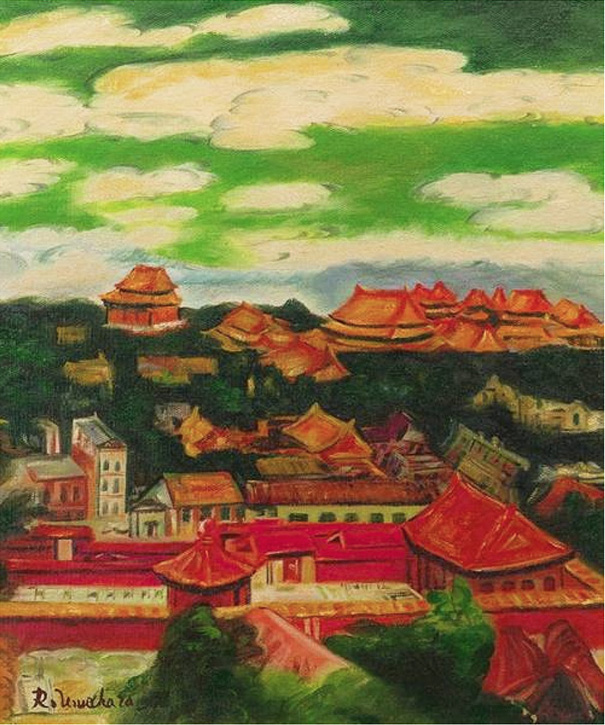
Ryuzaburo Umehara(梅原龍三郎) had Sotaro Yasui(安井曽太郎).
In the manga Star of the Giants(読売巨人軍), Mitsuru Hanagata (花形満)had Hyuma Hoshi(星 飛雄馬).
And in Lupin the Third(ルパン三世), Inspector Zenigata(銭形警部) had Lupin.
At the end of the series, when Inspector Zenigata finally captures Lupin and has him imprisoned, Zenigata loses his purpose in life and sheds tears.
He is almost like a fiercely dedicated salaryman who has suddenly reached mandatory retirement.
In any case, these two artists have shown us just how high Japanese artists can climb in the world of art through their own efforts.
For that, I am truly grateful.
They are my hope, the lanterns illuminating the cave ahead of me.
Truly!
I would like to add just one point.
I think that Hiroshi Senju benefited from receiving the Venice award and subsequently being offered much larger opportunities, but perhaps he became so attached to that award that, in the end, he was unable to completely shed and abandon the waterfalls, even to this day.
Once you remain committed to waterfalls, the natural next step is to add color and create variations.
But because the possibilities for creating subjects and motifs are infinite, I have always wondered whether this became a kind of constraint that prevented him from moving in the direction of continuing to innovate toward infinity.
Takashi Murakami did not win an award at Venice.
But perhaps, precisely because he did not, he gained the freedom and lightness that allowed him to act without being bound by such expectations.
Picasso, Matisse, Kandinsky, Klee.
There has never been a painter who became a great international master of art and entered history simply because winning awards made him famous.
Isn’t that so?
Over the past forty years, including Venice, I believe it was inevitable that the value of awards at all kinds of contests and competitions gradually declined.
I confirmed this not only with Yutaka Yamamoto, representative of Tokyo Gallery, but also with several other gallery owners, including Shugo Satani (佐谷周吾 シューゴアーツ Syugo arts).
The general response was essentially: “Even if a critic tells us that this artist is good and that we should represent them, that is none of their business. There is no reason why we have to handle the artist just because they say so.”
“Of course, it does make it easier to sell the work.”
That was why I stopped submitting my work to competitions from that point onward.
After the Great East Japan Earthquake, Hiroshi Senju Recalled an Experience When He Visited Temporary Housing in the Disaster-Stricken Area
Senju recalled the experience as follows:
「その時に僕が驚いたのは、仮設住宅の人たちに何がほしいか聞くと、美しい絵がみたいって話されたんですよ。これが人間なんだなって僕は思ったんですね」
“What surprised me at the time was that when I asked the people living in the temporary housing what they wanted, they said that they wanted to see beautiful paintings. That was when I thought, ‘This is what it means to be human.’”
In an extreme situation where people lacked even the basic necessities needed to survive, what they wanted was a “beautiful painting.”
This formative experience deepened Senju’s conviction about the power of art, and he came to say:
「国境を越えて人を感動させる力があるなら、その芸術作品は世界的なコミュニケーションの手段になりうる。私はそう信じているんです」
“If an artwork has the power to move people across national borders, then that artwork can become a means of global communication. That is what I believe.” (GQ Japan, 2015)
In his book If I Were to Talk About Art, he also describes art as “the wisdom that enables people to get along with one another.”
His definition is essentially: “Art = Communication.”
However, when we consider this definition and look at the forefront of contemporary art, including the world’s largest international art exhibition, the Venice Biennale, a question arises.
This time, I would like to think about that “reality.”
Examining the Claim that “Heavy Themes Are Bound to Be Highly Evaluated”
Held every two years in Venice, Italy, the international art exhibition brings together more than 90 countries and regions, each presenting its own national pavilion and competing for the highest award, the “Golden Lion.” It is regarded as the pinnacle of competition in the international art world.
Now, in online discussions and in the art world, one sometimes encounters a claim like this:
“Countries that deal with tragic themes such as disasters and war have a considerable advantage when it comes to winning awards at the Biennale.”
Is this really true?
Let us examine the question based on the official records.
| Year (Background) | Golden Lion (Highest Award) | Notes / Developments Concerning the Japanese Pavilion, etc. |
|---|---|---|
| 2011 (Year of the Great East Japan Earthquake) | German Pavilion | The Japanese Pavilion did not receive an award. |
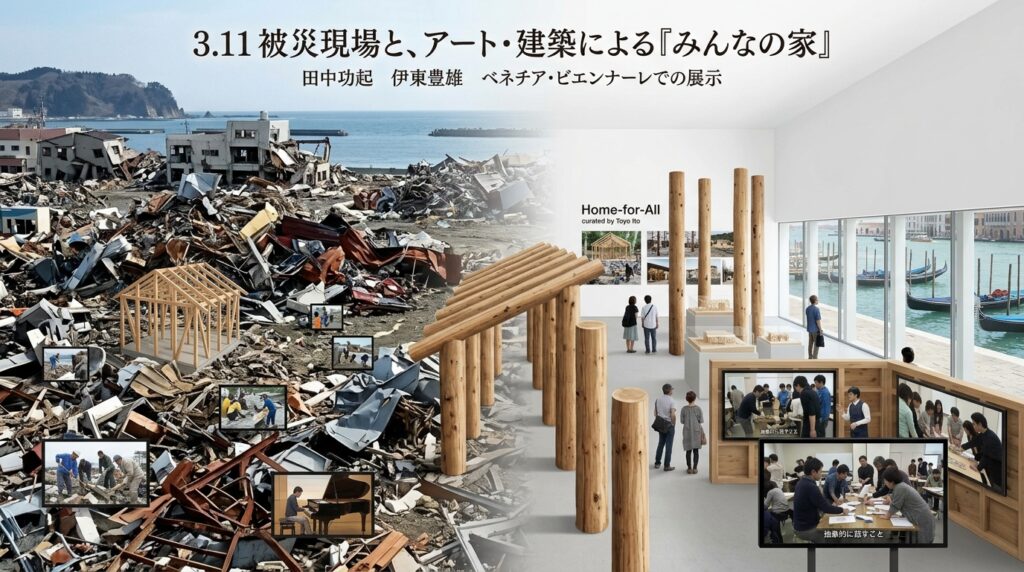
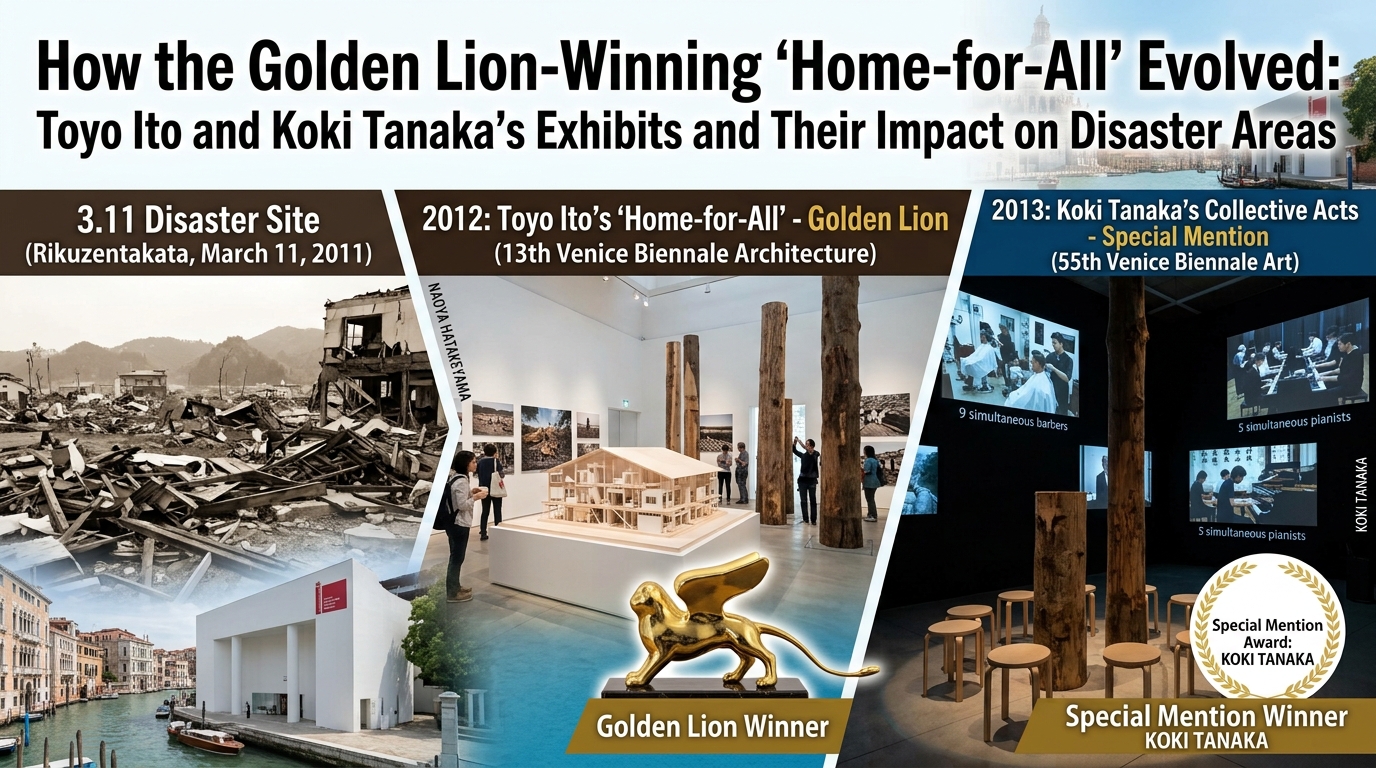
| 2012 (※ Architecture Exhibition) | Japanese Pavilion | Toyo Ito and others received the award for their exhibition documenting “Home-for-All,” temporary community centers created after the earthquake (Reference). |
| 2013 | Angolan Pavilion | Koki Tanaka of the Japanese Pavilion received a special mention. |
| 2022 (Year of Russia’s invasion of Ukraine) | British Pavilion | The Ukrainian Pavilion, which was in the midst of the war, did not receive the award. |
| 2024 (Year of the Gaza conflict) | Australian Pavilion | Palestinian-American artist Samia Halaby received an individual special mention (Official Record). |
In conclusion, it is certainly not the case that works dealing with disasters or war “always win.”
The Ukrainian Pavilion, for example, failed to win the highest award in 2022.
However, there is an important fact that should not be overlooked. The strong memory of the Japanese Pavilion receiving the Golden Lion at the 2012 Architecture Exhibition for confronting the aftermath of the earthquake, together with the fact that the work of a Palestinian artist working amid conflict received significant attention at the 2024 Biennale, demonstrates that works that sincerely confront the pain of disasters and war have repeatedly attracted strong evaluations and attention.
Koki Tanaka also received a special award.
The Structure Sometimes Called the “Trauma Olympics” and the Attraction of Spectacle
Why do works dealing with tragedies and social problems possess such extraordinary power?
In international art media such as Artnet and The Spectator, as well as in contemporary art criticism, the recent tendency for international exhibitions to become arenas in which artists effectively compete over “who can expose the most tragic history or social injustice” is sometimes discussed or mocked using terms such as “Trauma Olympics” and “identity politics.”
There is a useful reference page titled “When Art Fights War: The ‘Olympics of Art’ — Tracing the History of the Venice Biennale.” Please take a look at it.
For jurors and critics as well, when confronted with a work carrying the pain of a disaster area or battlefield, it is ethically extremely difficult to dismiss it by saying, “The theme is too heavy and the work lacks sophistication as art.”
The “urgent pain” contained within the theme itself can powerfully reinforce the evaluation of the work.
Art journalist Makoto Murata had already pointed this out about the nature of international exhibitions back in 2003:
“I think an international exhibition is a kind of ‘spectacle.’”
“For better or worse, on the stage of an international exhibition, whoever stands out wins.”
The word “spectacle” may sound cynical, but it gets to the heart of the matter.
On a gigantic stage where countless works from around the world are gathered, it is not enough simply to present something quietly. An artist needs the power to “captivate”—to seize people’s attention instantly.
On such a stage, few things possess a stronger gravitational pull than themes involving human life and death, war, and disasters.
Quite apart from the artist’s own sincerity, there is a structural “gravity” by which the theme itself attracts public attention and draws evaluation toward the work.
When pure dialogue is converted into “market value,” we are forced to go one step further and confront the “raw reality” of the art world.
Being recognized at an international exhibition such as the Biennale has a definite “next stage” waiting for it: the art market.
In 2024, the American art media outlet ARTnews referred to this phenomenon as the “halo effect.”
Once an artist exhibits at the Biennale and attracts attention, the eyes of collectors around the world become focused on the artist, and auction prices can soar. Galleries and auction houses do not deny this market mechanism.
What emerges is an unavoidable cycle:
Themes involving tragedy and social problems (easy to attract attention) ⟶ Recognition and attention at international exhibitions ⟶ Conversion into fame and artwork prices (economic value).
Once we arrive at this point, doesn’t the pure resonance of Senju’s statement that “art = communication” begin to take on a somewhat more complicated color?
The moment a work born from dialogue with disaster victims is placed on the stage of an “international exhibition” as spectacle, it becomes an object of evaluation and is eventually swallowed up by the enormous waves of the market.
When “dialogue” is transformed into the form of an artwork, to what extent can it remain pure dialogue?
This is a difficult question for even the most idealistic and sincere artist.
The Resolve to Accept the Possibility of “Hypocrisy”
Then, how should artists live within this structural contradiction?
In his final book, How Many Full Moons Will I See in the Future?, musician Ryuichi Sakamoto(坂本龍一)spoke quietly about his own social activities, including environmental issues and his support activities following the earthquake:
“Even if people criticize me and say that it is hypocrisy, if it makes society even slightly better, then I think that is all right. My efforts concerning ecology and my activities after the earthquake are both supported by that belief.”
“It may be hypocrisy.”
“In the end, isn’t it really for my own fame?”
It means being prepared from the outset to accept such criticism from outsiders, as well as one’s own internal conflicts.
There is strength in acknowledging that no one can ever become a completely pure and innocent being, yet continuing to act despite carrying those contradictions.
However, having observed and heard about Ryuichi Sakamoto’s actual activities, and having myself experienced trying to approach him by email after he was appointed commissioner of the Sapporo International Art Festival, I have to say that I was left with a somewhat different impression.
I repeatedly saw Sakamoto appear stylishly at the most prominent point of large gatherings and demonstrations—events in which everyone had struggled together to build an organization and generate momentum—deliver a “signature speech,” complete with what might be called a cool catchphrase rather than a signature line, and then disappear with a nihilistic air.
I cannot shake the impression of him as a kite swooping down to snatch the most delicious part of the effort.
I had a similar impression of Kenzaburo Oe, who appeared on the same stage as Sakamoto at a large gathering protesting the legislation concerning the overseas deployment of the Self-Defense Forces on the grounds that it was unconstitutional.
It was almost like Shigeo Nagashima at a snack corner in a baseball stadium dugout, eating only the “sweetest and most delicious part” at the very top of triangular slices of watermelon one after another, then smoothing the top with his hand before walking away! LOL.
Although I had only had limited contact with Ryuichi Sakamoto, I felt that he was extremely cold toward people who could not contribute to his own fame or prestige.
Of course, if someone were to say, “You have no right to say anything because you are the one doing nothing!” that would be the end of the argument.
Nevertheless, I cannot help wondering: before the large gathering protesting the unconstitutionality of the legislation concerning the overseas deployment of the Self-Defense Forces, did Sakamoto or Kenzaburo Oe actually help with the work that had gone into organizing it?
And afterwards, did they coordinate with the members of the organization to provide as much follow-up and publicity as possible, using the influence they possessed as famous figures?
So I investigated the contents of the works exhibited by Toyo Ito and Koki Tanaka that received awards at the Venice Biennale in connection with 3.11, as well as their subsequent impact on disaster-stricken areas and elsewhere. I also investigated the content of Ryuichi Sakamoto’s “ZERO LANDMINE” project and its subsequent impact on the global effort to eliminate landmines.
Click here for other pages in this series!
★【Part II】A Venice Biennale Award-Winning Exhibition Born from a Major Disaster and War and Becoming a Topic of Discussion! What Happened to “Home-for-All” Afterwards? — What Toyo Ito and Koki Tanaka Exhibited, and Their Impact on Disaster-Affected Areas!【See this page】
★【Part III】 A Venice Biennale Award-Winning Exhibition Born from Large-Scale Disasters and War In the Rubble and on the Battlefield, People Seek Flowers!【See this page】
★[Part IV] A Venice Biennale Award-Winning Exhibition Born from Large-Scale Disasters and War What Is Buddhist Enlightenment? — Exhibitions That Were Created from Large-Scale Disasters and War and Became the Focus of Attention at the Venice Biennale!【See this page】
Main Sources
- Hiroshi Senju interview (episode concerning temporary housing):nybiz.nyc
- GQ JAPAN (August 2015):gqjapan.jp
- Kinokuniya Bookstore, If I Were to Talk About Art:kinokuniya.co.jp
- Japan Foundation (1995 — Hiroshi Senju receives Honorary Mention):venezia-biennale-japan.jpf.go.jp
- Japan Foundation (2012 Architecture Exhibition — Japanese Pavilion wins Golden Lion):jpf.go.jp
- OPENERS (2012 Architecture Exhibition, Japanese Pavilion):openers.jp
- List of Previous Award Winners (Wikipedia):en.wikipedia.org
- Official Venice Biennale (2024 Awards):labiennale.org
- The Art Newspaper (British Pavilion wins in 2022):theartnewspaper.com
- Makoto Murata, “The Spectacle Nature of International Exhibitions” (artscape, 2003):artscape.jp
- ARTnews, “The Halo Effect” (2024):artnews.com
- Ryuichi Sakamoto, review of How Many Full Moons Will I See in the Future?:nipp_