【Japanese Theories of Art and Fine Art】 — Motoori Norinaga, Nishida Kitaro, and the Influence on Ryuzaburo Umehara through the Shirakaba School

In the previous articles in this series, I have explored the structure of “lingering emotion” (yojo) and “yugen” in Japanese art, as well as the theories of the two Nishidas, Nojirou Nishida(西田直二郎) and Kitaro Nishida(西田幾多郎), who provided the intellectual foundations for them.
This time, I would like to go even further back into the depths of Japanese aesthetic consciousness and unravel the “grand baton of ideas and expression” passed down from the Edo-period scholar of National Learning, Motoori Norinaga(本居宣長), to the giant of modern philosophy, Kitaro Nishida(西田幾多郎), and then to the master of modern Japanese Western-style painting, Ryuzaburo Umehara(梅原龍三郎).
Although their achievements may at first appear completely unrelated, they are connected by a powerful underground current: “rejecting logic (the subject-object dualism) and becoming one with the life of the object itself.”
Motoori Norinaga: The Rejection of “Kara-gokoro” and “Mono no Aware”
Motoori Norinaga, a scholar of National Learning in the Edo period, criticized what he called “Kara-gokoro(からごころ 漢意),” or the Chinese way of thinking—that is, the tendency to impose imported Confucian and Buddhist(仏教徒) rationalism upon Japanese thought.
Through his study of The Tale of Genji, Norinaga(本居 宣長) argued that the essence of literature and art lies in mono no aware(もののあはれ).
For Norinaga, mono no aware was the natural emotion that arises when the human heart responds directly to the things and events of the world, before they are dissected through abstract reasoning.
For example, when one encounters the cherry blossoms of Mount Yoshino, one does not first analyze them intellectually and then decide that they are beautiful. Rather, one is simply moved by their beauty.
The self and the object become emotionally united.
This direct emotional identification with the object can be regarded as one of the sources of Japanese aesthetics.
Kitaro Nishida: The Elevation of This Sensibility into “Pure Experience” and the “Place of Absolute Nothingness”
Kitaro Nishida transformed the sensibility articulated by Norinaga into a universal philosophy by bringing it into dialogue with the logic of Western philosophy.
“Pure Experience” as the Absence of a Subject-Object Distinction
In An Inquiry into the Good, Nishida described “pure experience” as the state of “truly experiencing things just as they are,” before they are divided and distinguished through language.
He gives the following famous example:
“当時、花を見る時、我というものもなければ、花というものもない。ただ花の色、花の美しさがあるだけである”
When one is looking at a flower, there is neither a “self” nor a “flower” as something conceptually separated from that self. There is only the color of the flower and the beauty of the flower.
In other words, the subject and the object have not yet been separated.
The person looking at the flower and the flower itself exist within one unified experience.
The “Place of Absolute Nothingness” at the Center of Nishida Philosophy
The concept of the “place(場) of absolute nothingness「絶対無の場所」(無の場)” first appeared explicitly in Nishida’s essay “Basho(場所),” published in June 1926 in Tetsugaku Kenkyu(哲学研究).
Nishida’s philosophy developed through several stages.
In his early period, he focused on “pure experience.” In the middle period, he developed the concepts of “self-awareness” and “place.” In his later period, he developed the idea of “absolutely contradictory self-identity.”
The concept of “absolute nothingness” or the “place of absolute nothingness” became one of the central concepts of Nishida’s middle-period philosophy and continued to be developed until his later years.
Nishida’s “place” is not simply an empty physical space.
Rather, it is the field or place within which individual beings exist.
In other words, instead of looking only at the individual things that exist, Nishida asks us to look at the “place” or “field” that makes their existence possible.
Is “Nothingness” Really Nothing at All?
This idea can be connected, as an artistic metaphor, with the white space found in Japanese ink painting and screen painting.
White space is not actually “nothing.”
When a single flower is placed against a white background, the flower’s presence, its quietness, its life, and even the viewer’s imagination emerge precisely because of the surrounding empty space.
The blank space is not “nothingness.” Rather, it is an important space that enables the existence of what has been painted.
The “Place of Absolute Nothingness” and “Blank Space” Are Not the Same Thing
However, an important qualification is necessary here.
Nishida’s “absolute nothingness” should not simply be equated with the blank space of Japanese painting.
Nishida himself did not define the blank spaces of Japanese painting as “absolute nothingness.”
Nevertheless, as an artistic metaphor, the structure is highly suggestive.
The same can be said of the paintings and theories of Lee Ufan(李禹煥), in which the unpainted space plays an important role in making the painted elements come alive.
In this sense, “nothingness” and “being” are not merely opposites.
Rather, nothingness can be what makes being possible.
Nishida Philosophy and Art
This is not simply a case of retrospectively associating Nishida’s philosophy with Japanese art.
Nishida himself discussed art throughout his career, from his early writings to his later works.
Among his important writings on the subject are “Goethe’s Background” (1931), “Logic and Life” (1936), and “Artistic Creation as Historical Formative Activity” (1941).
For Nishida, art is deeply connected with the relationship between human beings and the world, intuition, expression, and creation.
Contemporary scholarship has also reconsidered Nishida’s theory of art from the standpoint of “place,” in which the opposition between subject and object disappears, and has examined its connection with twentieth-century abstraction.
Thus, Nishida’s idea of looking not merely at a thing itself but at the field and relationships within which that thing exists is particularly interesting when thinking about painting.
Then, How Is This Related to Hideki Yukawa’s Meson Theory?
Here, however, we need to be careful.
It would not be accurate to claim that Nishida’s philosophy of “absolute nothingness” directly influenced Hideki Yukawa(湯川秀樹) and thereby led to his meson theory.
Yukawa (湯川 秀樹)first presented his meson theory at an academic meeting in November 1934, when he was a lecturer at Osaka Imperial University. He subsequently published his theory in 1935 in the Journal of Mathematical Physics under the title “On the Interaction of Elementary Particles. I.”
The immediate scientific problem Yukawa was addressing was the nature of the nuclear force and why it has such a short range.
He proposed that the force was mediated by a particle whose mass was approximately 200 times that of an electron.
The particle predicted by his theory was eventually associated with the pi meson, whose discovery in 1947 provided experimental support for the theory. Yukawa was awarded the Nobel Prize in Physics in 1949.
Therefore, it would be historically inaccurate to say that meson theory was derived from Nishida’s concept of absolute nothingness.
However, There Is a Truly Fascinating Connection between Yukawa and Eastern Thought
What is genuinely interesting here is the role of Zhuangzi(荘子).
Yukawa had read Laozi and Zhuangzi before entering middle school. Later in life, when he was thinking about elementary particles, he recalled the ideas of Zhuangzi and wondered whether there might be something undifferentiated behind individual particles—something resembling “chaos.”
Yukawa later wrote about this experience in his book 創造的人間 (Creative Human Being).
He described how, while thinking about elementary particles, the image of the “chaos” described in the philosophy of Laozi and Zhuangzi came back to him.
This recollection was not the origin of his 1935 meson theory.
Rather, Eastern thought appears to have provided Yukawa with an intellectual image and a language through which he could later reflect upon the deeper meaning of particle theory.
The idea of “chaos” subsequently became related to Yukawa’s later theoretical work, including his nonlocal field theory and the “elementary domain theory” he proposed in 1966.
Thus, it is more accurate to say that Yukawa used ideas from Eastern philosophy as an intellectual image or conceptual language in reflecting on particle theory, rather than claiming that Laozi, Zhuangzi, or Nishida’s philosophy directly produced the mathematical derivation of meson theory.
Researchers have indeed discussed the relationship between Yukawa’s thought and Lao-Zhuang philosophy, particularly in terms of his intellectual background and methodology. This is a different question from whether Eastern philosophy directly caused the scientific derivation of meson theory.
「京都大学総長の山極寿一は、ジャーナリスト池上彰との対談(週刊文春の今年の新年特大号)で、日本人で最初にノーベル賞を受賞した湯川秀樹の「中間子理論」は、西田幾多郎の哲学に通じていると指摘。「西田哲学というのは、『間』の理論で、つまり『私とあなた』の“と”のことなんですね。これは、なかなか欧米人には考えつかない、日本的な思考の効用だったと思います」
In a dialogue with journalist Akira Ikegami(池上彰) published in the New Year’s special issue of Shukan Bunshun<(週刊文春)/em>, Juichi Yamagiwa(山極寿一), President of Kyoto University, pointed out that the “meson theory” of Hideki Yukawa, the first Japanese person to receive a Nobel Prize, has something in common with the philosophy of Kitaro Nishida. He stated: “Nishida philosophy is a theory of the ‘in-between,’ that is, the ‘and’ in ‘you and I.’ I believe this was an advantage of Japanese thinking that is rather difficult for Westerners to conceive.”
There is also something else that I find extremely interesting here: the Japanese language itself.
Japanese has an extraordinarily rich vocabulary for distinguishing subtle fields of thought and expression.
For example, Japanese has precise terms corresponding to painting, printmaking, art, fine art, novels, and many other categories. In addition, the language can combine kanji, hiragana, katakana, on-yomi readings, kun-yomi readings, onomatopoeic expressions, and even English loanwords.
This gives Japanese an extraordinary capacity for making fine distinctions in thought and theory.
Nobel Prize-winning chemist Ryoji Noyori(野依良治)also emphasized the importance of Japanese as a language of science in an interview with Kyoiku Shimbun in January of this year.
Noyori argues that, since the Edo period, translating foreign concepts into Japanese using kanji has helped people understand abstract concepts and has contributed to raising the general public’s ability to understand science.
He stated:
“英語は外国語であり『道具』です。しかし、母語である日本語は『精神』そのものであると知ってほしい”
“English is a foreign language and a ‘tool.’ However, I want people to understand that one’s mother tongue, Japanese, is the ‘spirit’ itself.”
He also said:
“日本語の知的伝達能力は圧倒的に高いので、今後も読み書きについては最大限の努力を”
“Because Japanese has an overwhelmingly high capacity for intellectual communication, we should continue to make the greatest possible effort in reading and writing it.”
This also reminds me of the difficulties experienced by some returnee students and graduates of international schools, who can end up feeling that they have mastered neither language completely and may even struggle with the question, “What nationality am I?”
I feel that I am able to write these papers myself precisely because Japanese is my mother tongue.
My “Yokota Theory of Musical Translation” and my “Definition of Art” may well be theories that could not have been conceived in quite the same way if Japanese had not been my native language.
■ The Image of “Particles Emerging from Empty Space”
In quantum field theory, particles are understood as excitations of underlying fields.
The vacuum is the lowest-energy state of a field, in which there are no particles, but it is not “absolute nothingness” in the philosophical sense.
Nevertheless, as a philosophical metaphor, this gives us an interesting way of thinking.
Rather than looking only at individual visible particles, we can look at the field that makes their individual existence possible.
This can also be connected with the white canvas.
■ Is a White Canvas or Sheet of Paper “Nothingness”?
A white sheet of paper or a white canvas has nothing drawn upon it yet.
But at the same time, it is the place where every possible expression can emerge.
One line creates a line.
One color creates a color.
One shape creates a relationship with the surrounding blank space.
“Nothing” and “the possibility that anything may emerge” are therefore not necessarily the same thing.
A white canvas should not be presented as an explanation of Nishida’s philosophy of absolute nothingness.
However, it is a powerful artistic metaphor for the concept of “place.”
3. Ryuzaburo Umehara(梅原 龍三郎) and the Shirakaba School(白樺派): “Action-Intuition” Transformed into Painting
I have come to feel that Ryuzaburo Umehara beautifully expressed “pure experience” through his paintings.
His masterpieces Sakurajima and Autumn in Beijing can almost be regarded as visual evidence of Nishida’s philosophy.
When I look intently at Umehara’s paintings, I can almost sense the human drama taking place inside the houses, and I find myself moved to tears.
I was so moved!
However, Umehara and Nishida did not have a direct teacher-student relationship.
There may instead have been a connection through the Shirakaba School.
Nishida taught Soetsu Yanagi(柳宗悦) during his time at Gakushuin. Yanagi later became the founder of the Mingei movement and was also one of the central figures associated with the Shirakaba group.
The figures associated with the Shirakaba School were deeply engaged with Nishida’s philosophy.
Umehara, meanwhile, had close friendships with Saneatsu Mushanokoji(武者小路実篤), Naoya Shiga(志賀直哉), and Soetsu Yanagi.
It is therefore possible to imagine that, through this intellectual community, an underground current emphasizing affirmation of the self and life, as well as the importance of intuition, flowed into Umehara’s art.
However, I have searched extensively and have not found any evidence that directly supports this hypothesis.
Nishida later defined artistic creation through the concept of “action-intuition”—becoming the thing itself, seeing as the thing itself, and acting as the thing itself.
This concept provides an especially interesting framework for understanding Umehara’s painting.
4. The Contrast with Sotaro Yasui: Two Approaches to Truth
Sotaro Yasui(安井曾太郎)is often discussed alongside Umehara as one of the “two pillars” of modern Japanese painting.
Both were regarded as national painters and as rivals.
Umehara was a genius of color, while Yasui was a prodigy who placed particular emphasis on form and drawing.
Yet both possessed extraordinary talent and devoted enormous effort to their art.
Personally, I found Yasui’s particular strengths and artistic hallmark more difficult to understand.
At one point, Tokyo Gallery faced a serious management crisis, and Yasui helped the gallery through that difficult period.
The gallery held many solo exhibitions of his work, and because Yasui’s paintings sold well, it is likely that his popularity contributed to the gallery’s survival during those crises.
My own inspiration to become a painter, however, came from Umehara.
When I was in the first year of junior high school, I encountered Umehara’s Sakurajima, Blue in Kadokawa’s Japanese Language I for Junior High School textbook.
I was so deeply moved that I burst into tears.
From that moment, Umehara became my goal—and the genius I wanted to surpass.
I have discussed this repeatedly with Mr. Yamamoto, the representative of Tokyo Gallery.
Our positions are almost completely opposite.
I believe that this very difference has contributed to the unusually long relationship between us, as well as to the fact that we have absorbed ideas from one another.
Mr. Yamamoto himself has said much the same thing.
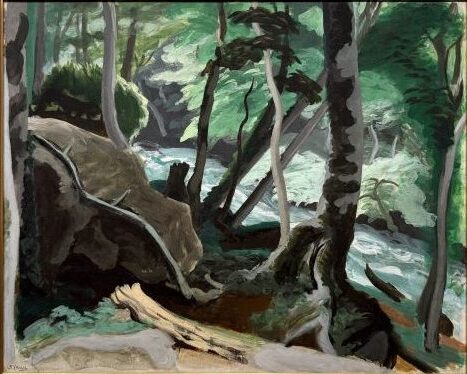
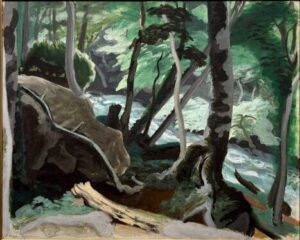
I once saw Umehara’s Autumn in Beijing (the photograph at the top of this page) and Yasui’s Oirase Mountain Stream side by side at the Tokyo National Museum.
I stood there studying both paintings for a long time.
From the standpoint of art history, both can be regarded as painters who combined post-Impressionist and Expressionist approaches with realism.
Yet their materials and techniques were completely different.
Umehara used materials associated with Japanese painting, whereas Yasui used oil paints.
I suspect that Umehara painted Autumn in Beijing on paper, probably using Maai-gami(間合紙), a small-batch-produced type of torinoko-gami(鳥の子紙).
He painted with gansai pigments and nikawa glue, using what is known as a “transparent technique.”
Umehara was a painter who excelled at this transparent technique, building up thin layers of pigment much like transparent watercolor.
Regarding the term “détrempe” that appears in books on art, I once consulted a technical adviser at Holbein who had been involved in the joint development of Holbein oil paints.
According to that consultation, there may have initially been cases in which gansai pigments(岩彩 日本画の絵具) were diluted with glue, but it soon became clear that Umehara was definitely painting with gansai pigments dissolved in nikawa(膠).
I have also discussed this in another article of mine.
Many genius colorists apply paint in very thin layers.
Henri Matisseis a good example.
Vincent van Gogh, by contrast, applied paint quite thickly, but even his paint is not necessarily as thick as we tend to imagine.
Yasui applied oil paint somewhat thickly and used brush marks with a highly sophisticated technique.
He was essentially an opaque painter.
He did not often build up many layers, allowing the underlayer to show through.
I myself place great importance on the materiality of the surface of oil paint.
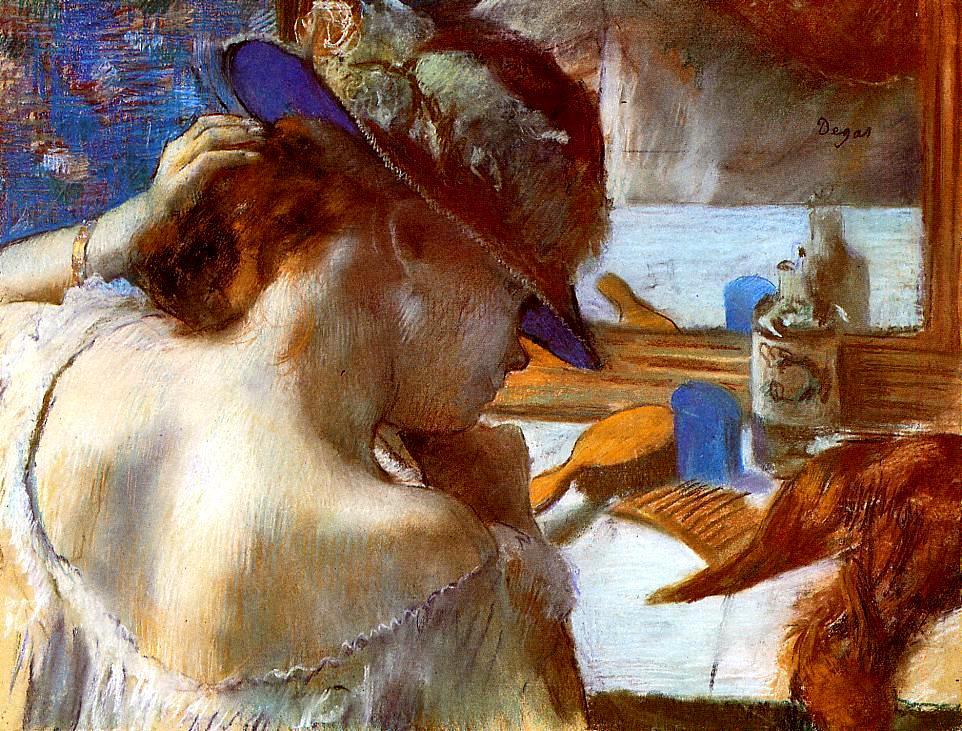
Japanese artists have often found it difficult to achieve the balanced, glossy matière seen in the paintings of Pierre Bonnard, Moise Kisling, or Paul Cezanne.
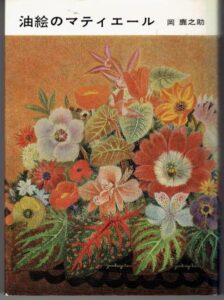
The Japanese painter Shikanosuke Oka(岡鹿之助)even wrote The Matière of Oil Painting(油絵のマティエール) about the difficulties Japanese painters face in handling oil paint.
I myself used oil paints from the first year of high school until around the age of forty.
I struggled with them for many years.
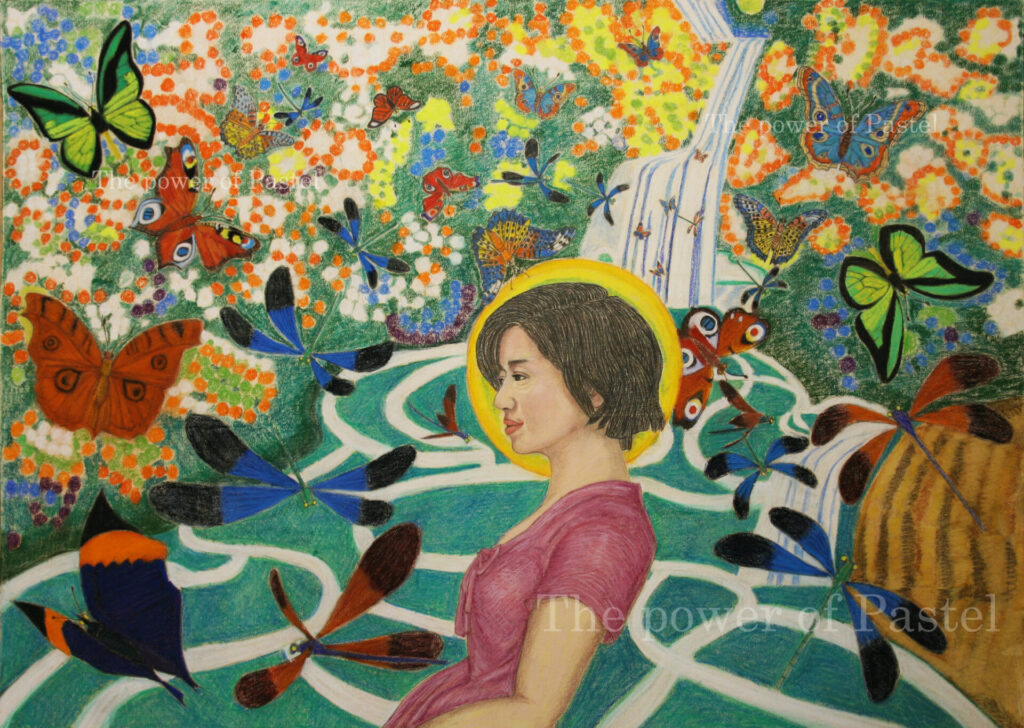
Eventually, I naturally shifted to pastel and colored pencil because their tonal qualities are closer to those of Japanese gansai pigments and better suited to my own qualities as an artist.
Around the same time, I also stopped using acrylic paint.
In 2023, I saw the Matisse exhibition at the Tokyo Metropolitan Art Museum.
That exhibition convinced me that most painters apply oil paint far too thickly.
Oil paint is said to have been developed by the Van Eyck brothers for the purpose of achieving highly realistic, almost photographic images.
But oil paint is not necessarily suited to thick application.
Paint manufacturers produce what might be called “guild paints,” the highest-grade professional paints developed for artists who can fully exploit their qualities.
The subtle beauty of such paints can be lost when they are applied too thickly.
When thick layers cover the white ground of the canvas, they can obscure the beauty of the pigments themselves.
In that sense, excessive thickness defeats one of the very purposes of using such high-quality pigments.
Johannes Vermeeris a good example.
In Girl with a Turban, the blue of the turban was created using lapis lazuli.
Lapis lazuli was an extraordinarily expensive pigment.
Even a small amount could cost more than an entire house.
It was more expensive than gold.
Artists such as Matisse, who developed compositions with broad, flat areas of color, and San Yu(常玉), the Chinese Matisse-like colorist, are precisely the kind of artists who should use such paints—and who can bring out their full potential.
This is somewhat like a Stradivarius or Guarneri violin, a vintage Les Paul electric guitar, or a Porsche 911 GTS2.
These are products whose subtle performance characteristics can be fully drawn out by a top professional.
“Guild paints” were developed for precisely this purpose.
However, most painters do not seem to recognize this.
As for me?
Well, I believe I can use them effectively now, of course.
I have been away from oil painting for quite some time, so there would probably be some trial and error at first.
But I believe I would be able to master them.
| Comparison Item | Ryuzaburo Umehara: Establishing and Depicting “Pure Experience” | Sotaro Yasui: “Construction of a System for Producing Profound Impressions through Color and Form” |
|---|---|---|
| Relationship with the Subject | Subject and Object Undivided (Dissolution of Self and Object) | Struggle Between Subject and Object (Confrontation Between Self and Subject) |
| He painted the emotion and imagination arising from seeing a mountain through carefully calculated theories of drawing and sophisticated techniques. In particular, he consciously employed, to a considerable degree, the theory of color harmonies that I explained in another article. | He carefully observed the subject and placed even greater emphasis than Umehara on the delicate treatment of form and modeling, while depicting the emotion produced by what he saw. |
Summary: From Motoori Norinaga’s “Mono no Aware,” through Kitaro Nishida, to Ryuzaburo Umehara
We have now traced a long intellectual current.
Motoori Norinaga’s mono no aware begins with an emotion that arises directly from encountering the world, without imposing abstract rationality upon it.
Kitaro Nishida(西田 幾多郎) transformed this sensibility into the philosophical concept of “pure experience,” and subsequently developed it into the philosophy of the “place of absolute nothingness.”
Ryuzaburo Umehara then expressed something remarkably close to this way of experiencing the world through painting.
In other words, we can see a fascinating lineage:
Motoori Norinaga → Kitaro Nishida → Ryuzaburo Umehara
The spirit of Japanese aesthetics may have flowed through this lineage—not necessarily through direct teacher-student relationships, but through the transmission and transformation of ideas.
And this is where my own definition of art becomes relevant.
I define art as:
“An expression of what the artist wishes to assert, together with a device or mechanism that creates dialogue and debate.”
Furthermore, my theory of physically translating musical modes into colors attempts to transform the invisible structure of music into visible painting.
I believe that these ideas may represent a continuation, in a contemporary form, of this long historical lineage of Japanese thought about art and expression.
There is one particularly interesting episode concerning Umehara’s Autumn in Beijing(北京秋天).
The painting was exhibited at the Kokuga-kai exhibition(国画会展) and created a sensation.
His friend, the novelist and playwright Matsutaro Kawaguchi(川口松太郎), purchased the work and displayed it in his home, looking at it every day.
One day, Umehara telephoned him and said that he wanted to donate Autumn in Beijing to the National Museum of Modern Art, Tokyo.
He offered to give Kawaguchi another painting in exchange.
Kawaguchi’s wife strongly opposed the idea.
Nevertheless, Umehara eventually let the painting go.
Umehara later spoke about the work, which he had painted in 1942, saying:
「私は高い秋空に興味をもった。何となく音楽を聞いているような空だった。これも朝の絵だ!」
“I became interested in the high autumn sky. Somehow, it was a sky that felt like listening to music. This too is a morning painting!”
This statement is extremely suggestive.
Umehara was not merely trying to reproduce the scenery before his eyes.
He was experiencing the sky almost as if he were listening to music.
In other words, the landscape had been transformed into an experience of color, atmosphere, rhythm, and emotion.
This is remarkably close to what Nishida called “pure experience.”
It also suggests that Umehara was aiming at a form of painting that could function almost like music.
Today, however, it would be impossible to paint exactly the same landscape.
Sakurajima and Mount Fuji are now surrounded by buildings and houses.
The scenery Umehara encountered belonged to a particular historical moment.
No painter today could simply reproduce that same landscape.
It was a once-only encounter between an artist, a place, and a particular historical period.
Perhaps this is another reason why the painting is so powerful.
Could it be that the spirit of Motoori Norinaga’s(本居宣長) mono no aware(もののあはれ) was inherited by Kitaro Nishida and then by Ryuzaburo Umehara?
This connects beautifully with my previous article, “What Is the Definition of Japanese Art?”, doesn’t it?
[Sources] [1] Kitaro Nishida(西田幾多郎), “Basho(場所),” Tetsugaku Kenkyu(哲学研究), No. 123, June 1926. [2] Kitaro Nishida(西田幾多郎), An Inquiry into the Good, Part I, Chapter 1, “Pure Experience,” Aozora Bunko. [3] Yuichiro Asakura(朝倉友一郎), “Nishida Philosophy and Art — The Significance of Art from the Standpoint of ‘Place’,” Journal of Nishida Philosophy, No. 2, 2005. [4] Yuichiro Asakura(朝倉友一郎), “Nishida Philosophy and Art — Aspects and Prospects of Related Research,” Bulletin of the Graduate School of Nihon University, 2004. [5] Takaki Okubo(大久保隆樹), “Blank Space and Sitting — Development of Japanese Mentality, Part Three,” Journal of Tokyo Woman’s Christian University, Vol. 65, No. 2, 2015. [6] Osaka University, “Making Hideki Yukawa’s ‘Meson Theory’ Dissertation Public” — Yukawa’s theory was presented at an academic meeting in November 1934. [7] Osaka University, Hideki Yukawa Physics, “Physics in Yukawa’s Era and Meson Theory (2).” [8] Nobel Foundation, “Hideki Yukawa — Facts” — Yukawa predicted a particle with a mass approximately 200 times that of an electron. [9] Hyogo Prefectural Museum of Literature, “Hideki Yukawa” chronology — Yukawa proposed his elementary domain theory in 1966. [10] Seigo Matsuoka(松岡正剛), “Senya Sensatsu, Night 828: ‘Creative Human Being,’ Hideki Yukawa” — including Yukawa’s recollections concerning Laozi, Zhuangzi, “chaos,” and Nishida’s lectures at Kyoto University. [11] Shinichi Sakamoto(坂本慎一), “Kitaro Nishida and Hideki Yukawa — Their Interactions and Philosophical Agreement,” Studies in Comparative Philosophy, No. 51, March 2025, pp. 75–82. [12] Hideki Yukawa(湯川秀樹), “Hideki Yukawa’s Elementary Particle Theory Research and Chinese Lao-Zhuang Philosophy,” Elementary Particle Theory Research, Vol. 85, No. 2. [13] “Quantum Field Theory,” Wikipedia. [14] “Yugen,” Wikipedia — medieval Japanese poetics, including Fujiwara Shunzei and the concept of beauty associated with lingering emotion. [15] Kitaro Nishida(西田幾多郎), “The Logic of Place and the Religious Worldview” — Nishida’s final paper.