◆What Is Art? (Part II)— I Investigated the Theories of Earlier Thinkers and Artists: Examining the Originality and Validity of My Definition

In the previous article, I explained my definition of what art is: 『Geijutsu(芸術)is the expression of something intentionally meant to be expressed, or a mechanism/device created to provoke discussion.』 I also discussed the actual state of education concerning definitions of geijutsu(芸術)at bijutsu daigaku(美術大学)and geijutsu daigaku(芸術大学)in Japan.
This time, I investigated the theories of earlier thinkers and examined the originality and validity of my own definition.
When Creating a Definition, We Face the Problem That Words, Terms, and Expressions in One Language Cannot Be Translated into Another Language on a Strict One-to-One Basis.
There is one point I would like you to keep in mind here.
In Europe, whose civilization has its origins in ancient Greece, there is no single word that corresponds exactly, on a one-to-one basis, to the Japanese words geijutsu(芸術)or bijutsu(美術).
Even today.
This has long been a major problem in university language education, has it not?
Words, phrases, and expressions in one language simply cannot always be translated into another language on a one-to-one basis.
The Japanese words geijutsu(芸術)and bijutsu(美術), and the Greek-derived concept of technē and the Latin ars, are related to the origins of the modern word "art." Ars appears in the famous expression "Ars longa, vita brevis."
This is the Latin translation of a maxim attributed to the ancient Greek physician Hippocrates. The original is:
"Ὁ βίος βραχύς, ἡ δὲ τέχνη μακρή
Ho bios brachys, he de techne makre"
A meaning close to a literal translation would be: "Life is short, while the acquisition of skill, technique, craftsmanship, or learning takes a long time."
For example, at the Otaru University of Commerce library, a sign bearing the words "Ars longa, vita brevis" has been displayed for many years.
When I entered the university in 1980, President Ryōichi Hasebe(長谷部亮一)wrote in the university bulletin that although the phrase is often misunderstood as meaning "art is long and life is short," *ars* means technique or skill, and the word also came to refer to academic disciplines such as science.
When I read President Hasebe's statement, I was extremely disappointed—or perhaps I felt a certain harshness in it.
I felt that it clearly implied: "Science and technology, and academic learning, are superior to art."
This phrase planted in me a long-lasting sense of opposition toward the attitude of university professors.
However, I later discovered that the earlier faculty members of the university had actually placed considerable importance on art.
Why?
Because immediately inside the entrance of the university library stood, prominently displayed in the center, a specially constructed bookshelf containing the expensive, large-format complete collection of Shūeisha's Contemporary World Art Encyclopedia: Western Art / Japanese Art.
I was the person who read and used those books more than anyone else, and I cannot even count how many times I read them.
I now believe that this was probably a message from the university to its students:
"What should human beings regard as truly valuable in life?"
Otherwise, the university would not have produced literary figures such as Nobel Prize in Literature candidate Sei Itō(伊藤整) and Takiji Kobayashi(小林多喜二), the author of *Kanikōsen*, who was ultimately tortured and killed by the Special Higher Police.
Because of this linguistic and cultural background, in Europe and the United States both artists and musicians are still generally called "artists."
When reading academic papers, therefore, one must determine from the context, the surrounding sentences, and photographs whether the word refers to a visual artist, a musician, or another kind of artist.
Even the word "painting" can be represented by words such as "drawing" or "picture," while the Japanese concept of hanga(版画)is generally translated as "prints"—which, after all, can also simply mean printed materials. (laughs)
In Japanese, by contrast, there are specific compound terms that directly identify particular types of bijutsu(美術)works, such as nihonga(日本画), yusaiga(油彩画), suisaiga(水彩画), chokoku(彫刻), urushi-kōgei(漆工芸), dōban-ga(銅版画), and seki-han-ga(石版画).
Once we recognize this difference, it becomes clear that when attempting to define what geijutsu(芸術)is, we cannot completely escape the influence of differences in terminology and the origins of those terms.
People sometimes envy those who grow up bilingual.
But it is also said that such people can end up feeling that they are halfway between two languages and may struggle deeply with the question, "What nationality am I really?"
Perhaps this is because without becoming deeply proficient in one's native language, it is difficult to construct one's thoughts with precision.
In Japanese, this includes not only classical literature, but also kanji(漢字), katakana(カタカナ), hiragana(ひらがな), mimetic words, onomatopoeia, and one's knowledge of history and cultural heritage, including bijutsu(美術)works.
Incidentally, the character *bi*(美)in bijutsu(美術)is a Chinese character. It is traditionally explained as deriving from the image of a sheep that is large, plump, and apparently delicious.
In other words, the character 美 can be understood as "a large sheep."
If so, its meaning is quite different from the Latin word *venustas*, meaning beauty, grace, or charm—the etymological source associated with Venus.
This leads me to speculate that the original semantic association of 美 may have been less about "beauty" in the modern abstract sense and more about praising abundance: something that is delicious and nutritious, large and vigorous, and seemingly capable of producing many offspring.
Definitions of Art Proposed by Earlier Thinkers — The Western Tradition
★ The Type of Theory That Explains Art as Expression
- Leo Tolstoy (1897) understood art as an activity through which a person communicates emotions that he or she has experienced to other people, causing the recipients to experience the same emotions.
- Immanuel Kant regarded art as purposive representation in itself and as something that enhances the faculties of the mind for social communication.
- Arthur Danto's definition has been interpreted as including conditions such as having a subject, expressing an attitude or point of view toward that subject, and using rhetorical ellipsis that invites the participation of the audience.
- David Davies (2004) argues that creating a work requires the presentation of an "artistic utterance."
- Noël Carroll argues that understanding the artist's intention can be a legitimate goal of interpreting a work, just as we understand a speaker's intention in ordinary conversation.
Theories Close to the Idea of Art as a "Device for Generating Discussion and Dialogue"
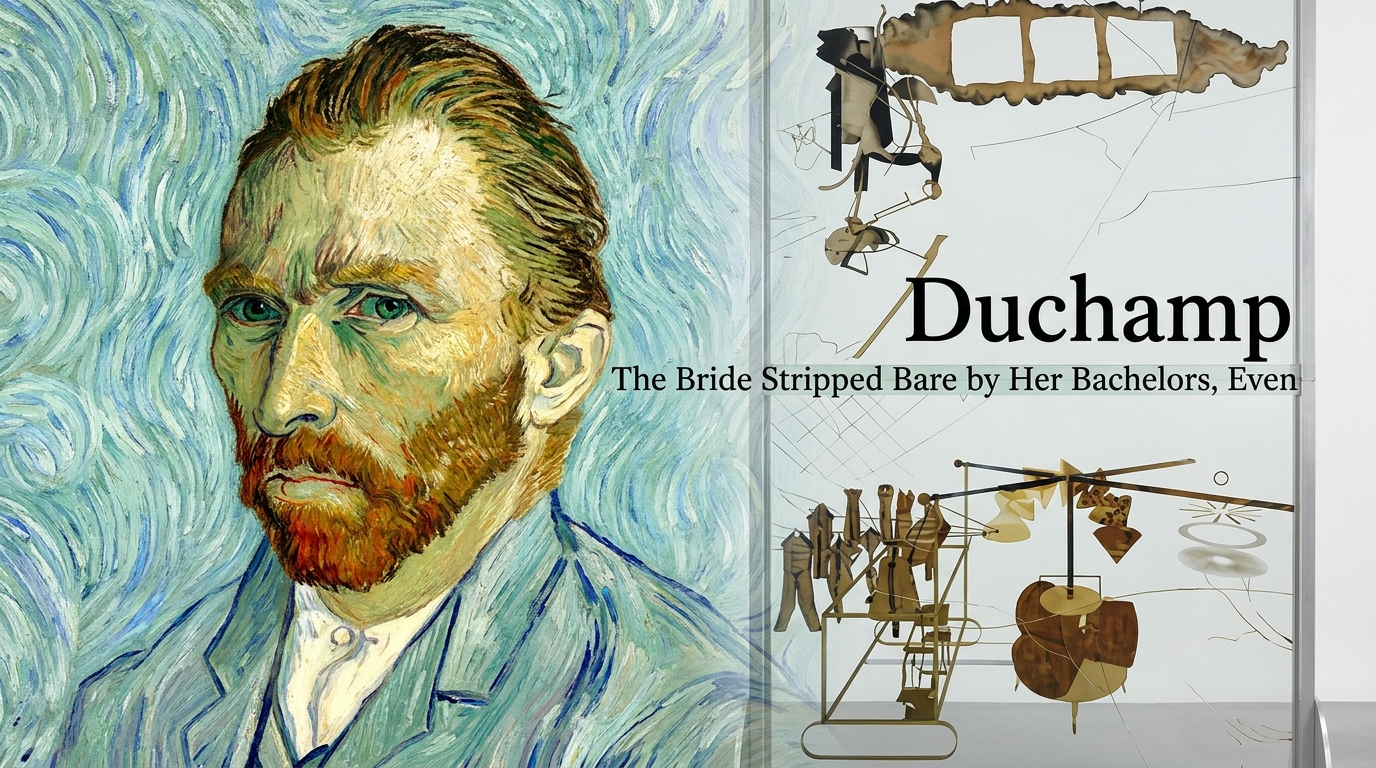
- Marcel Duchamp stated in 1957 that the creative act does not belong solely to the artist. Through decoding and interpretation, the viewer connects the work to the external world and thereby participates in the creative process.
- Umberto Eco's The Open Work (1962) introduced the concept of "openness," in which part of the structure of a work is left to the public or to chance, and presented a view of response as an interaction between the work and its reader.
- Alfred Gell's Art and Agency (1998) regards art as instrumental action that functions to influence the thoughts and behavior of others. This is one of the closest precedents to my use of the word "device." Grant Kester's Conversation Pieces (2004) discusses art as something that functions as conversation rather than merely as a visual spectacle.
- Claire Bishop (2004) argued that antagonism, like social cohesion, can become a driving force in the production and reception of art. This is one of the earlier studies that comes closest to my emphasis on "discussion and debate."
Contemporary Influential Definitions of Art
The "Definition of Art" entry in the Stanford Encyclopedia of Philosophy divides contemporary definitions into conventionalist approaches that emphasize institutions and history, traditional approaches that emphasize aesthetic properties, and hybrid approaches combining the two.
- Institutional theory: George Dickie defines an artwork as an artifact created to be presented to the public of the "artworld."
- Historical theory: Jerrold Levinson defines art in terms of something being seriously intended to be regarded in ways in which earlier artworks have been correctly regarded.
- Aesthetic definition: Monroe Beardsley defines art in terms of an arrangement intended to provide an experience with a distinctive aesthetic character.
- Cluster theory: Berys Gaut understands art as a cluster of ten features associated with art, including aesthetic properties, expression of emotion, the ability to convey complex meanings, and the presentation of an individual point of view.
- Hybrid and evolutionary approaches: These include the approaches of Robert Stecker, Stephen Davies, Ellen Dissanayake, and others.
This entry concludes that which definition is preferable depends on what one considers to be the facts that a definition of art most importantly needs to explain.
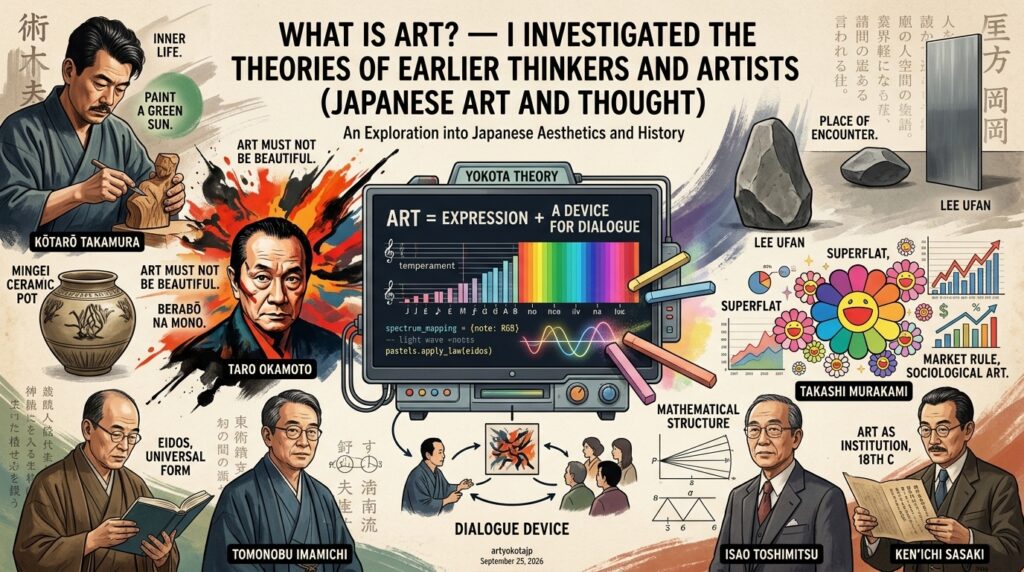
Position of Yokota's Definition — Art Is a Form of Expression and a Device for Provoking Controversy
The first half of my definition belongs to the lineage of expression theories extending from Tolstoy and to Noël Carroll's emphasis on the artist's intention.
The second half belongs to a lineage including Duchamp and Eco, who emphasize the role of the viewer, and Kester and Bishop, who discuss dialogue and conflict.
Within the range of sources I investigated, I could not find a definition that combines these two elements with "or" and asserts that there are no alternatives in exactly the same form.
The following theories take positions that are opposed to the type of definition proposed by Yokota.
- Roland Barthes criticized reducing the meaning of a work to the intention of its author.
- Duchamp went so far as to say that the artist cannot be consciously aware, at the aesthetic level, of what he is doing or why he is doing it.
- Jacques Rancière argued that meaning does not reside in the transmission of the artist's knowledge or inspiration to the spectator, but in a "third thing" that belongs to neither of them and exists between them.
Is Yokota's Theory Falsifiable?
For this article, I have not yet examined theories originating in Japan. I will do so in a future article.
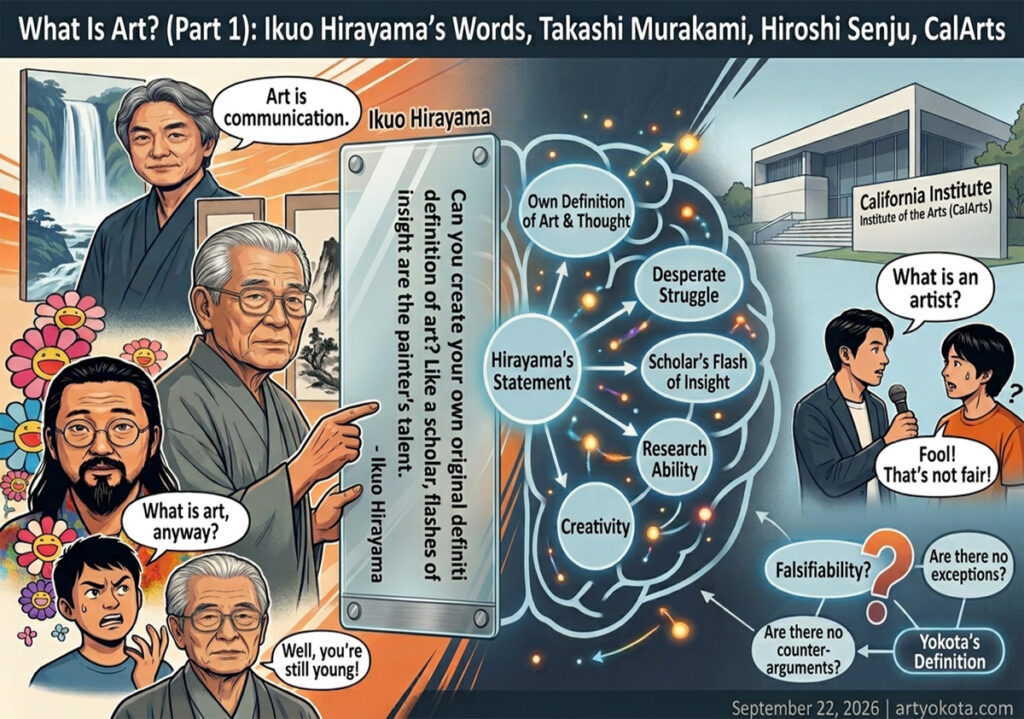
So, at this point, can Yokota's theory be immediately falsified in the same way as Hiroshi Senju's "communication theory"?
Please try.
If you think of a convincing counterexample, I would very much like you to contact me through the inquiry form. If the argument is sufficiently persuasive, I will publish it in a future article.
There is one point I would like to clarify here.
When I refer to a certain form of "expression," I mean a case in which the artist consciously or unconsciously intends to alter the psychology of the viewer after encountering the work and, if possible, influence the viewer's subsequent behavior.
For example, Marcel Duchamp is a quintessential artist who produced works that functioned as "devices for provoking controversy."
Suppose, however, that Duchamp says, "It is difficult to be conscious of why I made this work!"
Even if he were therefore to say, "I did not express anything with any particular intention," the statement itself remains, and he cannot completely escape from its implications.
"Why did you make this work, take it to an exhibition, and present it to the public?"
If the answer is:
"I had absolutely no expectation that anyone would view it. I had no expectation whatsoever that it would cause any psychological change or development in the viewer."
then wouldn't that amount to saying:
"Is it dog poop?"
In other words, when one creates and exhibits a work—even if it is placed on a street wall, as in the case of Banksy—there is virtually no way that the artist has absolutely no expectation of viewers, their reactions, changes in their psychology, or the possibility that the work will be reported in the news.
Communication, by contrast, does not necessarily involve intention.
For example, when a victim of 9/11 desperately tells government officials or members of the Self-Defense Forces about the difficulties they are facing, the victim is not necessarily expecting to change the other person's feelings.
Rather, the victim simply wants the other person to understand the difficulty they are facing, think of a solution, and actually solve the problem.
So, can this Yokota theory—"expression + a device for provoking discussion"—really be falsified?
Furthermore, Yokota's theory is not intended to apply only to bijutsu(美術).
It applies to music, literature, poetry, theater, drama, film, screenwriting, performance, dance—all of them, does it not?
Therefore, if someone says:
"That is merely your subjective opinion. Don't impose it on us!"
then I ask you to falsify it.
Just as in scientific discovery, a definition that cannot be falsified is not a truth or a fact, but merely an assertion.
If so, many artists loudly proclaim their own views of art and their own theories of art while producing and exhibiting their works.
Could it be that those views are actually the things that should be regarded as "your subjective opinion, misunderstanding, mistaken assumption, or personal assertion"?
Would it not be useful to examine one's own work once against Yokota's theory and use it to evaluate its quality and social significance?
Yutetsu Yamamoto(山本豊津), the representative of Tokyo Gallery, taught me something to this effect about twenty years ago and has also communicated the same idea in various lectures and magazine interviews:
Simply making art because you like doing it is the attitude of an amateur. A professional considers the audience and society, calculates what approach to take and how to influence the other person's mind and behavior, and how to communicate one's intention. A professional creates, announces, and promotes the work while taking the intended audience into account.
What I want to communicate is essentially the same.
If you want to become a professional, you should adopt a professional approach to production.
If you properly understand Yokota's theory, then a systems engineer would naturally try to create artwork using the same kind of system-development methodology:
"Requirements definition → Basic design → Internal design → Detailed design → Coding (program creation) → Error correction and modification → Integration and completion."
Wouldn't the change in the graduate's way of thinking be enormous?
Click here for other pages in this series!
◆What Is Art? (Part I) — Art Is an Expression of What the Artist Wants to Communicate, and a Device for Provoking Dialogue and Debate! (Part I)【Go to this page!】
◆What Is Art? (PartⅢ ) Japanese Art and Thought)— I Investigated the Theories of Earlier Thinkers and Artists【Go to this page!】
◆What Is Art? (Part IV)What Is Japanese Culture? Discovering the Characteristics of Japanese Art and Fine Art Through the Research of Earlier Scholars!【Go to this page!】
## References
Gaut, "The Cluster Account of Art," in N. Carroll (ed.), *Theories of Art Today* (2000) ※Title not verified / Danto, "The Artworld," *The Journal of Philosophy* 61 (1964) / Dickie, *The Art Circle* (1984) / Carroll, *Beyond Aesthetics* (2001) / Davies, *Art as Performance* (2004) / Tolstoy, *What Is Art?* (1897) / Duchamp, "The Creative Act" (1957) / Eco, *Opera aperta* (1962) / Gell, *Art and Agency* (1998) / Kester, *Conversation Pieces* (2004) / Bishop, "Antagonism and Relational Aesthetics," *October* 110 (2004) / Rancière, *Le Spectateur émancipé* (2008) / Adajian, "The Definition of Art," *Stanford Encyclopedia of Philosophy* (2024 revision)