◆What Is Art? (Part I) — Art Is an Expression of What the Artist Wants to Communicate, and a Device for Provoking Dialogue and Debate! (Part I)

What Is Art? — An Expression Arising from an Intention, and a Mechanism or Device Designed to Provoke Dialogue
“An enormous number of books have been published on the theme of ‘What is art?’ Yet, even up to the present day, no one has been able to provide a definitive answer to the question of what art is.” (Hiroshi Senju(千住博), from [Part 1] Reflections on ‘What Is Art?’第1回】「芸術とは何か」についての考察, “It is also the mission of artists living in the contemporary age to express ‘chaos.’”)
Today, I would like to present my own definition of art by examining the definitions and ideas proposed by those who came before us, and by explaining whether they stand up to scrutiny.
Yokota's theory of art: 『Art is an expression of what the artist wants to communicate. Alternatively, it is a device created to provoke discussion and dialogue.』
◆Falsifiability — First, let us consider falsifiability, proposed by the philosopher of science Karl Popper in 1934. Any claim made in an academic discipline must be examined in terms of falsifiability in order to determine whether it is true or false. This applies equally to the humanities and the sciences, does it not?
For example, suppose a medical researcher claims, "The cause of lung cancer is long-term smoking."
Someone might then ask, "But how do you explain the fact that there are people who smoked very heavily for many years and nevertheless did not develop lung cancer?"
This is a "falsification."
Once such counterexamples are raised, the absolute claim that "smoking is the cause of lung cancer" can no longer stand as an absolute truth. The basis and significance of the claim then shift to probabilities obtained through statistical analysis of data.
If the incidence of cancer is significantly higher among smokers, then, provisionally, the statement "smoking is one of the causes of lung cancer" can be regarded as true.
Philosophical and scientific research therefore proceeds by examining claims in terms of falsifiability.
Hiroshi Senju's definition of art... Art is communication.
Hiroshi Senju (千住博) states in his books and elsewhere that "art is communication between people."
His definition can easily be falsified.
It seems that he arrived at this idea through dialogue with a survivor of 9/11. But if we regard this elderly woman who was a victim as an artist, then the other victims who spoke to her, the prefectural government officials, volunteers, and nurses would all have to be regarded as artists as well.
More broadly, politicians and their secretaries giving speeches at fundraising parties, as well as the attendees asking questions, would all become artists.
It is a serious problem for a university professor—and particularly for the president of Kyoto University of the Arts—to make such a claim.
A university is a place where scholars provide education and guidance, is it not? And scholars are philosophers and scientists, are they not?
Even if an art university is taught by practicing painters, sculptors, musicians, and film directors, making an exception to this principle would be quite problematic.
In fact, I believe we should be especially careful about this today.
That simply cannot be right. If this definition were accepted, everyone on Earth would become an artist.
Suppose graduates came to believe that "art is communication" and continued creating works on that basis. Would they really be able to develop successfully from that point onward? What if the very first rung of the ladder were broken?
The university president would presumably explain this definition in lectures, talks, and university classes.
A scholar should not present something to students as established knowledge when its falsifiability has not been demonstrated and secured.
If one wishes to present such an idea, one should instead say, "Could this be considered one of the functions of art? In what kinds of situations and circumstances would this definition fit and prove effective?"
The reason is simple: students who are being taught may come to believe that something incorrect is the truth and live their lives accordingly.
If graduates came to believe that "art is communication" and continued creating works on that basis... would they really be able to develop successfully from that point onward? What if the very first rung of the ladder were broken?
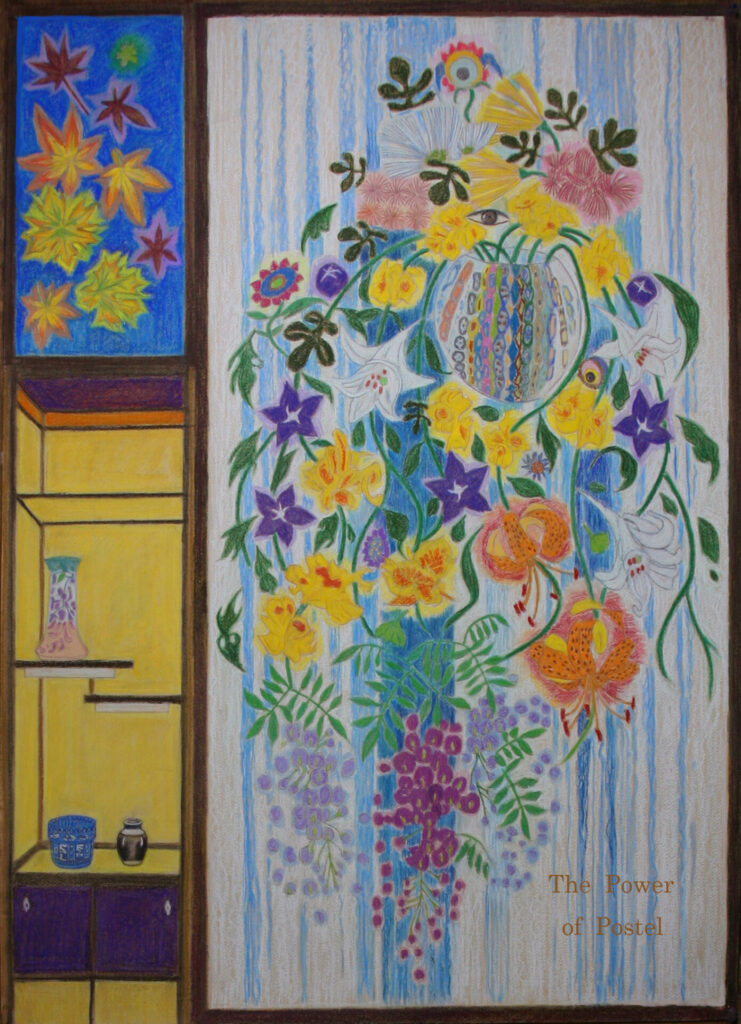
For example, suppose you paint flowers arranged in a vase.
As an example, suppose you paint flowers arranged in a vase, like Odilon Redon.
◆① A person who holds the fixed belief that "art is communication" might seriously struggle with questions such as: "What should I do, and how should I modify the work, to make it communication? Should I actively talk to viewers when presenting the work? What kind of work should I choose next in order to create a particular form of communication?"
◆② By contrast, under Yokota's definition:
"Ah, art is expression. So, what do I want to express in my next work? First, I should come up with many ideas, write them down in a notebook, narrow them down, and design the overall concept."
As I introduced earlier, Hiroshi Senju makes the following statement on this page【第1回】「芸術とは何か」についての考察. Let me introduce it once again.
“An enormous number of books have been published on the theme of ‘What is art?’ Yet, even up to the present day, no one has been able to provide a definitive answer to the question of what art is. However, the contemporary age has brought a clear answer to the questions of what art is and what role it should play. We have come to realize that art is communication itself between people, and that it is a form of wisdom that enables human beings to coexist.”
As Hiroshi Senju points out, no one in the world has ever been able to present a definition of art—an answer to the question ‘What is art?’—in a form that everyone could accept without being able to refute it!
In other words, one might follow essentially the same process as computer-system development:
Conceptual planning → Requirements definition → Basic design (designing the overall structure) → Internal and detailed design (designing the individual components) → Coding (production) → Debugging (rewriting or correcting individual parts) → Completion
At that point, he might suddenly realize:
"Wait a minute. Isn't this the same as writing a novel, a screenplay, an academic paper, or an editorial? Isn't creating a painting similar to the work of a television producer, film director, or screenwriter?"
He may then use methods from those fields as references and break through the boundaries between disciplines.
This would allow his creative ability to generate ideas more and more freely and make increasingly significant leaps.
As explained above, what one teaches as the fundamental initial definition can decisively determine the subsequent development of the student.
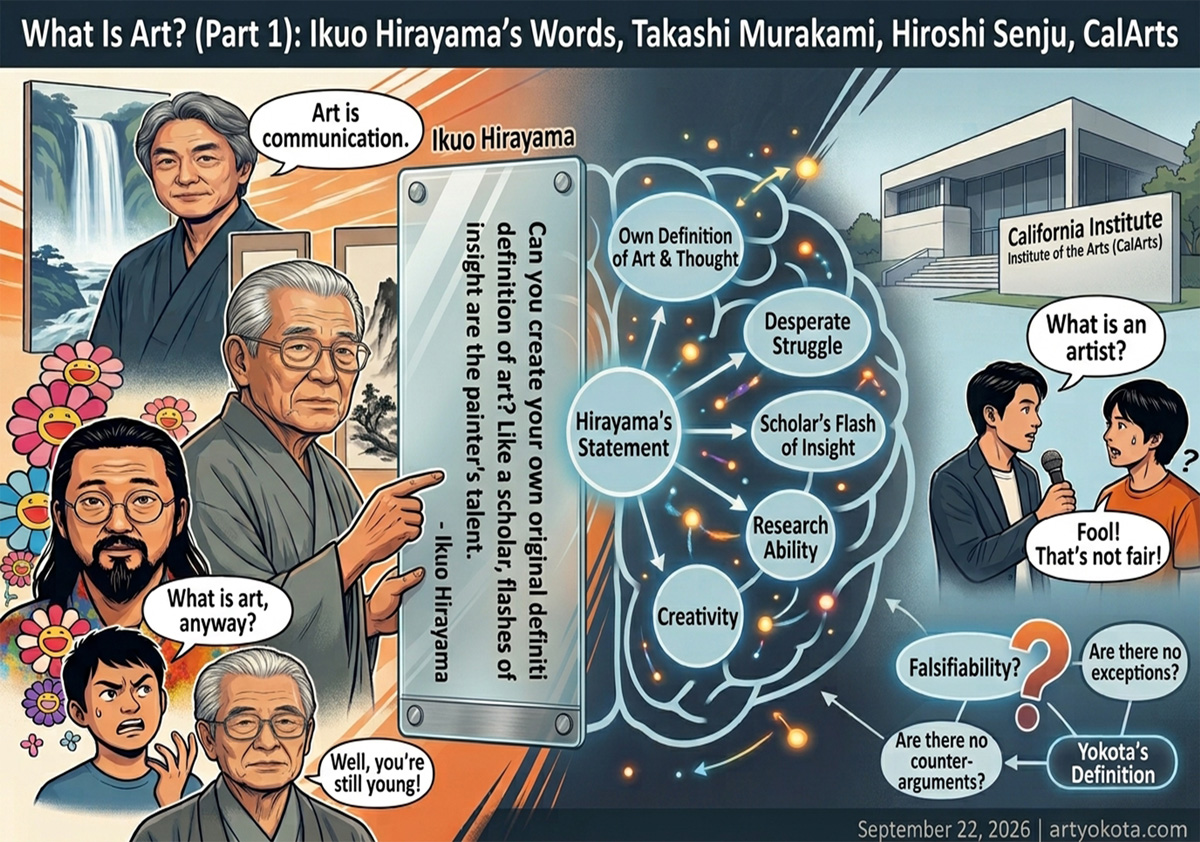
The episode in which Takashi Murakami (村上隆) asked President Ikuo Hirayama (平山郁夫), "What is art?"
When Takashi Murakami (村上隆) was a student at Tokyo University of the Arts, he became furious about what he saw as the terrible state of the Japanese art world. He asked President Ikuo Hirayama (平山郁夫), "Professor, what exactly is art?" Hirayama replied, "You're still young!" Murakami reportedly thought, "That isn't education." (Reference)
In other words, Murakami seems to have felt, "Is Tokyo University of the Arts really providing proper education in art and fine art?" This ultimately led him to create a system in which he personally supported and educated young artists whom he discovered through GEISAI.
In the same reference, he says:
"I used that experience as a lesson in what not to do. During the latter half of my eleven years at Tokyo University of the Arts, I worked very hard to study what 'fine art' and 'art' actually meant, and stubbornly continued until I obtained my doctorate."
I feel that this is one of the major differences between Takashi Murakami (村上隆) and Hiroshi Senju (千住博), who were roughly contemporaries.
In fact, in connection with this story, Ikuo Hirayama (平山郁夫) says in his book "Kono Michi Hitotsuji ni: Ikuo Hirayama Note" (Dōbun Shoin), around page 34:
"When I was young, I ran into the wall of the question, 'What is art?' An artist must spend his entire life developing an artistic philosophy of his own, unlike anyone else's. It is the same as a scholar making an unprecedented invention or discovery. Only those who are able to accomplish this can become artists, and such a thing cannot be born without truly desperate effort."
Therefore, I do not think that Hirayama simply did not know the answer. Rather, I believe he thought that "if I tell him my own view, I may interfere with his ability to develop his own original definition of art."
The same book explains this in detail. It says that, regardless of the path one takes, it is important to make people take detours.
There is also the following passage on page 33:
"To assert a point of view, to formulate a particular theory or argument—this is quite difficult. I believe that, in both art and academic disciplines, this is inspiration and talent."
However... as I can understand from my own experience, when viewed from the standpoint of a professor at a university responsible for training artists, this could reasonably be regarded as an "abdication of responsibility," and it is something that should not happen.
One should first present one's own firmly established view, and it should possess universality and withstand falsification. Then one should conduct the class by saying, "This is how I define it, but what do you think? Why don't we start discussing it right here?"
However, as a result, Takashi Murakami (村上隆), through tremendous effort and by becoming the first person in the Japanese Painting Department of Tokyo University of the Arts to obtain a doctorate, went on to develop a completely original theory: the "Superflat Theory."
This is similar to my own experience as a self-taught artist. As a result, not teaching someone directly and instead making them take detours can sometimes allow a small number of geniuses to eventually produce both flowers and fruit.
This is also very similar to the academic culture of Kyoto University... and, ultimately, that is what happens.
For all of these reasons, I want everyone to rigorously attempt to falsify the theories I introduce below—especially Yokota's definition: "Art is an expression of what the artist wants to communicate. Alternatively, it is a device created to provoke discussion and dialogue."
Are there exceptions to this definition? If so, how can they be explained?
If you can falsify it, I would very much like you to contact me through the inquiry form on this website.
When I asked AI about this, it responded:
"There is no consensus in contemporary aesthetics that any one of the following is the sole definition of art: that beautiful things are art, that something becomes art when it is displayed in a museum, or that something becomes art when a viewer feels something in response to it."
Even among the books and academic literature I have read and the statements made by artists, I have found no established definition that has become a commonly accepted standard—something like "this is the correct definition of art"—within academia or elsewhere.
Therefore, after investigating the arguments of those who came before me, I formulated my own definition.
The CalArts Example — "You Want to Know What an Artist Is? That's Not Fair!" — "You Fool!"
The book "The Unfinished Side of Contemporary Art" by Random House states the following on page 76.
The author visited CalArts (California Institute of the Arts), an institution that has produced many prominent artists, and repeatedly asked students, people affiliated with the institution, faculty members, and virtually everyone he encountered the following question:
"What is an artist?"
And what answers did he receive?
A student: "That's not fair!" "That's an absurd question!"
An artist holding an important position in the art department of one university responded by calling him a "fool." (laughs)
One prominent creator said:
"Well, none of your questions can really be answered except through tautology. To me, an artist is simply a person who makes art. That's circular reasoning, isn't it?
Usually, you only understand what an artist really is after you actually meet one!"
And I think: "Huh?" (laughs)
"Apparently, Leslie Dick could not believe that even one person had taken offense. 'An artist's work is actually play. But I mean that in an extremely serious sense! You know how a two-year-old discovers how to build a tower with blocks? It's the same thing. It's not something you can do casually, though. In other words, you grasp something within yourself, and then you expel what you have grasped in order to free yourself from it.'"
Hmmmm... The idea of "play," in particular, is certainly worth listening to as an opinion... but what is it supposed to mean?
Does it mean that art is the act of expelling some alien or demonic child from one's unconscious? (wry smile)
At the very least, it appears that CalArts does not have a unified institutional definition of art or artistic practice.
That is something we can reasonably say.
In other words, it seems that even in the United States, art is not necessarily being taught according to a clearly established definition.
Then, can the quality of the works produced by its graduates really be guaranteed?
In Part II, I will investigate the definitions of art proposed by earlier thinkers and artists in the West and examine the truth and validity of Yokota's definition.
Click here for other pages in this series!
◆What Is Art? (Part II)— I Investigated the Theories of Earlier Thinkers and Artists: Examining the Originality and Validity of My Definition【Go to this page!】
◆What Is Art? (PartⅢ ) Japanese Art and Thought)— I Investigated the Theories of Earlier Thinkers and Artists【Go to this page!】
◆What Is Art? (Part IV)What Is Japanese Culture? Discovering the Characteristics of Japanese Art and Fine Art Through the Research of Earlier Scholars!【Go to this page!】