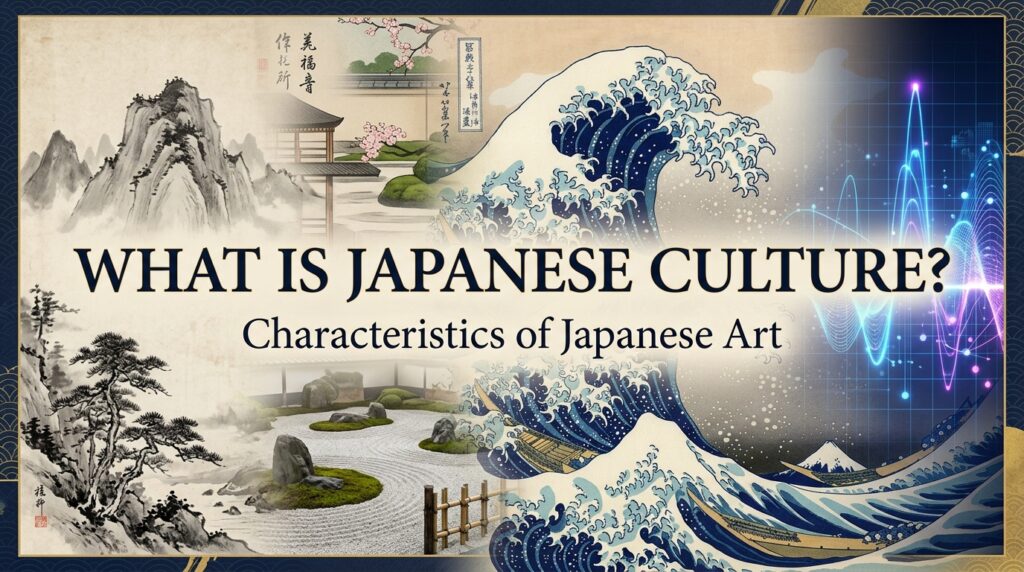
★★★【What is Japanese culture?No2】・・・Japanese Art and Aesthetics Theory — 本居宣長 (Motoori Norinaga), Its Succession by 西田幾多郎 (Nishida Kitaro), and the Influence on 梅原龍三郎 (Umehara Ryuzaburo) via the 白樺派 (Shirakaba-ha)

Japanese Art Theory and Aesthetics — From 本居宣長 (Motoori Norinaga) to 西田幾多郎 (Nishida Kitaro) and 梅原龍三郎 (Umehara Ryuzaburo) through the 白樺派 (Shirakaba School)
In the preceding articles in this series, I have explored the structure of 「余情」 (Yojō) and 「幽玄」 (Yūgen) in Japanese art, as well as the theories of the two Nishidas—西田直二郎 (Nishida Naojiro) and 西田幾多郎 (Nishida Kitaro)—that support these concepts.
This time, I will go even further back into the depths of Japanese aesthetic consciousness and examine the “grand baton of thought and expression” that extends from the Edo-period kokugaku scholar 本居宣長 (Motoori Norinaga), through the giant of modern philosophy 西田幾多郎 (Nishida Kitaro), and finally to the master of modern Japanese Western-style painting 梅原龍三郎 (Umehara Ryuzaburo).
Although their achievements may initially appear unrelated, they are connected by a powerful underground current: the rejection of abstract reasoning and the dualism of subject and object, and an attempt to become one with the very life of the object itself.
本居宣長 (Motoori Norinaga): The Rejection of 「漢意」 (Kara-gokoro) and 「もののあはれ」 (Mono no Aware)
During the middle of the Edo period, 本居宣長 (Motoori Norinaga) thoroughly criticized the tendency to interpret Japanese classics morally through imported systems of reasoning—such as Confucianism and Buddhism—which he called 「漢意」 (Kara-gokoro).
Through his close reading of works such as 『源氏物語』 (The Tale of Genji), he declared that the essence of literature and art was not moral instruction, but 「もののあはれ」 (Mono no Aware).
「もののあはれ」 (Mono no Aware) refers to the natural emotion that arises spontaneously in the heart when one encounters things and events in the world.
宣長 (Norinaga) deeply loved the mountain cherry blossoms of Yoshino and argued that the state in which one's heart is moved without rational explanation by the transience of falling cherry blossoms represents the original Japanese sensibility.
Rather than creating an intellectual barrier between the object—the cherry blossom—and oneself—the viewer—one achieves an emotional unity with the object.
This became one of the starting points of Japanese aesthetics.
西田幾多郎 (Nishida Kitaro): The Elevation of 「純粋経験」 (Junsui Keiken / Pure Experience) into the 「絶対無の場所」 (Zettai Mu no Basho / Place of Absolute Nothingness)
From the Meiji to Taisho periods, 西田幾多郎 (Nishida Kitaro) transformed the sensibility articulated by 宣長 (Norinaga) into a philosophy capable of engaging with Western philosophical thought.
「純粋経験」 (Junsui Keiken / Pure Experience) as a State in Which Subject and Object Have Not Yet Separated
The 「純粋経験」 (Junsui Keiken / Pure Experience) proposed by 西田 (Nishida) in his major work 『善の研究』 (Zen no Kenkyu / An Inquiry into the Good) refers to “the state of experience as it truly is, without adding intellectual discrimination through words.”
What 宣長 (Norinaga) described as “being moved by cherry blossoms without rational explanation,” 西田 (Nishida) shifted beautifully into the language of 「主客未分」 (shukyaku mibun)—the state before subjective and objective consciousness become separated:
“When we see a flower, there is neither such a thing as the self nor such a thing as the flower. There is only the color of the flower, the beauty of the flower.”
The 「絶対無の場所」 (Zettai Mu no Basho / Place of Absolute Nothingness) at the Center of Nishida Philosophy
One of the concepts representing the philosophy of 西田幾多郎 (Nishida Kitaro, 1870–1945) is 「絶対無の場所」 (Zettai Mu no Basho / Place of Absolute Nothingness).
This concept first appeared in the paper 「場所」 (Basho / Place), published in 『哲学研究』 (Tetsugaku Kenkyu / Philosophical Studies) in June 1926 (Taisho 15).
Nishida's thought is generally divided into the early period of “純粋経験” (Pure Experience), the middle period of “自覚” (Jikaku / Self-Awareness) and “場所” (Basho / Place), and the later period of “絶対矛盾的自己同一” (Zettai Mujunteki Jiko Doitsu / Absolute Contradictory Self-Identity).
In other words, 「絶対無の場所」 (Zettai Mu no Basho) was not an idea that suddenly appeared in Nishida's later years. It was already presented in the middle-period paper 「場所」 (Basho), and can be regarded as a central concept that continued to be developed until his final years.
Nishida considered “場所” (Basho / Place) in three stages: 有の場所 (Place of Being), 相対無の場所 (Place of Relative Nothingness), and 絶対無の場所 (Place of Absolute Nothingness).
The final “Place of Absolute Nothingness” is regarded as the true place of nothingness in which all beings come into existence.
This does not simply mean an empty space in which “nothing exists.”
Nishida was asking in what kind of “place” the individual things and selves that we ordinarily regard as “existing” actually exist.
In other words, his approach is:
Rather than looking only at “things that exist,” look at the place or field that makes their existence possible.
Is 「無」 (Mu / Nothingness) Really “Nothing at All”?
When we consider this idea from the perspective of Japanese art, something extremely interesting becomes visible.
In Japanese ink painting and shōheki-ga (paintings on sliding doors and screens), the entire surface is not filled with paint or ink. Instead, the 「余白」 (Yohaku / Empty Space)—the areas where nothing has been drawn—plays a major role.
But is that white space really “nothing”?
Suppose, for example, that a single flower is placed within a white picture plane.
If the white area is regarded simply as a “part in which nothing has been drawn,” then it is merely blank space.
However, precisely because the empty space exists, the single flower stands out. Its presence, silence, sense of life, and even the viewer's imagination emerge from it.
Yohaku is not “nothingness”; it is an important space that establishes the existence of what has been depicted.
Here we find a fascinating point of contact between Nishida's philosophy of 「場所」 (Basho / Place) and the 「余白」 (Yohaku / Empty Space) of Japanese art.
「絶対無の場所」 (Zettai Mu no Basho) and 「余白」 (Yohaku) Are Not the Same Thing
Of course, we must be careful here.
We cannot equate Nishida's philosophical concept of 「絶対無の場所」 itself with the white empty space in Japanese painting.
Nor did Nishida himself define “the empty space of Japanese painting” as “absolute nothingness.”
However, if we consider Nishida's philosophy of “place” as an artistic metaphor,
the structure found in Japanese art and in 李禹煥 (Lee Ufan)—in which “a space where nothing has been drawn gives life to what has been drawn”—is highly suggestive.
White paper or a canvas is not simply a “place where nothing exists.”
Only when lines, colors, and forms are placed there does a world begin to emerge.
And through the relationship between what has been depicted and what has not been depicted, the meaning and vitality of the entire picture plane emerge.
In this sense,
“Nothingness” and “being” are not merely opposites; “nothingness” makes “being” possible.
This idea is also an important perspective for considering the empty space, omission, suggestion, and 余情 (Yojō) found in Japanese art.
Nishida Philosophy and Art
This is not merely a retrospective association.
In his writings, Nishida referred to art in various forms from his early period through his later years, and he also wrote papers that dealt explicitly with beauty and art. Examples include 『ゲーテの背景』 (Haikei of Goethe / Goethe's Background, 1931), 『論理と生命』 (Riron to Seimei / Logic and Life, 1936), and 『歴史的形成作用としての芸術創作』 (Rekishiteki Keisei Sayō toshite no Geijutsu Sōsaku / Artistic Creation as a Historical Formative Activity, 1941).
In Nishida's philosophy, art is not simply “the creation of beautiful objects.”
It is deeply related to such questions as the relationship between human beings and the world, intuition, expression, and creation.
Today, there is also research that rereads Nishida's theory of art from the standpoint of 「場所」 (Basho / Place). Such research discusses how, in artistic creation, the framework of the opposition between subject and object disappears, and how this can also be connected to the “abstract” art of the twentieth century.
Therefore, Nishida's approach of looking not only at
“the things that exist in the world”
but also at
“the kind of place and relationships in which those things exist”
is extremely interesting when thinking about painting as well.
Then, How Does This Relate to 湯川秀樹 (Yukawa Hideki)'s Meson Theory?
There is a very interesting story here.
However, the commonly circulated explanation that
“Nishida's philosophy of absolute nothingness directly influenced 湯川秀樹 (Yukawa Hideki), leading to the discovery of meson theory”
cannot be asserted as historical fact.
Yukawa first presented his meson theory at an academic meeting in November 1934.
At the time, Yukawa was a lecturer at Osaka Imperial University. The theory was published as a paper in 1935 in the Journal of the Mathematical and Physical Society of Japan, under the title “On the Interaction of Elementary Particles. I.”
The reason that “1935” is often given as the year of the presentation is that this refers to the year of publication.
The direct physical problem that meson theory attempted to solve was the nuclear force that binds protons and neutrons together inside atomic nuclei.
The nuclear force operates only over an extremely short distance. Therefore, the particle mediating this force would need to have a certain mass.
Yukawa considered this relationship from the standpoint of quantum theory and predicted the existence of an unknown particle mediating the nuclear force, as well as its mass—approximately 200 times that of an electron.
In 1947, the π meson was discovered in cosmic rays, experimentally supporting the theory, and Yukawa received the Nobel Prize in Physics in 1949.
Therefore, it would not be accurate to explain that Yukawa derived meson theory itself from “absolute nothingness.”
However, There Are Truly Fascinating Facts about Yukawa and Eastern Thought
What is particularly important here is 『荘子』 (Zhuangzi / Chuang Tzu).
Even before entering middle school, Yukawa was dissatisfied with Confucianism alone and became fascinated with 『老子』 (Laozi) and 『荘子』 (Zhuangzi), which he read on his own.
Later, he wrote:
「ずいぶん長い間、私は老荘の哲学を忘れていた。それが4、5年前、素粒子のことを考えている際に、ふと荘子のことを思い出した。そして、素粒子の奥にあるものが、さまざまな素粒子に分化する前の、まだ未分化な何物かであるのかもしれないと思った。それはいままでに知った言葉でいうならば、渾沌というものであろうかと思った」
This passage is included in 『創造的人間』 (Sozōteki Ningen / Creative Human Beings), published in 1966.
Because Yukawa himself wrote “four or five years ago,” the period can be estimated as roughly the latter half of the 1950s to the early 1960s, although the exact year in which he wrote the passage cannot be determined from the available material.
In any case, this was not the story of how the meson theory of 1935 was created.
Yukawa's linking of “chaos” with his own ideas took place later, in his thinking about the structure of elementary particles as he moved toward nonlocal field theory and the elementary-domain theory he proposed in 1966.
In other words, it is more accurate to understand the relationship as follows:
Rather than saying that Eastern thought directly produced meson theory, Yukawa later actively employed Eastern thought as imagery and terminology for thinking about his theories of elementary particles.
At the same time, this should not simply be dismissed as irrelevant. There are researchers who have actually pointed out that Lao-Zhuang thought influenced Yukawa's creative background and methodology.
That is a different level of discussion from the direct causal claim that “the equations of meson theory emerged from Lao-Zhuang philosophy.”
Furthermore, this GLOBE article, “The ‘Abolition of Kanji’ Debate Was Not Limited to GHQ: Considering the Meaning of Continuing to Use Kanji Today”, states the following:
◆Original Japanese Text
“京都大学総長の山極寿一は、ジャーナリスト池上彰との対談(週刊文春の今年の新年特大号)で、日本人で最初にノーベル賞を受賞した湯川秀樹の「中間子理論」は、西田幾多郎の哲学に通じていると指摘。「西田哲学というのは、『間』の理論で、つまり『私とあなた』の“と”のことなんですね。これは、なかなか欧米人には考えつかない、日本的な思考の効用だったと思います」と述べている。”
●English Translation
“Juichi Yamagiwa(山極寿一), President of Kyoto University, stated in a dialogue with journalist Akira Ikegami, published in the New Year's special issue of *Shukan Bunshun* this year, that **the “meson theory” proposed by Hideki Yukawa, the first Japanese person to receive a Nobel Prize, has a philosophical affinity with the thought of Nishida Kitaro.** He explained:"
**‘Nishida's philosophy is a theory of “ma” (the space or interval between things)—in other words, it concerns the “and” in “you and I.” I believe this was an advantage of Japanese-style thinking that is rather difficult for Westerners to conceive.’**”
On the previous article, I presented my own view that:
“When considering what art and fine art are, the Japanese language is exceptionally rich in precise terms for painting, prints, art, fine art, novels, and other specific fields. It also possesses kanji, hiragana, katakana, on-yomi, kun-yomi, onomatopoeia, and even English words, making it one of the world's most precise and sophisticated languages for thinking about ideas and theories.”
The same page also introduces the view of Nobel Prize-winning chemist 野依良治 (Noyori Ryoji) that one factor behind the explosive increase in the number of Japanese Nobel laureates in science since the beginning of the twenty-first century is the Japanese language and the Eastern thought expressed through it.
It states:
◆Original Japanese Text
“ノーベル化学賞を受賞した野依良治は、今年1月の教育新聞でのインタビューで、科学における日本語の大切さを強調している。江戸時代から、外国語を漢字翻訳したことによって「抽象概念」の理解が進み、一般人の理科の理解能力が高まったと野依はみる。「英語は外国語であり『道具』です。しかし、母語である日本語は『精神』そのものであると知ってほしい」と述べている。「日本語の知的伝達能力は圧倒的に高いので、今後も読み書きについては最大限の努力を」と訴える。”
●English Translation
Nobel Prize-winning chemist Ryoji Noyori(野依良治) emphasized the importance of the Japanese language in science in an interview published in *The Education Newspaper* (*Kyoiku Shimbun*) in January this year. Noyori argues that, since the Edo period, the translation of foreign-language terms into kanji has promoted the understanding of “abstract concepts” and enhanced the general public’s ability to understand science."
He stated, **“English is a foreign language and a ‘tool.’ However, I want people to understand that their native language, Japanese, is ‘the spirit’ itself.”**
He further urged, **“Because the intellectual communicative capacity of the Japanese language is overwhelmingly high, we should continue to make the utmost effort in reading and writing.”**
This is also related to what I discussed in the previous article about Japanese returnee children and graduates of international schools who are bilingual but often suffer deeply from the feeling that “both my English and Japanese are incomplete, so what nationality am I?”
In fact, when writing papers such as these, I myself strongly feel that I am able to do so because Japanese is my native language and I have a highly developed command of it.
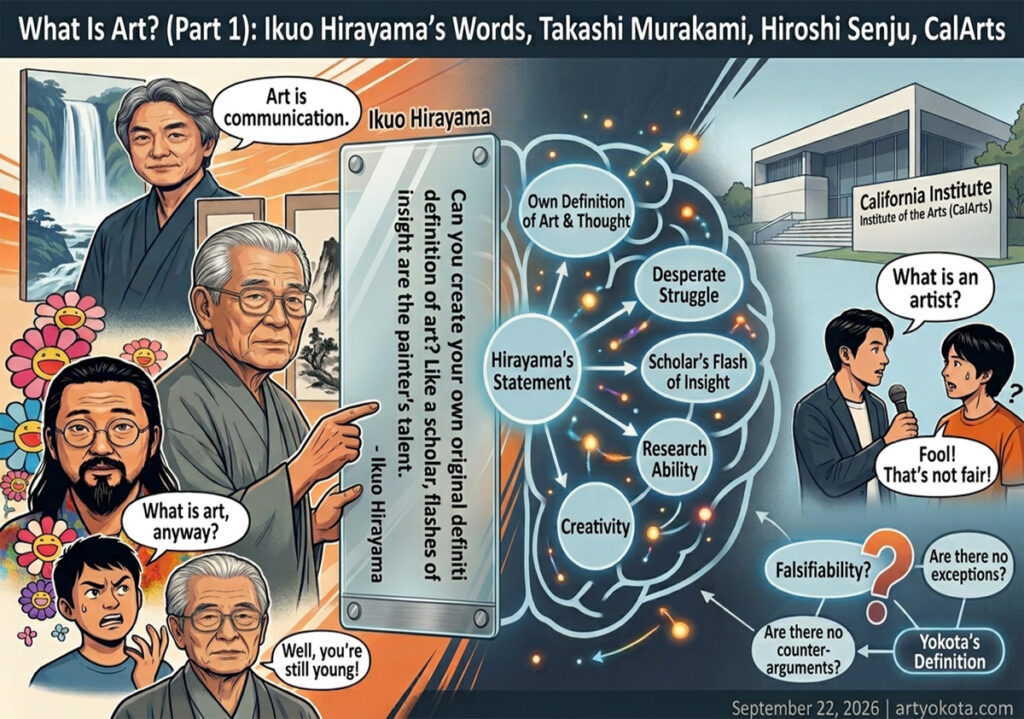
I believe that I could not have conceived “Yokota's Music Translation Theory” or “Yokota's Definition of Art” if Japanese had not been my native language.
“Particles Emerging from Empty Space” as an Image
There is another very interesting idea here.
However, in modern physics, it is not possible to simply think of particles as “suddenly appearing from a completely empty space and disappearing back into nothingness once their role is finished.”
In quantum field theory, elementary particles are understood as excitations of their respective fields.
And “vacuum” refers to the lowest-energy state of a field, in which no particles are present.
Therefore, the physical concept of “vacuum” cannot be equated with Nishida's philosophical concept of 「絶対無」 (Zettai Mu / Absolute Nothingness).
However, if we consider the idea as a philosophical metaphor, there is a fascinating commonality in the idea of
“looking not only at individual visible entities, but at the ‘field’ that makes those entities possible.”
This also overlaps with the artistic problem that
just because nothing has been painted on a white canvas does not mean that there is “nothing” there.
■ Is a White Canvas or Sheet of Paper “Nothingness”?
I believe this is a very important question when considering Japanese art.
A completely white sheet of paper or canvas has nothing painted on it yet.
However, it contains a place in which every kind of expression can become possible.
Draw a single line, and a line comes into existence.
Place a single color, and color comes into existence.
Place a single form, and a relationship emerges between that form and the surrounding empty space.
In other words,
“Nothing being there” and “anything being capable of emerging” are not necessarily the same thing.
In this sense, regarding the white canvas as the “Place of Absolute Nothingness” is not an explanation of Nishida's philosophy itself, but it becomes a very powerful metaphor for thinking about Nishida's philosophy of 「場所」 (Basho / Place) from an artistic perspective.
3. 梅原龍三郎 (Umehara Ryuzaburo) and the 白樺派 (Shirakaba School): 「行為的直観」 (Kōiteki Chokkan / Acting Intuition) Transformed into Painting
I have come to feel that the artist who brilliantly expressed the “純粋経験” (Junsui Keiken / Pure Experience) described by Nishida's philosophy through a series of works was 梅原龍三郎 (Umehara Ryuzaburo), who was called a national painter during the Showa period.
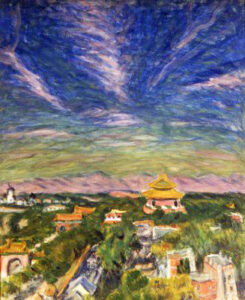
I believe that his masterpieces 『櫻島』 (Sakurajima) and 『北京秋天』 (Beijing Autumn) can be regarded as visual evidence of Nishida's philosophy.
When I look at his paintings very, very closely, the family dramas of the people living in the houses depicted within the picture come to mind, and tears begin to flow.
Such is the emotional impact!
There was no direct teacher-student relationship between 梅原 (Umehara) and 西田幾多郎 (Nishida Kitaro).
However, there was a network of people who may have connected them.
That was the 「白樺派」 (Shirakaba-ha / Shirakaba School).
During his time at Gakushuin, Nishida taught 柳宗悦 (Yanagi Soetsu), the founder of the Mingei movement and a central figure in the Shirakaba School, and members of the Shirakaba School were deeply attracted to Nishida's philosophy.
At the same time, Umehara had close friendships with members of the Shirakaba School such as 武者小路実篤 (Mushanokoji Saneatsu), 志賀直哉 (Shiga Naoya), and 柳宗悦 (Yanagi Soetsu).
Through this intellectual community known as the Shirakaba School, the underground current of Nishida's philosophy—affirmation of one's own life and an emphasis on intuition—may have flowed into Umehara's conception of art.
However, I searched everywhere and could find no evidence supporting this connection.
Nishida later defined artistic creation as 「行為的直観」 (Kōiteki Chokkan / Acting Intuition): “becoming the thing and seeing; becoming the thing and acting.”
4. Two Approaches to Truth: A Comparison with 安井曾太郎 (Yasui Sotaro)
As the opposite pole to 梅原龍三郎 (Umehara Ryuzaburo), the painter often regarded as his equal counterpart was 安井曾太郎 (Yasui Sotaro).
The contrast between these two artists vividly illustrates fundamental differences in approaches to art.
The two were both described as national painters and rivals: “梅原, the genius-like colorist,” and “安井, the highly accomplished painter who emphasized form and drawing.”
But there is no difference between them in the fact that both possessed extraordinary natural talent and both made tremendous, blood-and-sweat efforts to develop that talent into great art.
I personally found it more difficult to understand the appeal and power of 安井曾太郎 (Yasui Sotaro).
In fact, it was Yasui Sotaro who helped rescue the Tokyo Gallery from financial difficulties during its early period.
The gallery held several solo exhibitions for him, and because he was a popular and successful painter, these exhibitions presumably helped the gallery survive its financial difficulties time and again.
One of the things that inspired me to become a painter was seeing 梅原龍三郎 (Umehara Ryuzaburo)'s painting 『櫻島 青』 (Sakurajima: Blue) in the Kadokawa Publishing textbook 『中学 国語Ⅰ』 (Chugaku Kokugo I) when I was in the first year of middle school.
I was so deeply moved that I felt as though I could cry.
Since then, Umehara was my goal—and the genius whom I eventually sought to surpass.
In this respect, I have discussed this subject many times with Representative 山本 (Yamamoto), and our stances are actually the reverse of each other.
That is precisely why, in many respects, we have maintained a long relationship, and every time we meet, I believe that each of us has absorbed a great deal from the other—things that we ourselves did not possess.
Yamamoto has said the same thing to me.
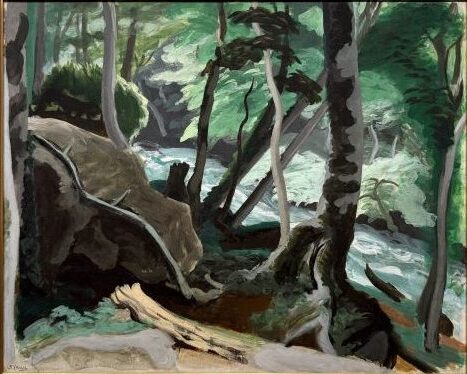
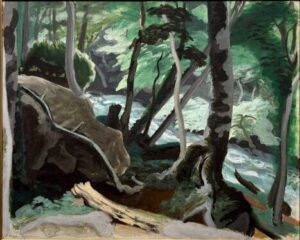
In fact, at the Tokyo National Museum, I once spent a long time comparing Umehara's 『北京秋天』 (Beijing Autumn), displayed next to each other with Yasui's 『奥入瀬の溪流』 (Oirase Stream) (photograph).
Considering their historical background, both are remarkably similar in that they are realistic painters influenced by Post-Impressionism and Expressionism.
However, the materials and techniques they used are completely different.
Simply put, Umehara's is essentially a Japanese-painting technique, while Yasui's is oil painting.
Umehara's 『北京秋天』 (Beijing Autumn) was probably painted on paper—most likely his favorite 間合紙 (maai-gami), a small-production type of torinoko paper—using 顔彩 (gansai / Japanese mineral and organic pigments) mixed with 膠 (nikawa / animal glue) or possibly a bonding medium, employing a “transparent technique.”
Umehara was a painter of “transparent technique,” building up thin layers repeatedly.
It is similar to the technique of transparent watercolor.
The technique described as “détrempe” in some art books has also been discussed with a technical consultant at Holbein, the company that jointly developed Holbein oil paints.
According to that confirmation, the “détrempe” technique may initially have involved 顔彩 (gansai) mixed with diluted bonding material, but it is certain that Umehara soon came to dissolve the pigments in 膠 (nikawa) when painting.
There is an article of mine that explains this matter in detail. Please read it.
Like Henri Matisse, many great colorist painters apply their paint in extremely thin layers.
Otherwise, the colors become muddy and dark.
There are also thick-painting artists such as Van Gogh, but even his paintings are probably not as thickly painted as we tend to imagine.
Yasui, on the other hand, applied oil paint somewhat thickly and used the marks of the brush with extremely sophisticated technique.
Yasui was essentially an opaque painter.
Therefore, he probably did not often employ a technique in which he built up layers while intentionally allowing the lower paint layers to remain visible.
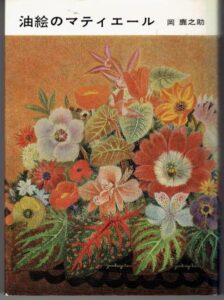
And he was a painter who placed great importance on the materiality of the surface texture of oil paintings.
Creating an appropriately balanced glossy matière with oil paint, like Bonnard, Kisling, or Cézanne, is extremely difficult for Japanese painters, who tend to have a “herbivorous” sensibility, so to speak.
The difficulties peculiar to Japanese painters of that era were described by his contemporary 岡鹿之助 (Oka Shikanosuke) in an essay entitled 「油絵のマチエール」 (Abura-e no Matière / Matière in Oil Painting).
I began using oil paint in my first year of high school and continued until I was around forty.
I struggled enormously with it—not only with matière but with every aspect of the medium.
Because of my own artistic temperament as well, I gradually and naturally shifted toward pastels and colored pencils, whose tones are remarkably similar to those of the Japanese-painting pigments known as 顔彩 (gansai).
I also stopped using acrylic paint at approximately the same time as oil paint.
I would add one thing.
In 2023, after viewing the Matisse exhibition at the Tokyo Metropolitan Art Museum, I became convinced that most painters apply oil paint far too thickly.
Oil paint is said to have been developed by the Van Eyck brothers to produce paintings with a photographic-like appearance.
Yet, precisely according to its original purpose, it is not particularly suited to heavy application.
Various paint manufacturers produce extremely high-grade, professional-level paints sometimes referred to as “guild paints.”
But if these are applied too thickly, the beauty of the pigments themselves is prevented from shining against the white ground of the canvas, making the use of such expensive pigments almost meaningless.
A simple example is the famous Vermeer painting 『ターヴァンを巻いた少女』 (Girl with a Turban / Girl with a Pearl Earring).
To produce the blue of the turban, Vermeer generously used the expensive pigment natural ultramarine, made from the gemstone lapis lazuli.
Even a small amount could cost more than a house. It was more valuable than gold.
These are the kinds of paints that should be used by painters such as Matisse in his planar compositions, or by 常玉 (Sanyu), the colorist sometimes called the “Chinese Matisse,” who could master them and draw out their potential.
They are like Stradivarius and Guarneri violins, vintage Les Paul electric guitars, or a Porsche 911 GTS2: products whose subtle high performance can be brought out by a small number of top professionals.
This is why “guild paints” were developed.
But I suppose most painters do not really recognize them in this way.
As for me?
Well, now, of course I can make full use of them.
I have been away from oil painting for some time, so there would probably be some trial and error at first.
But I believe I could master them.
| Comparison | 梅原龍三郎 (Umehara Ryuzaburo): Establishing and Depicting 「純粋経験」 (Pure Experience) | 安井曾太郎 (Yasui Sotaro): Constructing a System for Producing a Highly Sophisticated Emotional Impact through Color and Form |
|---|---|---|
| Relationship with the Object | 主客未分 (Shukyaku Mibun / Subject and Object Undivided) The emotion and imagination produced by looking at a mountain were rendered through a calculated drawing theory and sophisticated techniques. In particular, the theory of color harmonics explained in another article was used with a considerable degree of conscious awareness. | 主客の格闘 (Shukyaku no Kakutō / Struggle between Subject and Object) He carefully confronted the object, paying even greater attention than Umehara to form and structure, placing great emphasis on them while expressing the emotion produced by the encounter. |
Conclusion: From 本居宣長 (Motoori Norinaga)'s 「もののあはれ」 through 西田幾多郎 (Nishida Kitaro) to 梅原龍三郎 (Umehara Ryuzaburo)
The “emotion without rational explanation” that 宣長 (Norinaga) perceived in the cherry blossoms of Yoshino was systematized by 西田幾多郎 (Nishida Kitaro) into the philosophy of 「純粋経験」 (Pure Experience) and 「絶対無の場所」 (Place of Absolute Nothingness), and 梅原龍三郎 (Umehara Ryuzaburo) elevated it into a remarkable visual expression through his brush.
The “Art = Expression + a Device for Generating Dialogue” and “Physical Translation of Musical Tones into Colors” that I have proposed stand at the forefront of this historical lineage of thought and expression.
梅原龍三郎 (Umehara Ryuzaburo)'s 『北京秋天』 (Beijing Autumn) was exhibited at the Kokuga-kai exhibition and caused a major sensation.
His close friend 川口松太郎 (Kawaguchi Matsutaro) purchased it and enjoyed looking at it every day without ever tiring of it.
Then, one day, Umehara suddenly telephoned him and said, “I want to give it to the National Museum of Modern Art. I've prepared another work, so could you exchange it with me?”
His wife strongly opposed the idea, and apparently he finally gave it up only with great reluctance.
Regarding this work, which he painted in 1942, Umehara said:
“I became interested in the high autumn sky. Somehow, it was a sky that seemed as though I were listening to music. This, too, is a morning painting.”
This is precisely 「純粋経験」 (Junsui Keiken / Pure Experience).
And I believe that, once again, Umehara's major goal may have been to create “paintings like music.”
Even if we wanted to paint this landscape today, just as with Sakurajima and Mount Fuji, it would be impossible because buildings and houses now surround the scene.
This happened only once in history.
No painter today could paint it again.
The spirit of 本居宣長 (Motoori Norinaga)'s 「もののあはれ」 (Mono no Aware) was inherited by Nishida and Umehara?
This connects beautifully with my previous article, “What Is the Definition of Japanese Art?”
Click here for other pages in this series!
★★★【What is Japanese culture?No2】・・・Japanese Art and Aesthetics Theory — 本居宣長 (Motoori Norinaga), Its Succession by 西田幾多郎 (Nishida Kitaro), and the Influence on 梅原龍三郎 (Umehara Ryuzaburo) via the 白樺派 (Shirakaba-ha)
【Go to this page!】
[1] 西田幾多郎 (Nishida Kitaro), 「場所」 (Basho / Place) (June 1926, 『哲学研究』第123号) https://www.project-archive.org/0/027.html
[2] 西田幾多郎 (Nishida Kitaro), 『善の研究』 (Zen no Kenkyu / An Inquiry into the Good), Part I, Chapter 1, 「純粋経験」 (Junsui Keiken / Pure Experience) (Aozora Bunko) https://www.aozora.gr.jp/cards/000182/files/946_74853.html
[3] 浅倉祐一郎 (Asakura Yuichiro), 「西田哲学と芸術―「場所」の立場における芸術の意義―」 (Nishida Philosophy and Art: The Significance of Art from the Standpoint of “Basho”), 『西田哲学会年報』2巻 (2005) https://www.jstage.jst.go.jp/article/jnpa/2/0/2_110/_article/-char/ja
[4] 浅倉祐一朗 (Asakura Yuichiro), 「西田哲学と芸術―関連研究の諸相と展望―」 (Nishida Philosophy and Art: Aspects and Prospects of Related Research), 『日本大学大学院総合社会情報研究科紀要』 (2004) https://gssc.dld.nihon-u.ac.jp/wp-content/uploads/journal/pdf04/4-403-414-Asakura.pdf
[5] 大久保喬樹 (Okubo Takaki), 「余白と座―日本的心性の展開 その三」 (Yohaku and Za: The Development of Japanese Sensibility, Part Three), 『東京女子大学紀要論集』65-2 (2015) https://twcu.repo.nii.ac.jp/record/25094/files/TakakiOKUBO_20150315.pdf
[6] 大阪大学 (Osaka University), 「湯川秀樹の『中間子論』学位論文を公開」 (Publication of Hideki Yukawa's Dissertation on Meson Theory) (presented at an academic meeting in November 1934) https://www.osaka-u.ac.jp/ja/news/topics/2014/05/20140514_01
[7] 大阪大学 (Osaka University), 湯川秀樹の物理学「湯川の時代の物理学と中間子論(2)」 (The Physics of Hideki Yukawa: Physics in Yukawa's Era and Meson Theory, Part 2) https://www-yukawa.phys.sci.osaka-u.ac.jp/topics/75
[8] Nobel Foundation, Hideki Yukawa – Facts (the predicted mass was approximately 200 times that of an electron) https://www.nobelprize.org/prizes/physics/1949/yukawa/facts/
[9] ネットミュージアム兵庫文学館 (Hyogo Museum of Literature), 「湯川秀樹」年譜 (Chronology of Hideki Yukawa) (proposed the elementary-domain theory in 1966) https://www.artm.pref.hyogo.jp/bungaku/jousetsu/authors/a64/
[10] 松岡正剛 (Matsuoka Seigow), 「千夜千冊 828夜 『創造的人間』湯川秀樹」 (Sen'ya Sen-satsu, Night 828: 『創造的人間』 by Hideki Yukawa) (quotations concerning Lao-Zhuang thought and chaos, and Nishida's lectures at Kyoto University) https://1000ya.isis.ne.jp/0828.html
[11] 坂本慎一 (Sakamoto Shinichi), 「西田幾多郎と湯川秀樹―その交流と哲学的な一致」 (Nishida Kitaro and Hideki Yukawa: Their Interaction and Philosophical Convergence), 『比較思想研究』第51号 (March 2025, pp. 75–82) https://researchmap.jp/drecsakamoto/published_papers/50042014
[12] 湯川秀樹 (Yukawa Hideki), 「湯川秀樹の素粒子理論研究と中国の老荘哲学」 (Hideki Yukawa's Research into Elementary Particle Theory and Chinese Lao-Zhuang Philosophy), 『素粒子論研究』85巻2号 https://www.jstage.jst.go.jp/article/soken/85/2/85_KJ00004707127/_pdf
[13] 「場の量子論」 (Ba no Ryoshi-ron / Quantum Field Theory), Wikipedia https://ja.wikipedia.org/wiki/%E5%A0%B4%E3%81%AE%E9%87%8F%E5%AD%90%E8%AB%96
[14] 「幽玄」 (Yūgen), Wikipedia (medieval theories of poetry, 藤原俊成 (Fujiwara Shunzei), and the aesthetics of 余情 (Yojō)) https://ja.wikipedia.org/wiki/%E5%B9%BD%E7%8E%84
[15] 西田幾多郎 (Nishida Kitaro), 「場所的論理と宗教的世界観」 (Bashoteki Ronri to Shukyoteki Sekaikan / The Logic of Place and the Religious Worldview) (Nishida's final paper) https://repository.kulib.kyoto-u.ac.jp/server/api/core/bitstreams/8b87a40d-9e4f-400c-bf55-e95466e29789/content